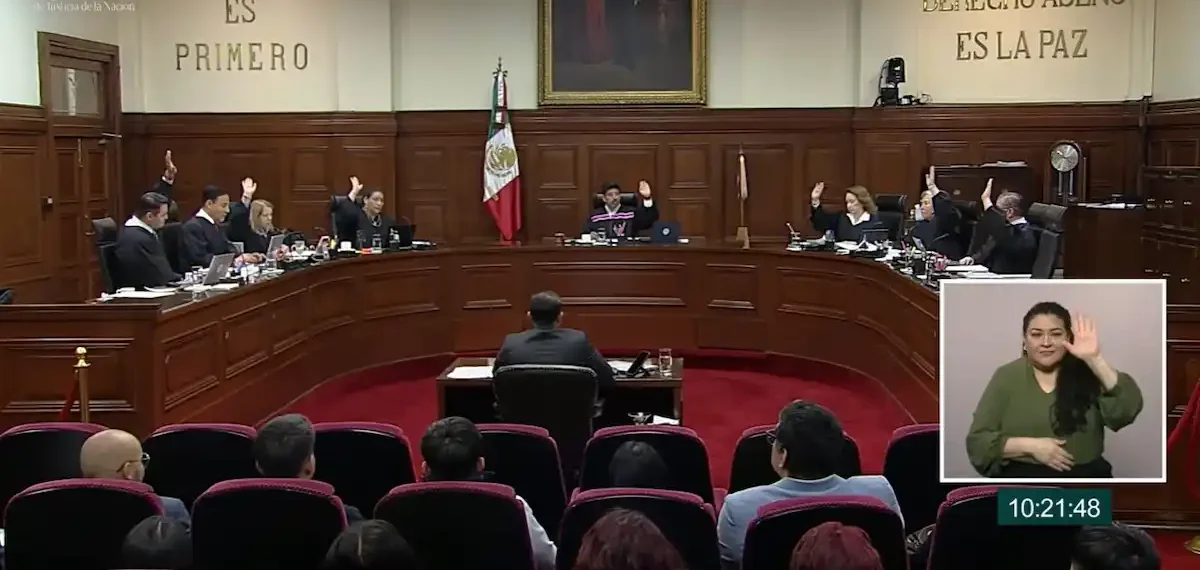
Chetumal, Quintana Roo — Mexico’s Supreme Court has agreed to review lower court decisions that rejected injunction requests against the Perfect Day cruise project in Mahahual and the construction of a military rest house beside Bacalar Lagoon.
During a plenary session Monday, the court unanimously approved taking up three complaints from the First Collegiate Tribunal of the Twenty-Seventh Circuit. The complaints challenge rulings by First District Judge Eugenia Maritza Valencia Hernández, who rejected amparo petitions filed by Mahahual residents against land-use changes approved by the Othón P. Blanco municipal government for Royal Caribbean’s Perfect Day project.
The Supreme Court will decide whether modifications to urban development programs are self-executing general norms — laws that take effect on publication — or administrative acts with specific effects, a distinction that determines how much time citizens have to file an amparo challenge.
Judge Valencia had limited residents to 15 days after publication in the state’s official gazette to contest the land-use change, a period the plaintiffs said was too short for people not expected to monitor government announcements. In another case, the judge treated the modification as a law, which allows a longer filing window, but still required the petition to be filed from the date of publication and rejected it.
“This decision will allow defining how those changes can be challenged and from when the deadline to do so begins,” the court said.
The complaints were originally before the First Collegiate Tribunal in Cancún. The civil organization Defendiendo el Derecho a un Medio Ambiente Sano (Dmas), which advises the Mahahual residents, asked the Supreme Court to take up the case after the tribunal signaled it would apply the same restrictive interpretation. Justice Irving Espinosa Betanzo backed the request.
In a separate matter, the court accepted a request to review the denial of a definitive suspension in an amparo suit filed by minors from Bacalar against the construction of a National Defense Secretariat (Sedena) rest house next to the Lagoon of Seven Colors, across from Fort San Felipe. The minors are represented by the Federal Public Defender’s Institute.
The justices will decide whether the precautionary principle must be applied when infrastructure projects threaten serious harm to natural and cultural heritage, particularly in cases involving children and intergenerational equity, or whether plaintiffs must prove direct and real injury under the 2025 reforms to the Amparo Law.
The district court had denied the suspension, ruling that the minors, though residents of Bacalar, were not directly affected by the construction and therefore lacked standing. The review was approved by a majority, with Justices Lenia Batres and María Estela Ríos González dissenting.
The Supreme Court’s review comes too late to halt the building, which is already complete and displays a large sign reading “Casa Militar Bacalar,” visible from Fort San Felipe. The denial had been issued by Judge Darío Alejandro Villa Arnaiz one day before he was replaced by Judge Valencia Hernández.
More Courts
- Iván Mondragón Released From Prison in Cancún Child Abduction Case
- Quintana Roo Governor Opens 2026 Notarial Certification Course as Profession Marks 50 Years
- No Date Set for Supreme Court Ruling in Quintana Roo Border Dispute
- Ex-Playa del Carmen Mayor Lili Campos Joins Mexico City Prosecutor’s Office Amid Quintana Roo Probes
- Judge Orders Federal Prosecutors to Accept Complaints From Mothers of Mexico’s Disappeared