
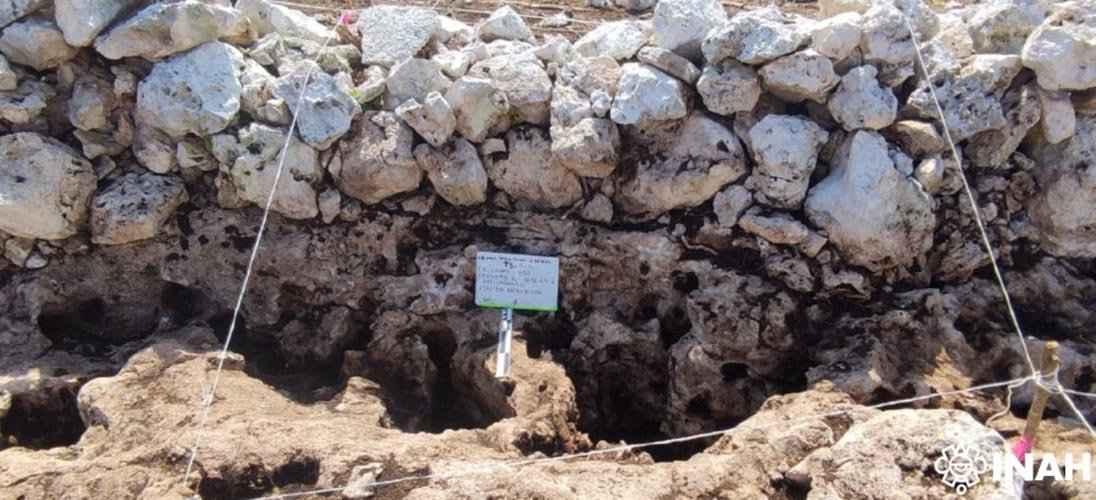
Tulum, Quintana Roo — A pre-Hispanic bee house uncovered during archaeological salvage work along Section 5 of the Maya Train route is giving researchers a clearer picture of how ancient Maya families organized their homes and working lands.
The structure was excavated in 2022 near the Aktun Chen Natural Park in Tulum, part of the domestic and productive spaces — known as solares — where Maya families grew crops, stored goods and drew on the natural resources around them. The work was carried out by the National Institute of Anthropology and History (INAH) under Mexico’s Culture Ministry.
A Ná’ajil Kab, or ‘House of the Bee’
Registered as T5_23001, the building was excavated by archaeologist Marisela Salazar Carrillo and measures roughly 19.5 meters long, 3.9 meters wide and 1.20 meters high. INAH Quintana Roo archaeologist Luis Ernesto Narváez Mac said it runs from west to east and is built mainly of limestone masonry laid directly on the bedrock.
Culture Secretary Claudia Curiel de Icaza said the discovery offers a closer look at how Maya families divided their spaces and made use of the resources in their surroundings.
Researchers believe the building served as a ná’ajil kab, a Maya term tied to the “house of the bee,” where jobones — hollowed, dried logs used to raise stingless melipona bees and produce honey — were arranged in rows. Its horizontal layout would have made the most of a broad floor area, and the roof was likely built from perishable materials. The walls hold between two and six courses of stones, with pieces of varying sizes set horizontally and vertically to reinforce stability.
The structure may date to the Late Postclassic period, between 1200 and 1521 AD, though that hypothesis still needs confirmation through analysis of the ceramics recovered at the site.
Stone Discs, Pottery and Signs of Daily Life
Among the most intriguing finds are around 40 discs made of limestone and coral, measuring between 10 and 20 centimeters in diameter, found near the walls. Researchers suspect they served as lids for the jobones. That possible use matters because evidence shows the Maya used stones to cover the logs used for raising meliponas — a practice that survives in some communities today, although wood coated with mud is now more common.
Excavators also found ceramic fragments that may have belonged to pots and containers used to store honey, along with stone objects that could have served as fishing net weights or metate manos.
To pin down the discs’ purpose, specialists will run physical and chemical tests. Because the stone is porous, they hope to identify traces of wax that would confirm the discs once covered the jobones.
A Productive Space Beyond Beekeeping
The find gains greater significance when considered alongside other evidence uncovered nearby. Within 100 meters of the bee house, researchers identified stone walls known as albarradas, leveled ground, foundations, a possible shrine, plus a cenote and a cavern.
For Narváez Mac, the layout points to a Maya solar — an integrated space where families combined different productive and domestic activities. In that system, beekeeping could occupy certain areas while others were used to grow corn and beans, store food or house the family.
The research also draws on historical accounts, including 16th-century descriptions by chronicler Gonzalo Fernández de Oviedo y Valdés, to help place honey production within spaces of broad resource use.
Laboratories Work to Pin Down the Site’s Past
As part of the investigation, researchers collected soil samples that will help reconstruct the environmental conditions at the site and identify what may have favored the keeping of Melipona beecheii, a stingless bee traditionally raised by Maya communities.
The soil samples went to a soil and chemical analysis laboratory in Yucatan, while ceramic and stone materials are being examined in specialized labs in Quintana Roo and Campeche.
The team also plans an ethnoarchaeological study of present-day meliponarios to compare current practices with the archaeological record.
Results from those analyses should clarify the function of the stone discs, the age of the structure and the environmental conditions in which the activity took place — adding new evidence of a tradition tied to Maya culture that has endured for centuries.
More Culture
- 146 Artisans Bring Mexico’s Folk Traditions to Xcaret Folk Art Fair
- Tulum’s Feria de la Cancha Maya to Gather Five Ceremonial Centers
- Maya Language Advocate Martiniano Pérez Angulo Dies at 67 in Quintana Roo
- Maya Midwife in Quintana Roo Fights to Keep a 25-Year Tradition Alive
- La BAMBA Festival in Playa del Carmen Closes Ninth Edition With Six-Hour Concert
More Tulum
- Deported Mexicans Flock to Quintana Roo as Support Services Strain
- Tulum Airport to Add Direct Flights to Five Canadian and U.S. Cities
- Tulum Targets Sports Tourism With 350-Athlete Event and 4.7 Million Peso Boost
- Fuel Tanker Erupts in Flames on Federal Highway 307 Near Tulum
- Unicaribe Students Mark One Year Monitoring Sian Ka’an Biosphere Reserve