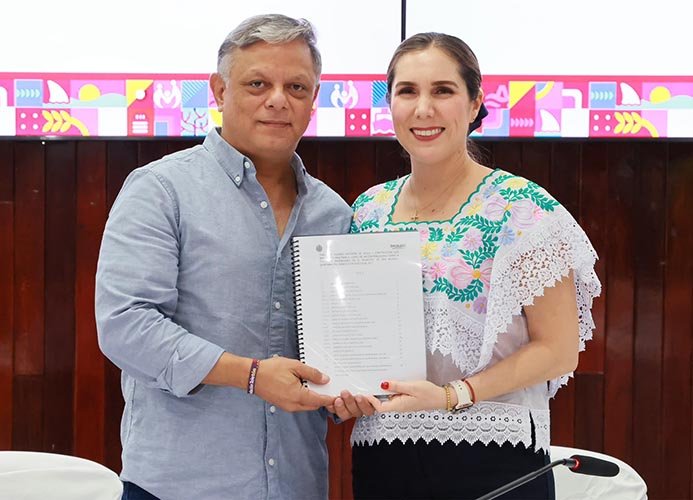
Isla Mujeres, Quintana Roo — The Isla Mujeres city council approved an update to its Municipal Development Plan for 2024-2027, a document that sets the administration’s priorities and was revised after consultations and proposals from residents of both the island and mainland areas of the municipality.
During the 51st ordinary council session, Mayor Atenea Gómez Ricalde said the review allowed officials to assess the administration’s progress, gather residents’ input once again and identify which actions need reinforcement during the remainder of the government term.
Five Strategic Axes Retained
The updated plan keeps five axes tied to security, public services, economic development, well-being and a government that stays close to residents. Gómez Ricalde said those areas continue to define the municipality’s work.
“Those five axes remain because they still represent the direction we want for Isla Mujeres, and today we have results that let us see how far we have come,” she said.
On security, the mayor said 84.3 percent of the municipal police force has completed training, alongside progress in professional development, the adoption of technology, prevention work and community outreach.
On services and public spaces, the citizen survey found that nine out of 10 participants rated parks, plazas and other public areas as good or very good. A similar share gave favorable marks to the service they received during municipal procedures.
Gómez Ricalde also said the administration’s score in the Consultative Guide for Municipal Performance rose from 43.48 percent in 2022 to 88.9 percent in 2024, an indicator the municipal government says reflects improvements in processes and institutional capacity.
Residents Submit Proposals
Public participation was a central part of the update. The process included online and in-person consultations, meetings with sector subcommittees, talks with residents and business owners, and outreach aimed at Indigenous and Afro-Mexican towns and communities.
Participants included residents of both the island and continental zones, as well as business owners, fishermen, tourism service providers, hoteliers, restaurant owners, teachers, athletes and representatives of the cultural and social sectors.
According to the results presented, 97.2 percent of participants submitted a concrete proposal for the municipality’s development.
“That speaks to a citizenry that wants to get involved, that wants to contribute and that also wants to be part of the decisions in its municipality. That is why this plan means so much to us,” Gómez Ricalde said.
With the update approved, the plan is structured around five strategic axes, 23 topics, 185 lines of action and 23 indicators and goals, tools meant to track government commitments and measure results.
Aligned With National and State Planning
The document remains linked to national and state planning instruments, including the 2025-2030 National Development Plan, the updated 2023-2027 State Development Plan and the Strategic Plan for the Sustainable Development of Quintana Roo 2050.
At the close of the session, the mayor credited COPLADEMUN, the Citizen Planning Council, the subcommittees, participating sectors and the various municipal departments that contributed to the update.
More Government
- TUCSA Cuts Playa del Carmen Public Transit Fleet to 56 Buses
- Cozumel Launches 2026 Workshops to Strengthen Civil Organizations
- Mexico Seeks Tariff Cuts on Steel and Autos in US Trade Talks
- Quintana Roo Expands State Scholarships by 21%, Reaching 15,682 Students
- Deported Mexicans Flock to Quintana Roo as Support Services Strain