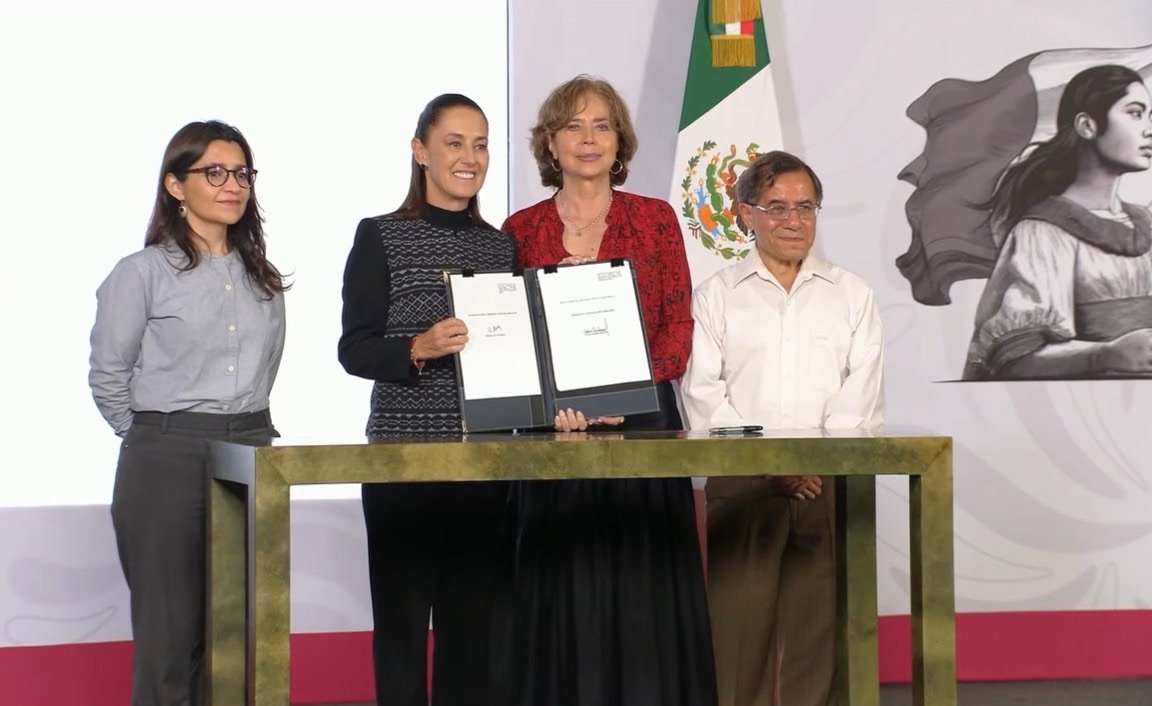
Mexico City — President Claudia Sheinbaum has transformed the National Institute of Historical Studies of the Revolutions of Mexico (Inehrm) into a public research and higher education institution that will study the rise of far-right movements worldwide and train new generations of social science and humanities specialists.
The decree, signed on July 1, converts Inehrm into a decentralized public body under the Secretariat of Science, Humanities, Technology and Innovation (Secihti). In addition to continuing historical research and dissemination, the institute will now offer bachelor’s, master’s, and specialized degree programs, expanding its role in higher education.
During the announcement, Sheinbaum said the change coincides with the anniversary of the 2018 electoral victory, which she described as the beginning of a new political era in Mexico. “Eight years ago, the fourth transformation of Mexico’s public life triumphed. The way to recognize the people’s victory is this institute dedicated to history and research of our country’s revolutions,” she said.
One of the most notable announcements was the institute’s new research focus. Science and Humanities Secretary Rosaura Ruiz said the president instructed the creation of a research line on the growth of right-wing and far-right movements in various countries, as well as the hate speech associated with these political phenomena.
“A topic the president has indicated is attention and research on the advance of the far right in different parts of the world, in the face of hate speech that seeks to exacerbate classism, racism, and social division. The history and memory of our people must be a moral barrier,” Ruiz said.
Ruiz explained that incorporating Inehrm into the National System of Public Research Centers will strengthen the state’s capacity to develop social science and humanities research in coordination with institutions such as CIDE, the Mora Institute, Ciesas, El Colegio de la Frontera Norte, El Colegio de Michoacán, and El Colegio de San Luis. The goal is to train specialists committed to studying the country’s historical and social processes.
Public, Free Education
Institute Director Felipe Ávila said the expanded functions respond to the need to strengthen academic training in historical, social, and political topics. He explained that the body will combine research, teaching, and social engagement through a model of public, free, and quality education.
Ávila announced that the institute will offer three bachelor’s degrees: History; Social Sciences and Humanities; and Public Administration and Good Governance. It will also offer three master’s degrees: Mexican Humanism, Gender Studies and Feminisms, and Social Movements and Rescue of Historical Memory. The offerings will be complemented by specializations in Political Communication and History Teaching, as well as diplomas on health, education, migration, ecology, artificial intelligence, alternative energies, human rights, violence, public administration, and other topics of national interest.
As part of this new phase, the institute will organize permanent seminars on contemporary social, economic, political, cultural, and environmental issues; geopolitics; and Latin American thought and integration. The aim, Ávila said, is to turn Inehrm into a meeting space for universities and research centers in Mexico and Latin America.
He also announced a broad editorial program with free digital books. Planned collections include classics of Mexican history and social sciences, Mexican left-wing thought, and fundamental works of contemporary critical thought. Some material will be translated into indigenous languages and also available as audiobooks.
Stopping the Far-Right Threat
On the international front, Ávila said the president instructed him to assemble an academic body of renowned Mexican researchers and invite Latin American specialists studying contemporary political processes. The goal is to enrich debate from different disciplines and regional experiences.
Ávila said this call also responds to the interest in analyzing the growth of right-wing movements in Latin America. “We want these people to be part of this collective discussion so we can close ranks to stop these threats to civilization represented by the rise of the right and far right in Latin America, but also in the world,” he said.
The call for the first admission process will be published this July. After a preparatory course, classes will begin in September at a location in Mexico City’s Historic Center, at Guatemala Street number 80.
With this change, Inehrm will cease to be exclusively a center for historical research and dissemination and become a higher education institution with academic programs focused on contemporary historical, social, and political processes, including a specific research line on the advance of the far right and its expressions in different countries.