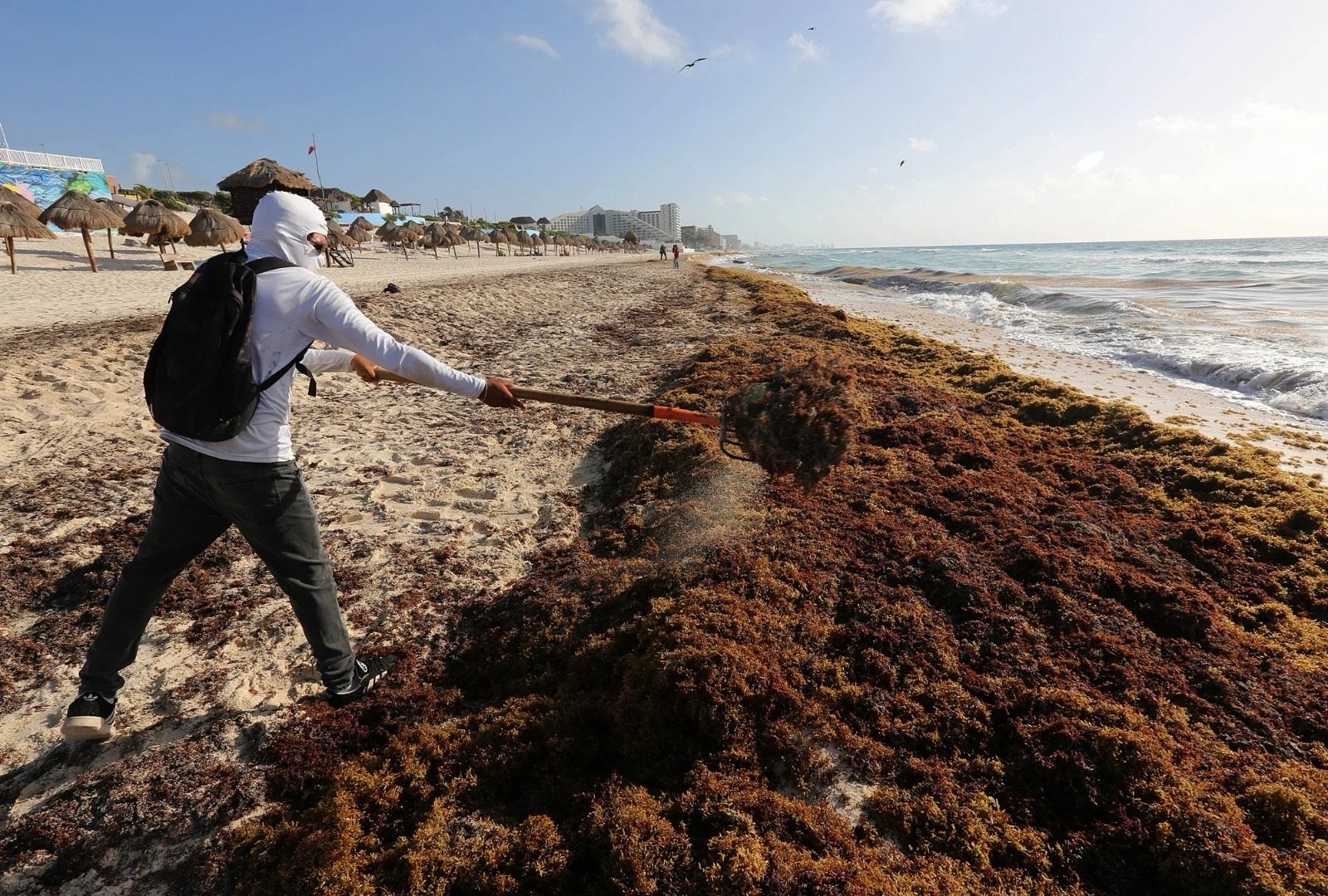
Playa del Carmen, Quintana Roo — The 2026 sargassum season is putting relentless pressure on Quintana Roo’s coastline, with authorities collecting nearly 80,000 tons of the seaweed so far, marking one of the most intense years on record.
According to the latest report from the state’s Secretariat of Ecology and Environment (SEMA), as of July 6, a total of 79,476 tons of macroalgae have been removed from beaches along the Mexican Caribbean. The massive influx continues to affect beaches, ecosystems, and tourist destinations.
Playa del Carmen leads in sargassum removal with 28,455.21 tons collected. It is followed by Cancún with 19,626.43 tons, Puerto Morelos with 9,823.41 tons, Othón P. Blanco (including Mahahual) with 8,899.56 tons, and Tulum with 8,350.60 tons.
Isla Mujeres reported 3,219 tons collected, while Cozumel added 1,057.10 tons. In contrast, Lázaro Cárdenas, home to Holbox, recorded just 36.25 tons, making it the least affected area this season.
As part of efforts to intercept sargassum before it reaches the shore, the state government has deployed 9,450 meters of anti-sargassum barriers. These are installed in Puerto Morelos (2,310 meters), Playa del Carmen (2,580 meters), Tulum (2,295 meters), and Mahahual (2,265 meters), where much of the seaweed arrives.
However, the report notes that Cancún, despite being the second-largest collector of sargassum, currently has no barriers installed. The state’s goal for 2026 is to reach 16,030 meters of barrier infrastructure, meaning about 41% of the planned system remains to be deployed at the peak of the season.
Offshore Containment
At sea, the containment strategy is led by the Mexican Navy (Semar), which has deployed one ocean-going sargassum vessel, 11 coastal boats, 22 smaller units, and three specialized AquaMarine vessels to intercept the seaweed before it reaches the coast.
Beach cleanup operations continue around the clock. The Navy has 350 personnel stationed along the coastline, supported by two state brigades of 25 specialists each, currently working in Mahahual to remove accumulated algae.
To speed up collection and transport, the state has added 19 dump trucks (14 cubic meters each), nine backhoes, three specialized model 600H sweepers, four ATVs with trailers, and three skid-steer loaders to its fleet.
More Environment
- Screwworm Cases Detected in Two Dogs and a Horse in Tulum
- Playa del Carmen Recognized as International Bull Shark Zone
- Five Zones in Playa del Carmen Lose Urban Jungle to Construction Boom
- Hurricane Isaias Strengthens to Category 3 as Heavy Rain Hits Quintana Roo
- Hurricane Isaías to Bring Rain and Heat to Cancún and Playa del Carmen This Weekend
More Quintana Roo
- Tren Maya Freight Project Targets 4.7 Million Tons by 2030
- Cancún Business Council Launches Push to Diversify Quintana Roo’s Economy Beyond Tourism
- Mexico Adds COVID-19 Vaccine to Routine Childhood Schedule for Infants and Toddlers
- Power Outage in Chetumal Forces Closure of Quintana Roo Labor Courts
- Cancún Restaurants in the Red as Power Outages Add to Mounting Losses