
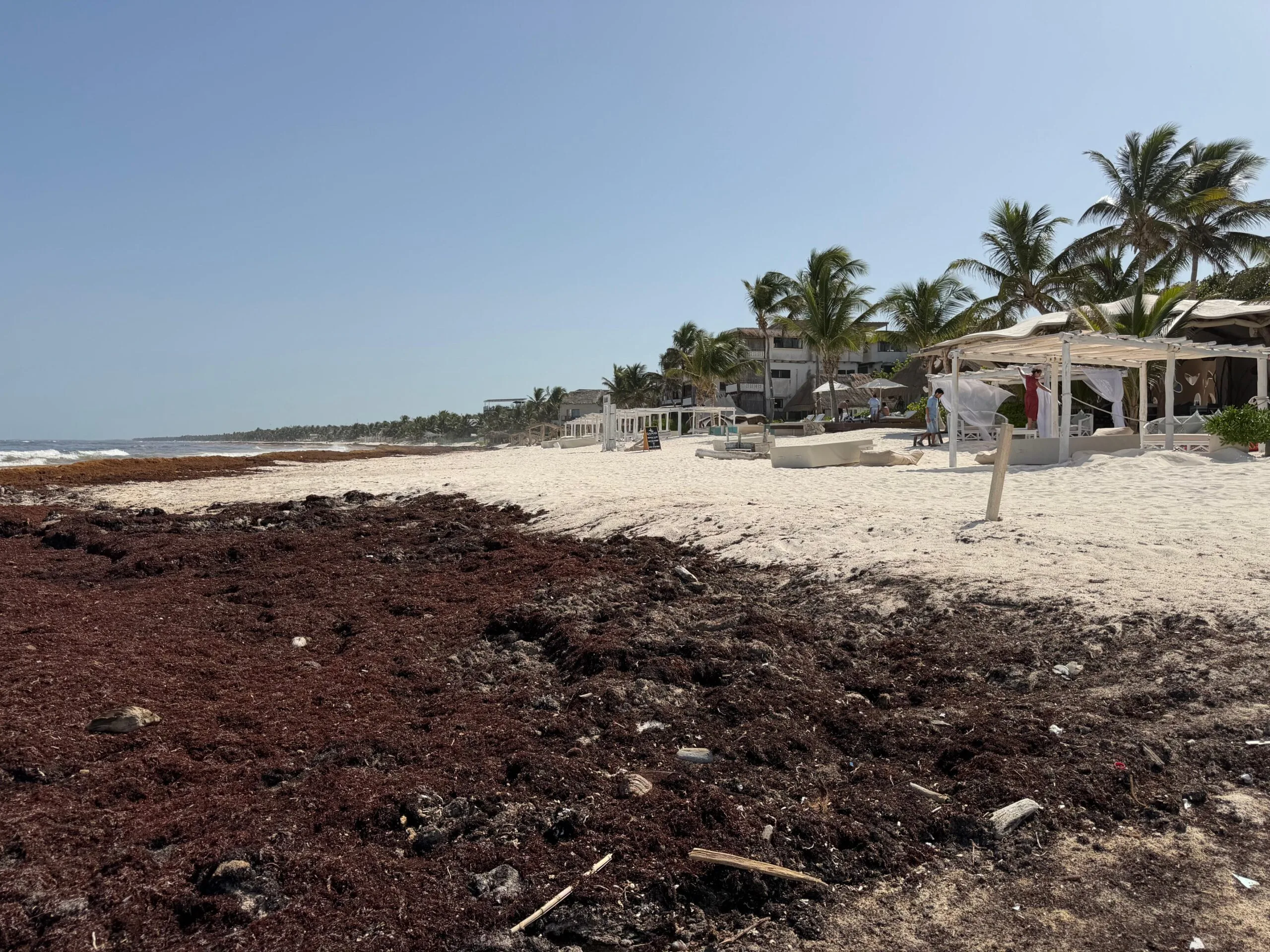
Tulum, Quintana Roo — Hotel operators in Tulum say the record sargassum crisis is forcing some businesses to consider what was once almost unthinkable: closing their doors during the months when keeping the beach clean costs more than the hotel can afford.
David Ortiz Mena, president of the Tulum Hotel Association, warned that seasonal operation cannot become the normal business model for beachfront hotels. Sargassum is now affecting parts of the Mexican Caribbean for eight or nine months of the year, he said, making it increasingly difficult to identify a reliable period when coastal properties can operate without the added expense.
Closing during the worst months might reduce cleanup bills, but it would also eliminate permanent jobs, reduce purchases from local suppliers and weaken restaurants, transportation companies, tour operators and other businesses that depend on hotel guests.
“A hotel can spend up to three times more removing sargassum than it pays for electricity,” Ortiz Mena said in an earlier interview about the crisis.
He argued that the private sector can continue cleaning the beaches directly in front of its properties, but cannot be expected to finance offshore interception, regional monitoring and final disposal without sustained government support.
A record season that started unusually early
The concern comes during what authorities have described as one of Quintana Roo’s worst sargassum years on record.
By mid-August, more than 105,000 metric tons had been removed from the state’s coastline, already surpassing the 92,783 tons collected during all of 2025. Officials had originally projected that approximately 119,000 tons could arrive during 2026, although the final amount will depend on winds, tides and ocean currents.
The season also began far earlier than expected. Tulum collected 244 tons in February, compared with 59 tons during the same month in 2025.
Traditionally, the heaviest arrivals occurred between spring and early fall. In recent years, however, significant landings have appeared during winter, while some communities have reported little or no break between one season and the next.
That does not mean every beach is covered every day. Conditions can vary dramatically over relatively short distances because the seaweed is moved by local currents and wind. One Tulum beach can be overwhelmed while another remains largely clear, and conditions may change overnight.
It does mean hotels can no longer build annual budgets around a short, predictable cleanup season.
The problem has grown since 2011
Sargassum is a floating brown seaweed that provides shelter and food for marine life while it remains in the open ocean. The ecological emergency begins when unusually large quantities wash ashore and decompose.
Large recurring accumulations began appearing across the Caribbean in 2011. Scientists now track a vast floating region known as the Great Atlantic Sargassum Belt, extending from West Africa across the tropical Atlantic and into the Caribbean.
Researchers have linked its growth to a combination of changing ocean conditions, warmer water and an increased supply of nutrients, including nitrogen and phosphorus entering the Atlantic from rivers and agricultural runoff. The exact contribution of each factor is still being studied.
Satellite monitoring by the University of South Florida shows that major summer blooms have occurred in almost every year since 2011. The researchers caution that regional forecasts cannot predict the condition of an individual beach, since local winds and currents ultimately determine where the seaweed lands.
The scale and duration of the new Atlantic blooms explain why Ortiz Mena describes sargassum as a structural problem rather than a temporary inconvenience.
Low occupancy makes cleanup harder to absorb
The hotel association reported that European-plan hotels along Tulum’s coastal road, where guests pay separately for meals and services, have recently recorded occupancy of approximately 20 percent. All-inclusive properties were reportedly closer to 40 percent.
Those figures are industry snapshots for particular categories of beachfront hotels, not an official occupancy rate for every hotel, vacation rental and hostel in the municipality. They nevertheless illustrate the pressure on properties with high fixed costs and too few occupied rooms to cover them.
Sargassum is not the only reason for weak occupancy. Tulum is also dealing with a strong peso, economic uncertainty in major travel markets, increased competition from other Caribbean destinations, high local prices, transportation complaints and a rapid expansion in hotel and vacation-rental inventory.
But the seaweed has become a particularly visible disadvantage because images of heavily affected beaches circulate rapidly through social media, travel groups and booking reviews. Even when conditions improve, older photographs and videos can continue influencing travelers.
Research published by the Inter-American Development Bank found that sargassum on Quintana Roo beaches was associated with an estimated 11.6 percent reduction in local economic output. The study also detected effects for up to 12 months after seaweed appeared, suggesting damage to a destination’s reputation can outlast the physical arrival.
The true cost is larger than the cleanup bill
There is no comprehensive figure showing exactly how much Tulum loses to sargassum each year.
Direct hotel expenses include barriers, collection equipment, additional labor, fuel, transportation and maintenance. Properties must then find an approved place for the material, which can contain sand, plastic, salt and other debris.
A scientific assessment of cleanup operations in Tulum, Solidaridad and Puerto Morelos estimated annual costs ranging from approximately $300,000 to $1.1 million per kilometer of coastline, depending heavily on the collection method and volume involved.
Mechanical removal can create another problem. Heavy equipment may compact the beach or carry away large amounts of sand along with the seaweed, contributing to erosion. Cleanup crews also have to work around sea-turtle nests during nesting season.
Once sargassum begins decomposing, it releases hydrogen sulfide, the gas responsible for its rotten-egg smell. At elevated concentrations it can irritate the eyes and respiratory system, creating an occupational concern for workers exposed for long periods.
Accumulated seaweed can also reduce oxygen in nearshore water, block sunlight and harm seagrasses, fish and other marine organisms.
Federal government promises a larger role
The federal government has announced a 2 billion-peso strategy intended to increase the amount of sargassum intercepted before it reaches shore.
Plans include additional Navy collection vessels, expanded offshore barriers, smaller support boats, satellite monitoring and more permanent operating and maintenance resources. The strategy also calls for closer cooperation among federal, state and municipal authorities, scientists and the tourism industry.
Offshore collection is generally preferable because it prevents the seaweed from decomposing on beaches and reduces the amount of sand removed during cleanup. It is also expensive and technically difficult. Barriers can fail during rough weather, and the floating mats may simply move around them.
Government vessels cannot capture all the seaweed approaching Quintana Roo’s hundreds of kilometers of coastline. The practical goal is to intercept the largest concentrations before they reach the most vulnerable or heavily visited areas.
Turning sargassum into a product remains difficult
Companies and researchers are developing uses for collected sargassum, including fertilizers, soil enhancers, construction materials, biofuels, cosmetics and bioplastics.
Creating a market could help offset collection and transportation costs, but commercial use is not as straightforward as processing an ordinary crop.
Sargassum can absorb arsenic and other contaminants while floating in the ocean. Its salt content is also high, and material collected from beaches is frequently mixed with sand, garbage and decomposed organic matter. Any product intended for agriculture, cosmetics or human use requires careful testing and processing.
Most commercial projects remain relatively small compared with the volume reaching the coast. For now, disposal remains a cost rather than a reliable source of revenue.
Ortiz Mena is asking authorities to calculate that cost more accurately: how much governments spend, how much hotels absorb, how many reservations are lost and how the effects move through the broader economy.
Without that information, it is difficult to decide how government funding should be distributed or what kind of assistance could keep struggling hotels open.
His larger warning is that Tulum can no longer wait for a “normal” sargassum season to return. If the seaweed is now present through most of the year, cleanup, offshore interception, disposal and monitoring must also become year-round operations.
More Tourism
- Maya Train’s Entire Route Gets Internet Next January
- Mahahual Faces Economic Uncertainty as Perfect Day Fallout Chills Investment
- Progreso Hyperbaric Chamber Logs 181 Sessions for Divers and Patients Since June
- Quinta Avenida Board in Playa del Carmen Aims to Start Work in Early 2027
- Yucatán Draws 11,566 Million Pesos in Tourism Investment, Creating 15,508 Jobs
More Tulum
- Captain Sun’s Tulum Penthouse: Cash Trail Under Scrutiny
- Tulum Reports Fewer Traffic Accidents and Injuries in Third Quarter of 2026
- Starbucks Exits Tulum: Why the Hotel Zone Is Losing Its Buzz
- Canada Drives Mexican Caribbean Demand for Final Quarter of 2026
- Tulum Fishing Cooperative Seeks Funds to Expand Facilities and Sustain 70 Families