
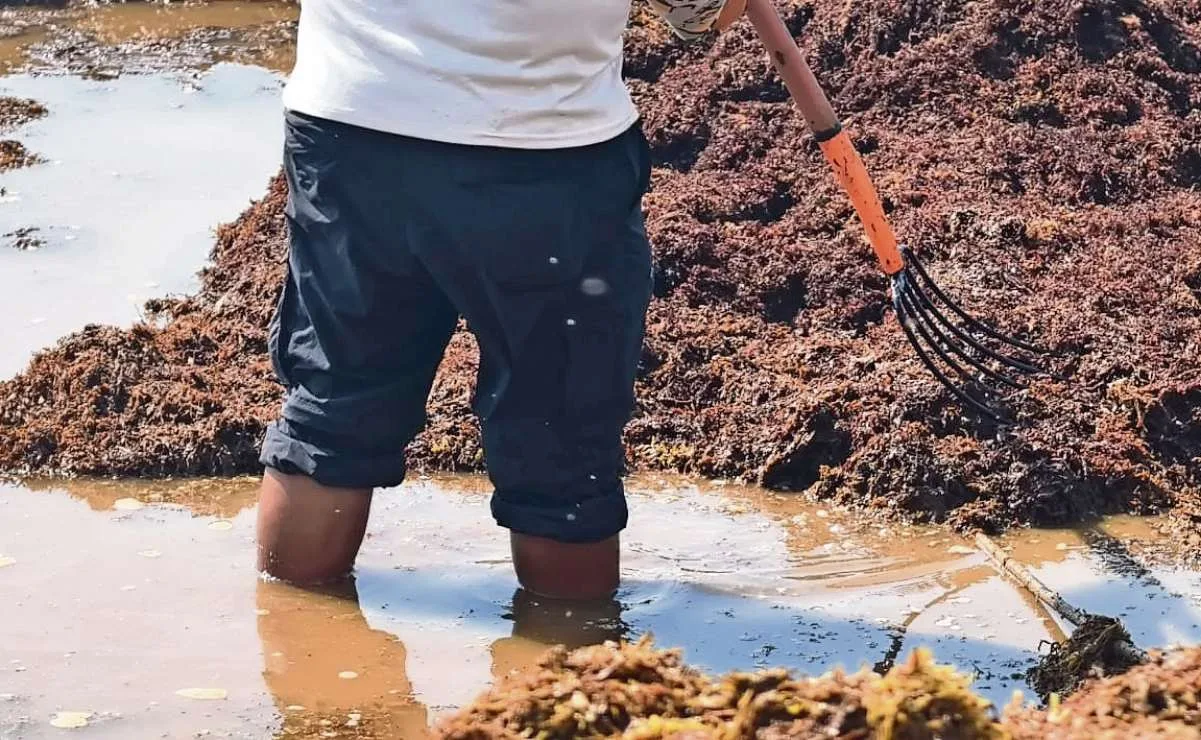
Cancún, Quintana Roo — A scientific study conducted on beaches of the Mexican Caribbean has found that workers who collect sargassum are suffering significant health impacts, which worsen as the seaweed rots and releases hydrogen sulfide (H2S) at levels that have exceeded permissible limits.
The research, the first of its kind to use direct, real-time measurements, monitored 35 sargassum collectors in Puerto Morelos, Playa del Carmen and Mahahual. It was supported by the National Autonomous University of Mexico (UNAM), the University of São Paulo and Canada’s New Frontiers in Research Fund.
Hydrogen sulfide is a toxic gas produced when sargassum decomposes in anaerobic conditions, recognizable by its rotten egg smell.
“To date, no published study has directly quantified real-time H2S exposure among sargassum cleanup workers,” the authors note. “This group likely faces greater risk than the general population due to prolonged, repeated contact with decomposing biomass, often without adequate protective equipment.”
Cleanup activities in the region can last up to nine months a year, with workers typically putting in eight-hour days, six days a week for several consecutive years, suggesting considerable cumulative exposure risks.
Among the monitored workers, 46.9% reported itching and burning skin; 43.8% had headaches; 37.5% suffered dermatitis and fatigue; 28.1% experienced eye irritation and nausea; 25% reported dizziness; 21.9% had hives and nasal congestion; and 18.8% reported throat irritation and difficulty breathing. Some also reported vomiting, anxiety, sleep disorders, skin infections, localized hair loss on legs and, in a few cases, loss of toenails.
The study, published in the April issue of the journal Harmful Algae, warns that the risk increases with decomposing sargassum, which releases hydrogen sulfide and other toxic compounds. Workers removing sargassum in the water or in areas with dense accumulations reported more severe dermatological symptoms.
Fieldwork took place between June and August 2024, during an unprecedented sargassum bloom. Researchers placed portable sensors on workers’ chests to measure H2S concentrations in real time and administered health questionnaires to 32 workers.
Results showed workers were frequently exposed to dangerous H2S levels, with concentrations ranging from 1 to 50.8 parts per million (ppm). Of the measurements, 46.3% exceeded the Mexican permissible limit of 1 ppm for an eight-hour workday; 11.3% exceeded the short-term exposure limit of 5 ppm; and 1.7% exceeded 10 ppm. Some exposures reached over 50 ppm, a level considered potentially life-threatening.
Lead researcher Rosa Rodríguez said the findings indicate an urgent need for protective measures, including continuous H2S monitoring, personal alarm sensors, mandatory protective equipment, proper respirators, staff rotation to limit exposure time, and keeping workers with asthma or respiratory conditions away from decomposition zones. She also recommended accelerating sargassum collection to prevent prolonged accumulations and establishing long-term medical surveillance and epidemiological studies.
Rodríguez stressed the need to prevent sargassum from reaching the coast and rotting, as has happened at beaches like El Recodo in Playa del Carmen, where the seaweed has turned into a dark sludge that must be removed with machinery. She noted that other sites have even higher hydrogen sulfide concentrations.
More Lifestyle
- Yucatán Suspends Classes in 27 Municipalities as Tropical Storm Isaías Nears
- Playa del Carmen Traffic Police Run No Operations Targeting Bike Lane Violations
- Scooter Users Demand Say in Playa del Carmen Micromobility Rules
- PGA Riviera Maya Renovates Executive Course, Lifting Tulum’s Golf Offer
- Isla Mujeres Day of the Dead 2026: Pandora, Catrinas & More
More Quintana Roo
- Sheinbaum Announces More Gas and Power Grid Upgrades for Quintana Roo
- Quintana Roo Port Authority Reports 254 Million Peso Budget Underspend
- Quintana Roo Plans 4.4 Billion Peso Wind Farm in Othón P. Blanco
- Quintana Roo Hoteliers Say DNR Hike Favors Punta Cana Over Cancún
- Tulum Ranks Second as Mexico Claims Six Spots on Best Beaches List