
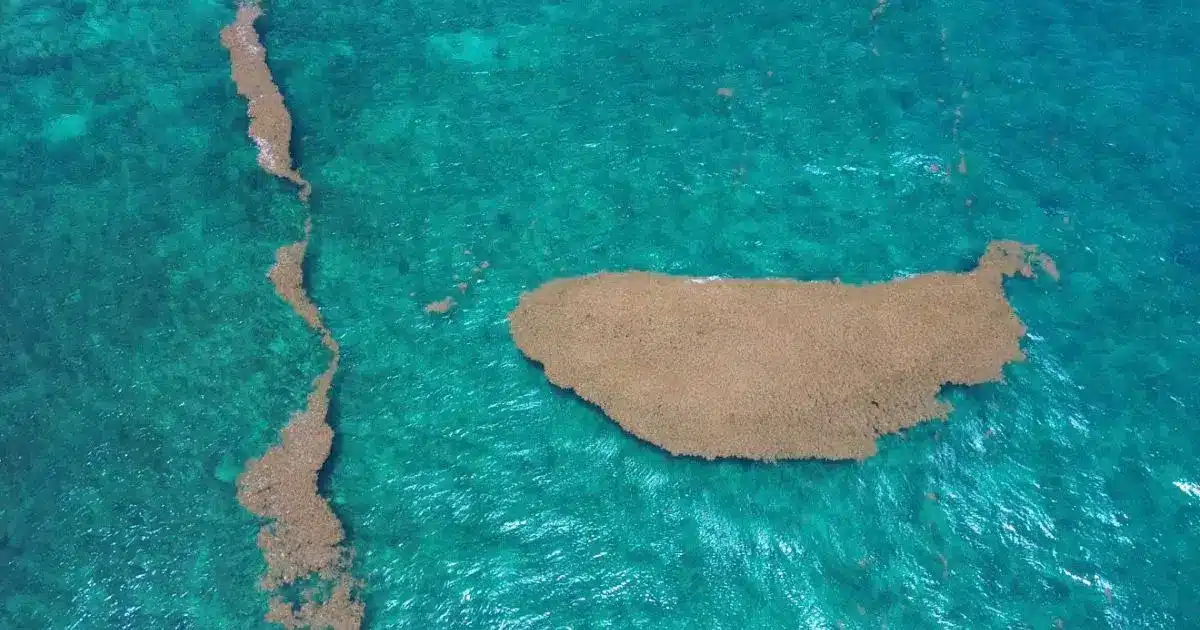
Cancún, Quintana Roo — Sargassum arrivals have started to taper off along the coast of Quintana Roo, particularly in the northern zone, where the seaweed’s presence has dropped notably in recent weeks, according to specialists monitoring the shoreline.
Esteban Amaro, coordinator of the Sargassum Monitoring Center in Quintana Roo, said beach conditions have improved for roughly two to three weeks. Of about 100 beaches monitored in the north, only four remain at red-alert level, with most others at green or yellow status.
Amaro explained that the Cayman Current, which normally pushes seaweed toward Quintana Roo’s beaches, has slowed, while the Yucatan Current, which flows toward the Gulf of Mexico, has strengthened. That combination, along with prevailing winds of 10 to 15 kilometers per hour, has kept more of the seaweed offshore and redirected a portion toward the north.
Although large amounts of sargassum biomass remain offshore, a significant share has drifted into the Gulf of Mexico, improving the outlook for the rest of the season, he said.
The heaviest arrivals occurred in May, June, and July, and the state is now in a declining phase. The expectation is that the downward trend will continue through September, with only minimal landings in October.
Despite the northern improvement, authorities continue monitoring the southern coast, where about 15 sites remain on red alert, mostly near Chetumal and the Sian Ka’an Biosphere Reserve. Mahahual currently shows better conditions, though vigilance remains.
Amaro estimated that 10,000 to 15,000 additional tons of sargassum could be collected by the end of 2026, putting the annual total at approximately 120,000 to 135,000 tons — below the 150,000 tons originally projected.
He added that current conditions point to a less complicated close to the season than previously anticipated, with the main arrivals still occurring in September and little to no seaweed expected from October on.
More Environment
- Quintana Roo’s Beaches Are Disappearing Up to 14 Meters a Year
- Rabies Found in Fox That Scratched Baby in Cancún
- Cozumel’s Reefs Get a 3D Map Divers Can Explore Before Entering the Water
- Documentary Exposes 30 Years of Pollution in Cancún’s Chacmuchuch Lagoon
- Crocodile Surprises Tourists Swimming at Cozumel’s El Cielo Sandbar
More Quintana Roo
- Quintana Roo Identifies 780 Irregular Settlements, Prepares Regularization Strategy
- Quintana Roo Lawmaker Proposes Mandatory Child Support Registry Check Before Marriage
- Riviera Maya Forum Pushes Caribbean Mexico Toward Regenerative Tourism
- Quintana Roo Prosecutors Search for 10 Missing People, Including Five Minors
- Childhood Obesity in Quintana Roo Up 18.5%, Diabetes Cases Rise