Puerto Morelos, Quintana Roo — A solution developed in Puerto Morelos during one of the Mexican Caribbean’s worst sargassum years is beginning to travel.
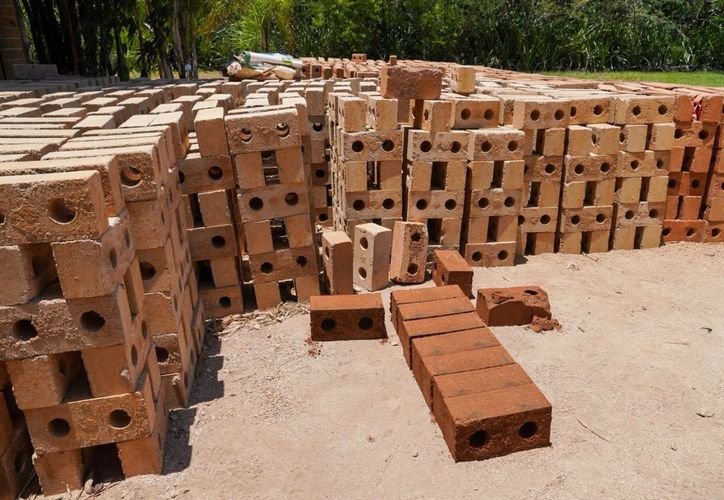
Sargablock, which transforms sargassum into construction blocks, has sold its first international franchise license in the Dominican Republic and is moving ahead with plans to replicate the system in Belize.
For founder Omar Vázquez Sánchez, the goal is not primarily to ship blocks made in Quintana Roo around the Caribbean. It is to license the process so communities dealing with their own sargassum arrivals can manufacture the material locally.
“We have already been to Belize, we have already been to the Dominican Republic. We were in Ghana, in Africa,” Vázquez said. “What we want to do is sell a license, a franchise, because there is sargassum all over the Caribbean.”
The Dominican Republic license was sold last year, according to Vázquez, although production has not yet begun. The company is studying local materials that can be combined with sargassum before establishing production there.
A separate project has been under development in Belize for several years, while Vázquez says there has also been interest from Barbados and Martinique.
It Started With Casa Angelita
Sargablock’s story began in Puerto Morelos during the massive sargassum arrivals of 2018.
Vázquez, who operated a nursery and landscaping business, had previously experimented with using sargassum as compost. He eventually began testing whether the material could be incorporated into building blocks inspired by the adobe construction he remembered from his grandparents’ home.
The result was Casa Angelita, named after his mother.
Built in Puerto Morelos with 2,150 Sargablocks, it became the project’s proof of concept. Approximately 20 tons of wet sargassum were used to produce the blocks needed for the house.
The United Nations Development Programme later highlighted Sargablock as an example of community-based innovation, noting that approximately 20 tons of sargassum can be put to use for every 2,000 blocks incorporated into a building. The project has also been documented by the Inter-American Development Bank in its review of innovations addressing Caribbean sargassum.
From Wooden Molds to Thousands of Blocks
What began as a largely artisanal operation has changed considerably.
Vázquez says Sargablock initially produced about 200 blocks a day using wooden molds. The Puerto Morelos operation now has three industrial machines, including an automatic diesel-powered hydraulic unit, and has the capacity to produce as many as 5,000 blocks per day.
Actual daily production varies with the type of block being made. The plant currently processes between 20 and 22 tons of wet sargassum per day, producing approximately 2,000 to 4,000 pieces.
The workforce has grown as well. The company started with four employees and now has 16 permanent workers, increasing to as many as 66 during peak sargassum season, according to Vázquez.
The blocks are now distributed beyond Quintana Roo to other parts of southeastern Mexico as well as Mexico City and Guadalajara, where a house has already been constructed with the material.
21 Houses Donated in Quintana Roo
Housing has remained an important part of the project.
Vázquez says Sargablock has now donated 21 houses in Quintana Roo. The figure represents steady growth from 2020, when the company announced construction of its 11th donated home, and 2025, when Vázquez reported 18 donated houses and two consulting rooms for the municipal DIF social-services agency.
The donations are tied closely to Vázquez’s original reason for developing the material. Casa Angelita was modeled on the adobe house of his grandparents in Jalisco, and he has spoken publicly about growing up without the security of a permanent home.
“For us it is a project with purpose more than an economic question,” he said of the company’s expansion.
A Small Piece of a Much Bigger Sargassum Problem
Sargablock cannot consume anything close to the enormous quantities of sargassum now reaching the Caribbean. But its expansion comes at an interesting moment.
Governments across the region are increasingly looking beyond simply removing sargassum from beaches and dumping it elsewhere. The focus is shifting toward developing commercial uses that could turn at least some of the material into a resource.
Construction is one of several possibilities being investigated internationally. A Caribbean sargassum-use guide produced by researchers and regional organizations identified applications including construction blocks, panels, resins and even bio-asphalt, while specifically highlighting Sargablock as an existing commercial example from Mexico.
That makes the international licensing model particularly relevant.
Transporting tons of wet sargassum is expensive and inefficient. A franchise system instead allows the seaweed to be collected, processed and converted into building materials close to where it washes ashore.
If the Dominican Republic and Belize operations move into production, they will provide an important test of whether something developed on a small scale in Puerto Morelos can be reproduced under different Caribbean conditions.
For a company that started with wooden molds in a Puerto Morelos nursery, that may be the more significant milestone: Sargablock is no longer simply selling blocks. It is beginning to sell the system for making them.
More Business
- Banco del Bienestar App Now Offers Free Transfers, QR Payments
- Grand Outlet Riviera Maya to Light ‘Dulce Resplandor’ Christmas Tree on Nov. 21
- Playa del Carmen Deploys Aerial Surveillance and Patrols for Buen Fin Shopping Season
- Secrets Marina Seeks Semarnat Approval for 7,933-Square-Meter Beach Club in Puerto Morelos
- Chetumal Taxi Drivers Could Join Uber Under Proposed Mobility Law Reform
More Puerto Morelos
- Quintana Roo Registry Lists 193 Irregular Real Estate Developments
- Puerto Morelos Renews 453 Business Licenses and Registers 109 New Ventures
- Cancún and Puerto Morelos Hotels Resume Job Fairs With 200 Vacancies
- Puerto Morelos Tourism Operators Sign Up for State Registry
- Free Mammograms in Quintana Roo: Bacalar, Cancún and Puerto Morelos Set for Nov. 17-20