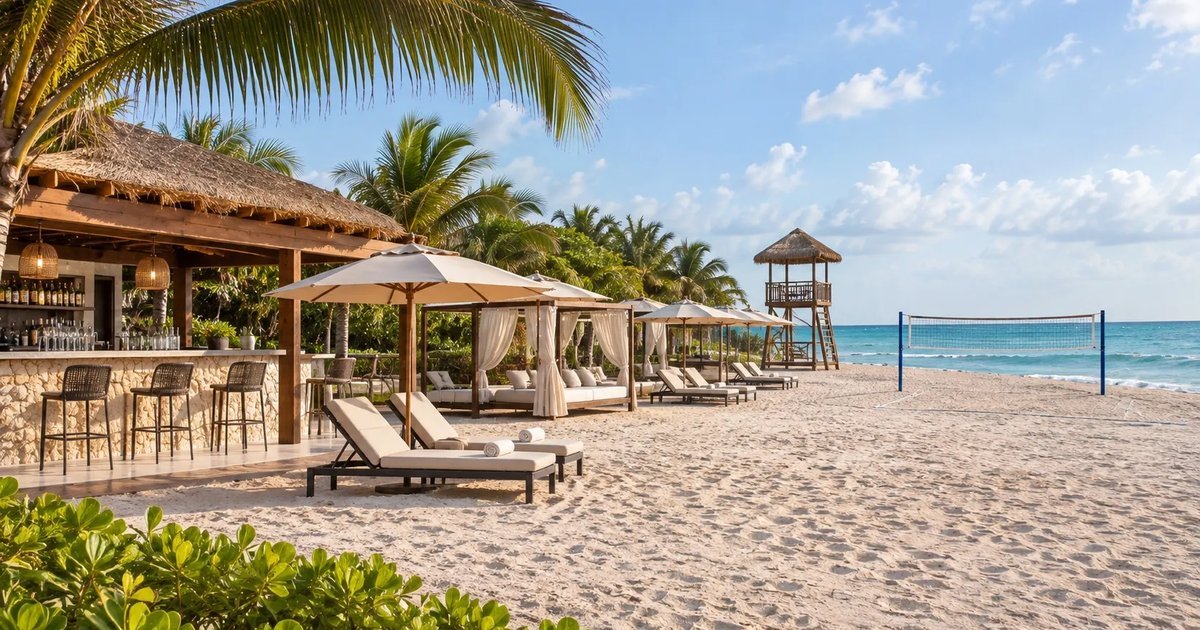
Puerto Morelos, Quintana Roo — The luxury Secrets Marina hotel under development here is seeking federal approval to build a 7,933.11-square-meter beach club on the federal maritime-terrestrial zone, with bars, loungers, rest areas and recreation facilities facing the Caribbean.
The proposal, filed as Secrets Marina Proyecto Playas, was submitted through an environmental impact statement (MIA) registered under case number 23QR2026TD079 so that federal officials can assess whether the works are viable. The site sits on Bulevar El Cid in Puerto Morelos and forms part of the beach facilities planned for the hotel complex.
According to the filing, 4,517.15 square meters would be used for tourist facilities and activities, while the remaining 3,415.96 square meters would be set aside to conserve the coastal dune.
A Luxury Hotel Still Under Construction
Secrets Marina Riviera Maya Resort & Spa is a luxury project developed by Pulso Inmobiliario in Puerto Morelos. The complex was announced in 2022 as a new high-end lodging option on Mexico’s Caribbean coast.
Early public references described 407 rooms, though later information from a contracting firm describes 452 rooms spread across ten buildings. The hotel has no confirmed commercial opening date; progress reported by the developer and job postings for pre-opening positions indicate construction is ongoing.
The new environmental application does not cover the hotel itself, only its beachfront recreation facilities.
What the Beach Club Would Include
The impact statement lists:
- Two food and beverage bars, one of them identified as Barracuda Bar with a planned area of 113.49 square meters
- Two Balinese daybeds and two multi-use pergolas
- A lifeguard tower and a volleyball court
- Four palapa structures for bars
- 62 umbrellas with loungers for guests
The design assigns 3,556.75 square meters to leisure and recreation, with no permanent structures in that area. Overall, facilities and recreation spaces would take up 56.94% of the requested surface, while the other 43.06% would remain a conservation zone to protect and help regenerate the coastal dune.
Sea Turtle Nesting a Key Issue
Protecting the sea turtles that nest on Caribbean beaches will be a central part of the environmental review. The developer’s study proposes measures to limit disturbance during nesting season, including removing temporary furniture at night while leaving certain semi-fixed structures in place.
Those semi-fixed structures would occupy 403.95 square meters, or 5.09% of the total project area, according to the document. The proposal argues the approach would keep most of the beach available during the hours when turtles are most active. Semarnat will decide whether the measures are sufficient to protect wildlife and the coastal ecosystem.
Construction Timeline and Location
The project envisions 12 months for site preparation and construction, including excavation, structural piling, flooring, roofing and hydraulic and electrical works. Once complete, the beach club would have an estimated operating life of 50 years.
The filing states that the facilities would sit more than 100 meters from the nearest mangrove areas, with no direct intervention on that vegetation, and that the site lies outside the boundaries of the Puerto Morelos Reef National Park. Both claims are subject to verification during the review.
What Semarnat Will Evaluate
The application was filed by Banco Ve por Más, S.A., acting as trustee, to obtain federal authorization on environmental impact grounds. Officials must weigh potential effects on the beach, the coastal dunes and protected species before deciding whether to approve the works and under what conditions.
Filing the impact statement does not mean Semarnat has approved the project, nor does it replace any other permits that may be required to occupy and use the federal zone.
More Development
- Cancún Removes More Than 200 Abandoned Vendor Stalls to Reclaim Public Spaces
- Quintana Roo Registry Lists 193 Irregular Real Estate Developments
- Rafael Nadal and Meliá Open First Zel Hotel in Mexico on Cozumel
- CFE Submarine Cable to Boost Power Supply in Playa del Carmen and Cozumel
- Posadas Opens Devossion by Live Aqua With 122 Rooms on Isla Mujeres
More Puerto Morelos
- Grand Outlet Riviera Maya to Light ‘Dulce Resplandor’ Christmas Tree on Nov. 21
- Puerto Morelos Renews 453 Business Licenses and Registers 109 New Ventures
- Cancún and Puerto Morelos Hotels Resume Job Fairs With 200 Vacancies
- Puerto Morelos Tourism Operators Sign Up for State Registry
- Free Mammograms in Quintana Roo: Bacalar, Cancún and Puerto Morelos Set for Nov. 17-20