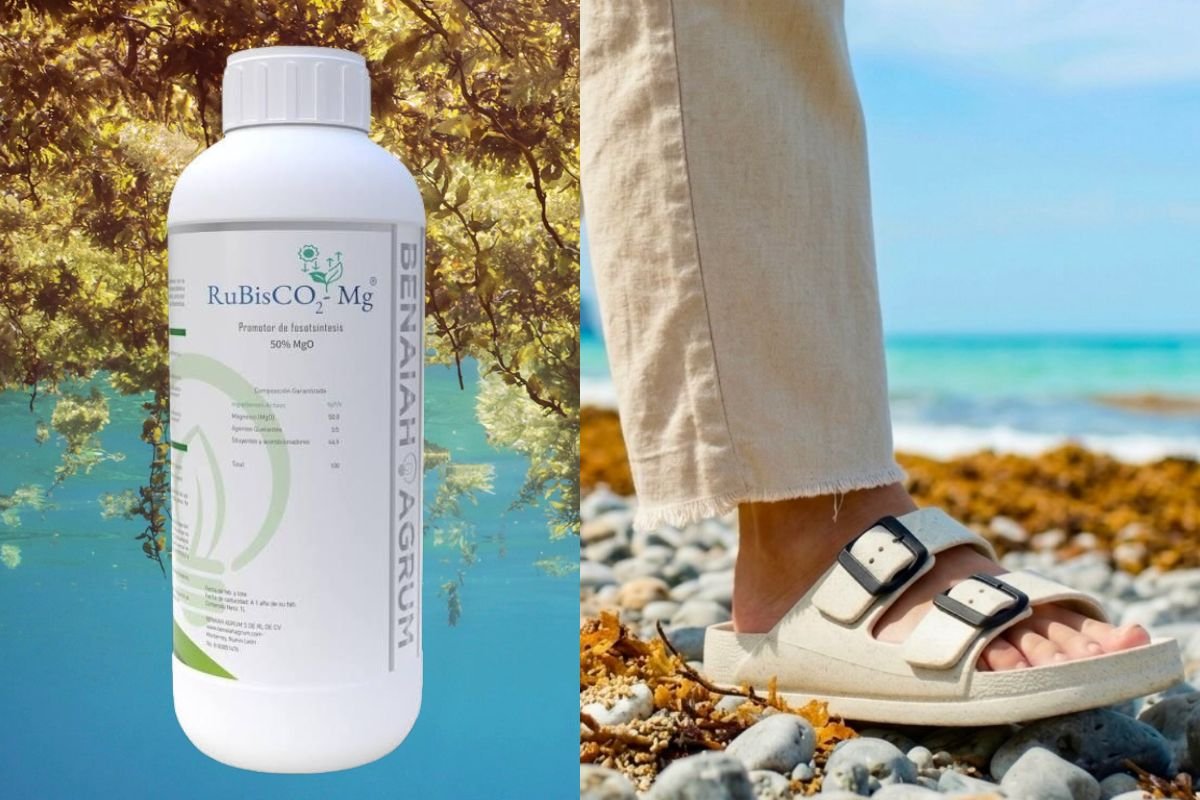
Playa del Carmen, Quintana Roo — Two Quintana Roo startups working to turn sargassum from an environmental crisis into commercial products will compete in the regional final of the Startup World Cup, with the goal of reaching the global stage in Silicon Valley and competing for up to $1 million USD in investment funding.
The projects, RubisCO2 and Sargazo Sandals, are being supported by Mayma México, an organization that works with entrepreneurs focused on sustainability, circular economy, and impact-driven business models. The regional pitch event is expected to take place during the last week of August in Playa del Carmen. Ten companies will be selected to present their projects before a jury. The winner will advance to the national final in Chihuahua, and from there may move on to the global Startup World Cup final in California.
The Startup World Cup is organized by Pegasus Tech Ventures, a Silicon Valley-based venture capital firm. The competition brings together startups from regional events around the world, with global finalists competing for a $1 million investment prize and international exposure.
For Quintana Roo, the focus on sargassum is not accidental. Sargassum has become one of the Mexican Caribbean’s most persistent environmental and economic problems. Large landings affect beaches, tourism, marine ecosystems, public health, and local government budgets. Once the seaweed reaches shore and decomposes, it can produce foul odors, affect water quality, and create costly cleanup demands. That has pushed entrepreneurs, scientists, municipalities, and investors to look for ways to collect, process, and reuse the algae instead of treating it only as waste.
RubisCO2, based in Playa del Carmen, is focused on converting sargassum into biochar, a carbon-rich material that can be used in construction applications such as concrete and asphalt. The company says its process uses pyrolysis, which heats biomass in a sealed, oxygen-free environment, preventing it from simply burning. The resulting biochar is designed to lock carbon into durable infrastructure for long periods.
According to RubisCO2’s own project materials, its first field deployment is in the Riviera Maya through the Tlacuache Project, working with the municipality of Solidaridad and local partners to harvest sargassum from impacted beaches and convert it into biochar on-site. The company says its biochar is undergoing verification through the Isometric Registry and is intended for long-term carbon removal.
RubisCO2 also states that its construction material has been validated by CEMEX for use in concrete. Local reporting has described a large order connected to CEMEX, reportedly involving 50,000 tons, but that specific order should continue to be attributed to the original report unless independently confirmed by the company or CEMEX.
Sargazo Sandals takes a very different approach. The Quintana Roo-born project transforms sargassum collected from Mexican Caribbean beaches into sandals and other eco-friendly products. The company’s model combines recycling, product design, local employment, and marine restoration messaging, presenting sargassum as a raw material that can be converted into something useful.
The project has drawn attention in Mexican media for its simple and marketable idea: take the seaweed that has become a burden on beaches and turn it into footwear and consumer products with a local identity.
A third project already mentioned among selected initiatives is Bioplaster, a Mérida-based company that develops bioplastics using sargassum polymers, innovative formulas, and injection machinery. Its inclusion points to the broader direction of the program, which is prioritizing ventures with a technological component and the potential to address social and environmental challenges.
“These projects demonstrate how sargassum can go from being a crisis to an opportunity for circular economy and sustainability,” said Olmo Torres Talamante, director of Mayma México. Torres said Mayma is helping entrepreneurs prepare not only a good story, but a solid business case. That includes financial mentoring, business plans, projections, and investor presentations.
“A company can come and tell a very nice story, but if it doesn’t have the solidity of a good financial plan, it is like they are selling me smoke,” Torres said. He added that Mayma’s free mentoring programs are designed to make sure entrepreneurs have the materials they need to seek investment or financing.
Mayma México’s accelerator program is supported by the Visa Foundation and Promotora Social México, with an approximate investment of $400,000 USD for a two-year project. The program includes free training in business-plan development, financial projections, and investor presentations, with particular emphasis on sargassum solutions and circular economy ventures.
The call for more participants remains open as Mayma continues searching for local entrepreneurs to take part in the Quintana Roo regional final. Organizers have also said they expect to invite the press and raffle a place on the jury for the event.
Torres emphasized that Quintana Roo needs a stronger impact-investment ecosystem, especially as the proposed Cancún Financial District takes shape. “The Financial District is a great opportunity, but what it still lacks are the players in the impact investing world,” he said.
Mayma says it acts as a bridge between entrepreneurs and patient capital funds, helping projects avoid the so-called “valley of death,” the stage where promising ideas fail because they lack financing, financial structure, or investor readiness. The organization also participates in forums such as the Latin American Impact Investment Forum in Mérida and the Sustainability Forum at Moon Palace, which this year is focused on regenerative tourism.
For Quintana Roo, the opportunity is practical. Sargassum is not going away. The challenge is whether the region can build serious, scalable businesses around collection, processing, reuse, and environmental restoration. If projects like RubisCO2, Sargazo Sandals, and Bioplaster can compete successfully for capital, the Mexican Caribbean could begin shifting the conversation from cleanup costs to innovation, jobs, and long-term climate solutions.
More Business
- Mexico Extends Deadline for Electronic Customs Value Declaration to October 31
- Nacional Monte de Piedad to Reopen Chetumal Branches on October 7
- 20 Community Tourism Projects in Quintana Roo Seek to Formalize Their Operations
- Sargassum Influx Triggers Two Types of Wildlife Die-Offs in Quintana Roo
- Quintana Roo Development Agency Inherits Labor Disputes from Defunct Derimaya
More Playa del Carmen
- Playa del Carmen Takes Artisans to Guanajuato Day of the Dead Festival
- Playa del Carmen to Renew Eight Blue Flag Beach Certifications, Eyes Two More
- New Power Outage Leaves Several Playa del Carmen Neighborhoods Without Electricity
- Xcaret Festival of Life and Death Returns for 20th Edition With Guanajuato as Guest State
- Playa del Carmen Reviews Parking Meter Concession Over Alleged Violations