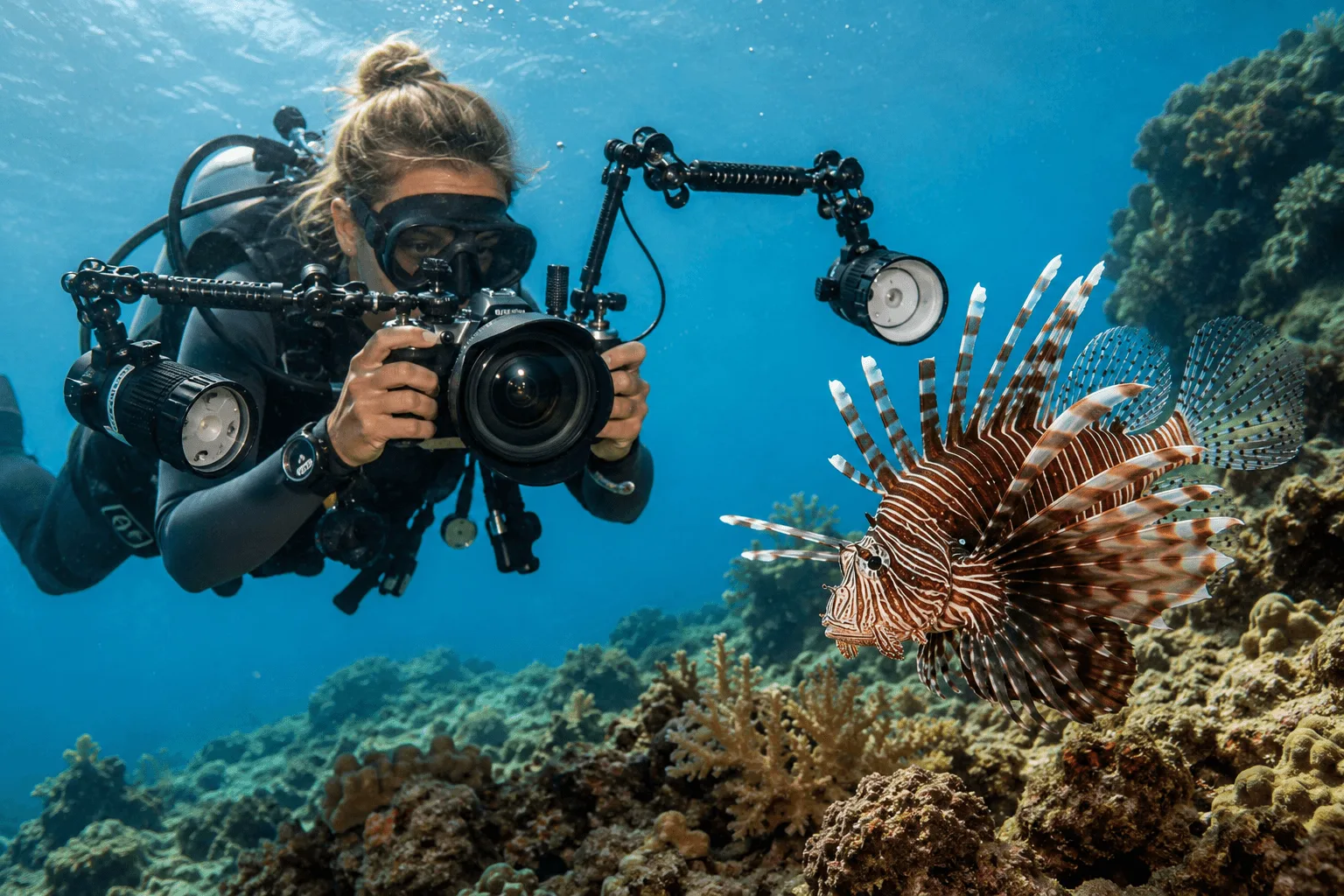
Cozumel, Quintana Roo – Quintana Roo tourism officials have opened discussions with federal customs authorities following complaints that visiting divers are being charged import taxes on underwater cameras and other equipment brought into Cozumel for personal use.
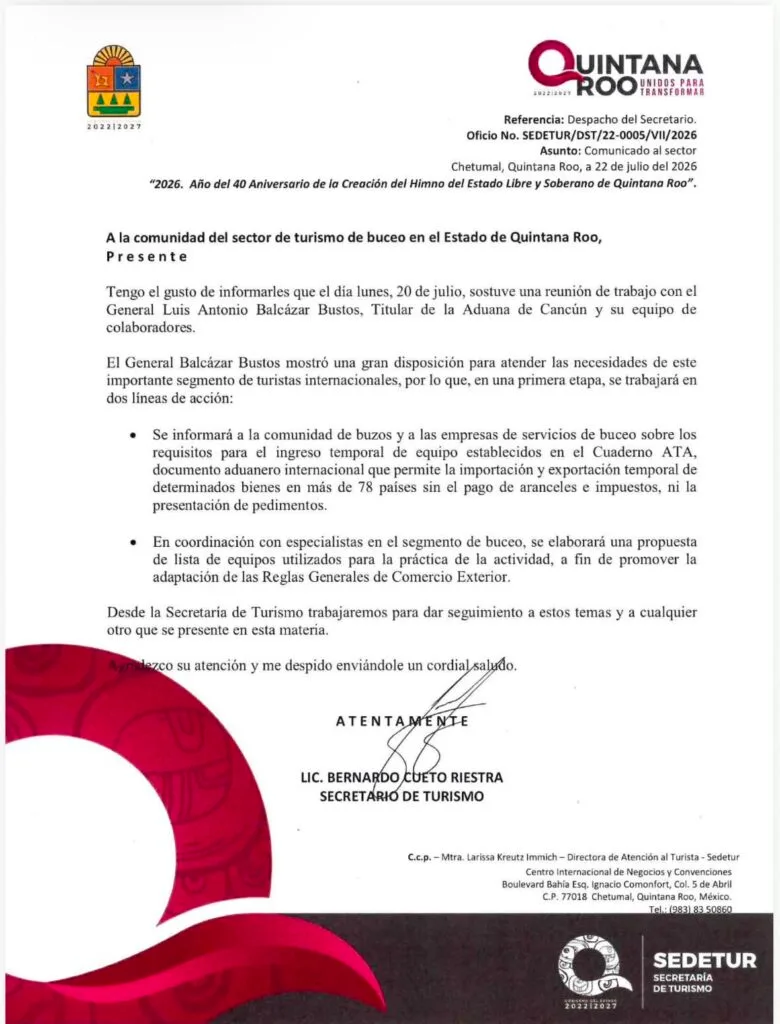
State Tourism Secretary Bernardo Cueto Riestra announced two initial courses of action after meeting July 20 with General Luis Antonio Balcázar Bustos, head of the Cancún Customs Office, and members of his staff.
According to a letter addressed to Quintana Roo’s diving tourism community, authorities will first provide divers and dive operators with information about using an ATA Carnet to temporarily bring eligible equipment into Mexico. The state will also work with diving specialists to develop a formal list of commonly used equipment and seek changes to Mexico’s General Foreign Trade Rules.
The talks follow a widely shared complaint from underwater photographer Jennifer Lynn Belger, who said she was required to pay 6,641 pesos, nearly $400 USD, after arriving at Cozumel International Airport on July 7 with a camera, underwater housing, lenses and lighting equipment.
Belger said the equipment was for her personal use and would leave Mexico with her at the end of the trip. Customs personnel reportedly classified part of the system as merchandise exceeding her personal baggage allowance and applied Mexico’s standard 19 percent passenger import rate.
She also presented documentation showing that Mexican customs had previously assessed the same underwater housing and lighting equipment during a 2024 trip. According to her account, officials still required a new payment.
Belger later returned to the airport with her receipt, flight information, equipment and a customs brochure listing cameras and photographic accessories among the articles permitted as personal baggage. She said she was unable to obtain a refund or a practical way to appeal the assessment before leaving Mexico.
Her original account, published through Scuba Chick and shared in the Diving Cozumel Facebook group, quickly attracted attention among divers, underwater photographers and local tourism businesses. The post received tens of thousands of views and hundreds of comments.
The dispute centers on how Mexico’s passenger baggage rules are applied to modern underwater photography systems.
The National Customs Agency of Mexico allows international passengers to bring two photographic or video cameras, photographic material and their accessories without paying import taxes. Travelers may also carry two sets of personal sporting equipment, provided the items can be transported normally by the passenger. These allowances apply to new or used articles included in a traveler’s personal baggage. ANAM’s current baggage guidance does not specifically identify scuba regulators, buoyancy compensators, dive computers, underwater housings, strobes or lighting arms.
That lack of detail can create different interpretations at inspection points. A camera may clearly qualify as personal baggage, while a large underwater housing, multiple strobes and specialized lenses can be treated as professional equipment or separate merchandise, particularly when the combined system is worth several thousand dollars.
Travelers may bring an additional $500 USD in merchandise beyond their personal baggage allowance without paying duties. When eligible undeclared merchandise exceeds that allowance, customs permits passengers to pay a flat 19 percent rate, provided the value does not exceed $3,000 USD. Customs personnel may determine the value when a traveler cannot provide an invoice or other proof of purchase. ANAM explains that the tax applies to merchandise outside the recognized personal baggage list, not automatically to every high-value personal possession.
Underwater photographers have reported similar problems at other Mexican resort airports. Dive travel companies have warned clients that camera housings are sometimes treated differently from the cameras they protect because housings are not expressly named in the federal baggage rules. The resulting decision can depend on how an individual officer classifies the complete system.
Quintana Roo’s proposed equipment list is intended to reduce that uncertainty. If incorporated into the General Foreign Trade Rules, it could identify the components normally carried by recreational and professional divers and clarify which pieces qualify as personal sporting or photographic equipment.
The second option under discussion is the ATA Carnet, an international customs document sometimes described as a passport for goods. It allows qualifying professional equipment, commercial samples and exhibition materials to enter participating countries temporarily without the usual import taxes or customs declarations, provided the equipment leaves again within the authorized period.
Mexico’s customs agency says ATA Carnets can be used for professional equipment, including material connected to the press, film production, technical installations and sporting events. They do not eliminate non-tariff restrictions that may apply to particular goods. ANAM’s ATA guidance states that eligible equipment can generally remain in Mexico for up to six months.
Carnets are more commonly used by professional photographers, film crews and businesses than by vacationing recreational divers. They must be obtained before travel and include a detailed inventory of the equipment. Mexico also requires foreign carnet holders to preregister at least seven days before arrival and pay a registration fee, according to a May 2026 advisory issued to U.S. carnet users.
The carnet system therefore offers a route for travelers carrying expensive professional equipment, but it does not by itself settle whether an ordinary diver should need one for a personal camera, housing and scuba kit.
The broader proposal to amend the federal baggage rules may be more relevant to recreational visitors. It could give customs officers, tourists and dive businesses the same written definition of standard dive equipment, reducing disputes at the airport.
Cozumel’s economy is closely tied to diving. Visitors arriving with their own equipment spend money on hotels, boat dives, marine park fees, restaurants and ground transportation, while underwater photographers often stay for several days and make repeated visits. Local operators are concerned that unpredictable customs charges could persuade those travelers to fly through another Mexican airport or choose a different dive destination.
For now, the customs rules have not changed, and the state’s letter does not announce refunds or a new exemption. No timetable has been given for the proposed equipment list or possible amendments to the General Foreign Trade Rules.
Divers traveling to Cozumel with expensive camera systems should carry an itemized inventory, serial numbers, purchase receipts and evidence that the equipment is used and intended to leave Mexico with them. Professional photographers carrying extensive systems may also need to examine ATA Carnet requirements before departure.
The state Tourism Secretariat said it will continue following the issue with customs authorities and the diving industry. The next test will be whether those discussions produce a written national rule that clearly distinguishes a visiting diver’s personal equipment from goods being imported for sale.
More Government
- Playa del Carmen Taps HR Directors to Boost Local Hiring
- Moderna COVID-19 Vaccine to Be Offered to Children in Cancún
- Trump Escalates Pressure on Mexico, Demands Action Against Cartel-Allied Officials
- Alleged Owner of Cancún Home Rented by Puerto Morelos Mayor Linked to Ultramar Fraud Case
- Paraguayan Tourists Challenge Asur Over $30 Exit Fee at Cancún Airport
More Cozumel
- Cozumel Hosts First Pueblos Mágicos Triathlon as Evelyn Rejón and Flavio Morandini Win
- Quintana Roo Names Winners of 2026 State Craft and Embroidery Prizes
- Cruise Tourism Trust Fund Spends 1.27 Billion Pesos Across Quintana Roo
- CFE and Playa del Carmen to Review Plan for Submarine Power Line to Cozumel
- Cozumel’s Museum of the Island Opens Exhibition by Architect José Manuel Sáenz ‘Txepo’