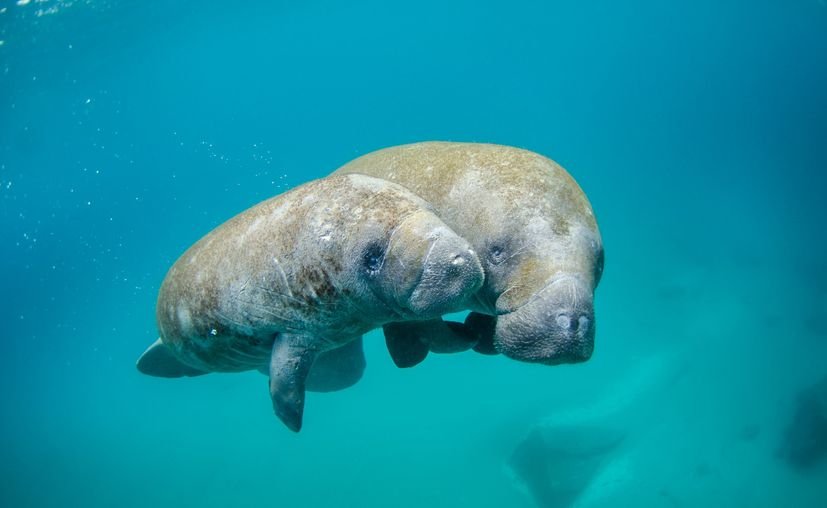
Othón P. Blanco, Quintana Roo — Quintana Roo is one of Mexico’s most important refuges for the Antillean manatee, an endangered species whose population along the state’s coastline is estimated at up to 250 individuals, according to research by El Colegio de la Frontera Sur (Ecosur).
The species (Trichechus manatus manatus) lives mainly in bays, lagoons, rivers and wetlands, where it finds the calm, shallow water it needs to feed on aquatic vegetation. In Quintana Roo, Chetumal Bay and the Hondo River stand out as the most important areas for the animal’s presence and movement.
Ecosur researchers counted 150 manatees during an aerial survey of the state’s coast, though the true population is likely larger because such monitoring flights can only record animals that are visible from the air. Benjamín Morales Vela, a researcher at the institution, said the figure of up to 250 is an estimate of the population living in state waters.
The gap between the number observed and the estimate also reflects how much the species moves. According to the National Commission of Natural Protected Areas (Conanp), manatees can travel long distances in search of food, shelter and suitable breeding sites, with some individuals moving between Quintana Roo and Belize.
Chetumal Bay, a Key Habitat
Chetumal Bay is one of the most important sites for manatee conservation in the Mexican Caribbean. Its mangroves, wetlands, lagoons and waterways provide feeding, shelter, breeding and transit areas for the animals.
Because of its environmental value, the Manatee Sanctuary-Bahía de Chetumal was decreed in 1996 to protect both the species and the ecosystems it depends on. The area forms part of an environmental system connected to waterways in northern Belize.
The presence of manatees in these ecosystems is tied to the availability of aquatic vegetation and the condition of the waterways. Changes to mangroves, wetlands, lagoons and coastal areas can therefore damage the sites the animals use to feed and move.
A Species That Reproduces Slowly
One of the main obstacles to rebuilding the population is its low reproductive rate. Females have a gestation period of roughly 12 to 15 months and generally give birth to a single calf.
That slow pace means the loss of individuals — particularly adults — can have a significant impact on the population, since numbers do not recover quickly.
Human Threats
Natural conditions are compounded by threats caused by human activity. The main ones are collisions with boats, accidental capture in fishing gear, habitat degradation and loss, and contamination of waterways.
These risks are especially relevant in Quintana Roo because of the tourism, fishing, urban development and navigation that take place along the coast. The same areas manatees use to feed, breed and travel are also the focus of intense human activity.
Listed as Endangered
In Mexico, the Antillean manatee is classified as an endangered species under the NOM-059-SEMARNAT standard, according to Conanp.
Conservation efforts include monitoring populations, scientific research, protecting natural areas, rehabilitating individual animals and environmental education.
The 12th State Manatee Week is again drawing attention to the species and to the Quintana Roo ecosystems where it can still be found. Specialists say knowing how many individuals exist, where they travel and the condition of their habitat is essential to setting protection measures and reducing the risks the population faces.
More Environment
- Sargassum Leaves 60 Boats Damaged and Millions in Losses in Playa del Carmen
- Bird Populations Decline in Quintana Roo’s Maya Zone, Academics Warn
- Deer Trapped in Playacar Fence Rescued After Social Media Reports
- Tulum Beaches Recover as Sargassum Arrivals Ease, Cleanup Work Continues
- First Monarch Butterfly of the Season Sighted at Cozumel’s Kuzá Park
More Chetumal
- Quintana Roo Prosecutors Confirm Traffic Officer Killed His Ex-Partner and Teenage Daughter Before Taking His Own Life
- Quintana Roo Governor Invites Families to First Janal Pixán Festival in Calderitas
- Chetumal Traffic Officer Shoots Two Dead, Then Kills Himself
- Santa Fe Klan Plays Nearly Four Hours at Expofer 2026 in Chetumal
- Expofer Opens in Chetumal: 150 Police, No Incidents on Night One