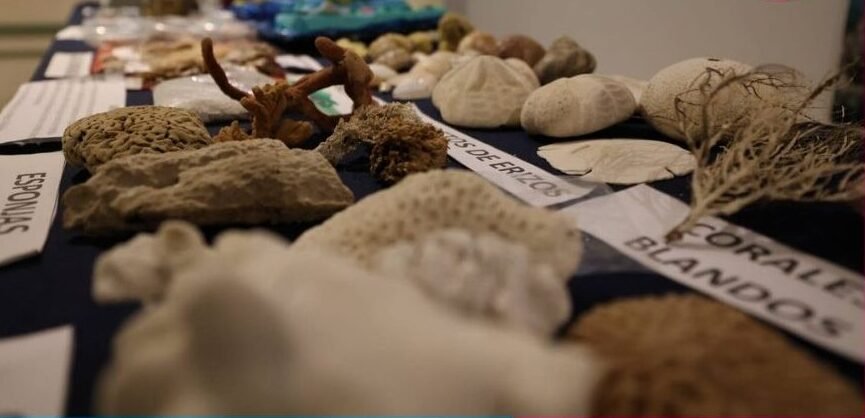
Puerto Morelos, Quintana Roo — Mayor Blanca Merari Tziu Muñoz inaugurated an exhibition and lecture series marking the 50th anniversary of the Academic Unit of Reef Systems (UASA), part of the UNAM Institute of Marine Sciences and Limnology, at the Cultural Center and Museum of Puerto Morelos.
The event coincides with the 10th anniversary of Puerto Morelos as a municipality. Merari praised UASA’s contributions, calling the institution a source of pride for the community and noting that Puerto Morelos has become a hub for researchers working alongside the local government.
UASA conducts ongoing research, defense, and conservation of the Mesoamerican Barrier Reef System, the second-largest reef in the world. “That reef, which has so often defended us against the onslaughts of nature, deserves reciprocity — caring for it, loving it, and protecting it,” Merari said. “That is exactly what this exhibition does: show a little of what the Academic Unit of Reef Systems has been doing for 50 years here in Puerto Morelos.”
Dr. Juan Pablo Carricart-Ganivet, head of UASA, explained that the unit conducts scientific research from the molecular to the geological level on the reefs of Puerto Morelos. The unit currently has 14 research laboratories and three service laboratories, staffed by 15 researchers, 11 academic technicians, administrative personnel, and support workers, along with 40 undergraduate, master’s, and doctoral students, and postdoctoral researchers.
“The institute’s first research was carried out in the late 1970s at the then Puerto Morelos station and has continued over five decades,” Carricart-Ganivet said. “These scientific studies have been fundamental for environmental decision-making, such as the decree creating the Puerto Morelos Reef National Park.”
He also acknowledged the coordination work of Fernando Negrete Soto and the support of students, researchers, and volunteers who helped organize the exhibition and academic activities.
César Santiago García, director of the Cultural Center and Museum of Puerto Morelos, welcomed attendees and thanked the scientific community and all participants for creating an exhibition that transcends the merely historical, thanks to the tireless work of the guardians of the Caribbean Sea.
The exhibition features a visual, historical, and scientific journey through UASA’s five-decade presence in the municipality, using photographs, documents, timelines, audiovisual materials, and digital resources to bring marine research and reef conservation in the Mexican Caribbean to the public.
Officials attending included First Councilor Rosario del Carmen Concha Naal, Second Councilor Reyes Antonio Chuc Pech, Environment Secretary Aimee Regina Rodríguez Vivas, and Culture Director Adriana Nava Gómez.
A series of lectures on marine conservation will be held from May 25 to 29 at the Cultural Center and Museum, covering topics such as the origin of UASA in Puerto Morelos, the current state of the Mexican Caribbean and the Puerto Morelos lagoon, UASA and the community, research on octopus development, and the future of the reef ecosystem and development in Puerto Morelos.
More Lifestyle
- Cancún Opens Registration for Janal Pixan 2026 Catrina and Altar Contests
- Brain-Eating Amoeba Found in Six Artificial Lakes in Mérida; Water Contact Restricted
- Cancún Launches 2026 Ocular Prosthetics Program With Free Evaluations
- Playa del Carmen Health Center in Villas del Sol to Close Two Days for Maintenance
- Tulum’s Mureco Museum Adds 53 Archaeological Pieces From Across Mesoamerica
More Puerto Morelos
- Quintana Roo Signs Deal for First Formal Sargassum Fishery, Involving Up to 840 Boats
- Puerto Morelos Plans Boat Procession, Altars and Contests for Mar de Almas
- Mexico’s Environment Agency Rejects Four Major Tourism Projects in Quintana Roo
- Semarnat Denies Environmental Permit for GL Dreams Subdivision in Puerto Morelos
- Quintana Roo Environment Agency Accepts Federal Ruling in Alux 33 Case