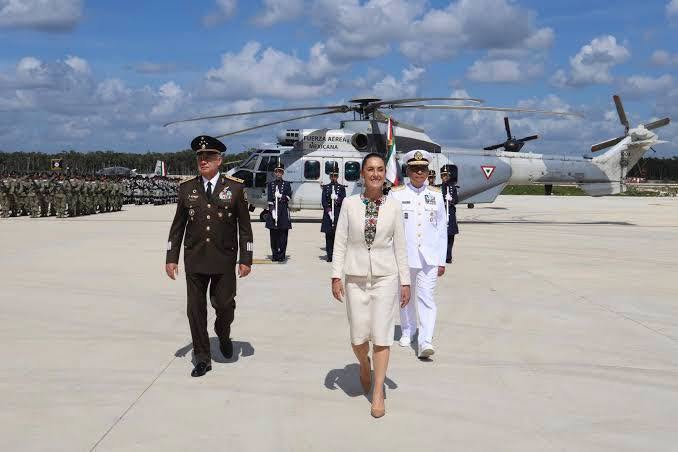
TULUM, Quintana Roo — President Claudia Sheinbaum is expected to return to Tulum this week for a working visit that could bring new announcements on public beach access and the federal government’s broader effort to revive a destination still struggling with the consequences of rapid growth, high prices and declining tourism.
The visit, reportedly planned for Thursday and Friday, July 16 and 17, comes eight months after the federal government unveiled Tulum Renace: Más Justo, Seguro y Sostenible, an ambitious package of 128 actions intended to address many of the problems that have damaged the destination’s image and economy.
At the center of the strategy is an issue that has become particularly important to residents and visitors: free public access to Tulum’s beaches.
The official presidential agenda for the visit had not yet been fully released at the time of writing, so the precise announcements and events remain subject to confirmation. But expectations are high among business owners, tourism operators and residents who want to see concrete progress on a recovery plan first announced in November 2025.
A Destination Trying to Recover From a Difficult Period
Tulum’s tourism troubles did not emerge overnight.
By September 2025, hotel occupancy had fallen to 49.2 percent, compared with 66.7 percent during the same month a year earlier, according to Quintana Roo tourism figures cited by reliable sources. Businesses reported quieter streets, restaurant closures and fewer international visitors, while complaints about high prices, taxi fares, beach restrictions and the cost of visiting attractions circulated widely on social media.
The situation was complicated further by unusually heavy sargassum arrivals, environmental pressures and frustration over access to beaches around the Jaguar National Park and hotel zone.
Beach access became one of the most politically sensitive parts of the crisis. Although Mexican beaches are public property, reaching them can be difficult when the surrounding land is controlled by hotels, private developments or protected areas with regulated entrances. In Tulum, residents and visitors repeatedly complained that accessing certain beaches involved entry fees, complicated rules or the expectation of spending money at a hotel or restaurant.
Sheinbaum publicly stated in October 2025 that access to beaches could not be limited based on a person’s ability to pay.
Tulum Renace: 128 Actions Across Four Areas
The federal government formally presented Tulum Renace on November 14, 2025. The plan brings together 15 federal agencies along with the Quintana Roo state government and the Tulum municipal government and is organized around four broad areas:
- Orderly regulation of tourist attractions.
- Responsible urban and environmental management.
- Tourism development and promotion.
- Improvements to public infrastructure and facilities.
The 128 actions include measures related to prices, tourism promotion, public spaces, urban planning, environmental management and infrastructure. The program was presented not simply as an advertising campaign but as an attempt to address structural problems that had become increasingly difficult to ignore.
Among them were complaints about inflated prices, fragmented transportation, unmanaged urban expansion, limited public access to the coast and the perception that Tulum had become increasingly expensive and exclusionary.
Beach Access Was One of the First Major Announcements
When Tulum Renace was unveiled, federal Tourism Secretary Josefina Rodríguez Zamora announced several measures intended to make the coast more accessible. The government said the traditional entrance and southern entrance to Jaguar Park would allow residents and visitors to reach four beaches within the park throughout the year. Two additional public accesses were also announced in the hotel zone: Playa Conchitas at kilometer 4.5 and Playa del Pueblo at kilometer 5.5.
Those steps followed months of controversy. Earlier in 2025, Tulum Mayor Diego Castañón publicly accused the state-owned Grupo Mundo Maya, which manages Jaguar Park, of failing to honor an agreement allowing free beach access for accredited local residents. Grupo Mundo Maya maintained that it was respecting the arrangement.
The federal government later intervened, and by November officials said access had been restored and expanded. The question now is whether Sheinbaum’s latest visit will produce further openings, improvements to existing access points or additional measures to make reaching the beach easier in practice.
The Problem Is Bigger Than Beach Access
For many local businesses, beach access is only one part of a much larger challenge. Tulum’s explosive growth brought investment, international attention and thousands of new hotel rooms and vacation rentals. It also brought traffic, infrastructure shortages, environmental pressure, high rents and increasingly expensive tourism services.
The destination’s downturn in 2025 exposed how vulnerable that model could be. Some businesses reported dramatic declines in sales, while empty restaurants and quieter hotel zones became increasingly visible. The complaints were not simply that fewer tourists were coming, but that Tulum had become too expensive and difficult for many travelers, particularly domestic visitors, to enjoy.
The federal response through Tulum Renace has therefore included more than opening paths to the sea. Authorities have proposed updating urban-development programs, strengthening environmental planning, creating new tourism routes and products, improving infrastructure and promoting the destination under a new image of being more accessible, orderly and sustainable.
What Residents and Businesses Will Be Watching
The visit comes at a sensitive moment because Tulum has heard promises of better planning before. For business owners, the most immediate concerns include bringing visitors back, improving access to attractions, controlling excessive costs and restoring confidence in the destination.
For residents, the list is broader: beaches that can genuinely be reached without paying for a meal or hotel stay, adequate roads and public services, environmental protection and a tourism model that does not leave local people priced out of their own community.
And for environmentalists, any attempt to reactivate tourism will inevitably raise questions about whether more promotion and investment can be reconciled with the enormous development pressure already facing Tulum’s forests, cenotes, underground water system and coastline.
The federal government’s own Tulum Renace plan acknowledges that the answer cannot simply be more tourism at any cost. Its stated objective is to make the destination fairer, safer and more sustainable.
The Real Test Comes After the Announcements
Sheinbaum’s visit is likely to attract considerable attention, particularly if it includes new measures on public beaches. But the larger test will be what happens after the presidential motorcade leaves.
Tulum’s problems were created over years of extraordinary growth, and they will not be solved by a single visit or one new access path to the beach. The success of Tulum Renace will ultimately depend on whether its 128 promised actions translate into visible improvements for residents, businesses and visitors.
For a destination whose international reputation was built on white sand, turquoise water and a sense of escape, that may begin with something very basic: making sure people can actually get to the beach.
More Politics
- Mexico Deputies Approve 2027 Federal Law of Rights
- Lawmakers Seek to Make Mexican Sign Language Mandatory in Quintana Roo Schools
- Brother-in-Law of Lázaro Cárdenas Mayor Elected to Lead Holbox Ejido
- Estefanía Mercado Files to Seek Morena’s Municipal Coordination in Playa del Carmen
- Electoral Institute of Quintana Roo Opens 152 Jobs Paying Up to 23,000 Pesos a Month
More Tulum
- Tulum’s Mureco Museum Adds 53 Archaeological Pieces From Across Mesoamerica
- Tulum Fishing Cooperative Seeks Funding to Modernize Its Facilities
- 23 Tulum Police Officers Complete Initial Training Course
- Tulum-Miami Flights to End as American Airlines Adjusts Routes
- Uber Opens Driver Registration in Playa del Carmen and Tulum for Taxi and Motorcycle Services