PLAYA DEL CARMEN, Quintana Roo — Sharks have spent decades being cast as the villains of the ocean. A free public talk in Playa del Carmen this weekend will try to set the record straight.
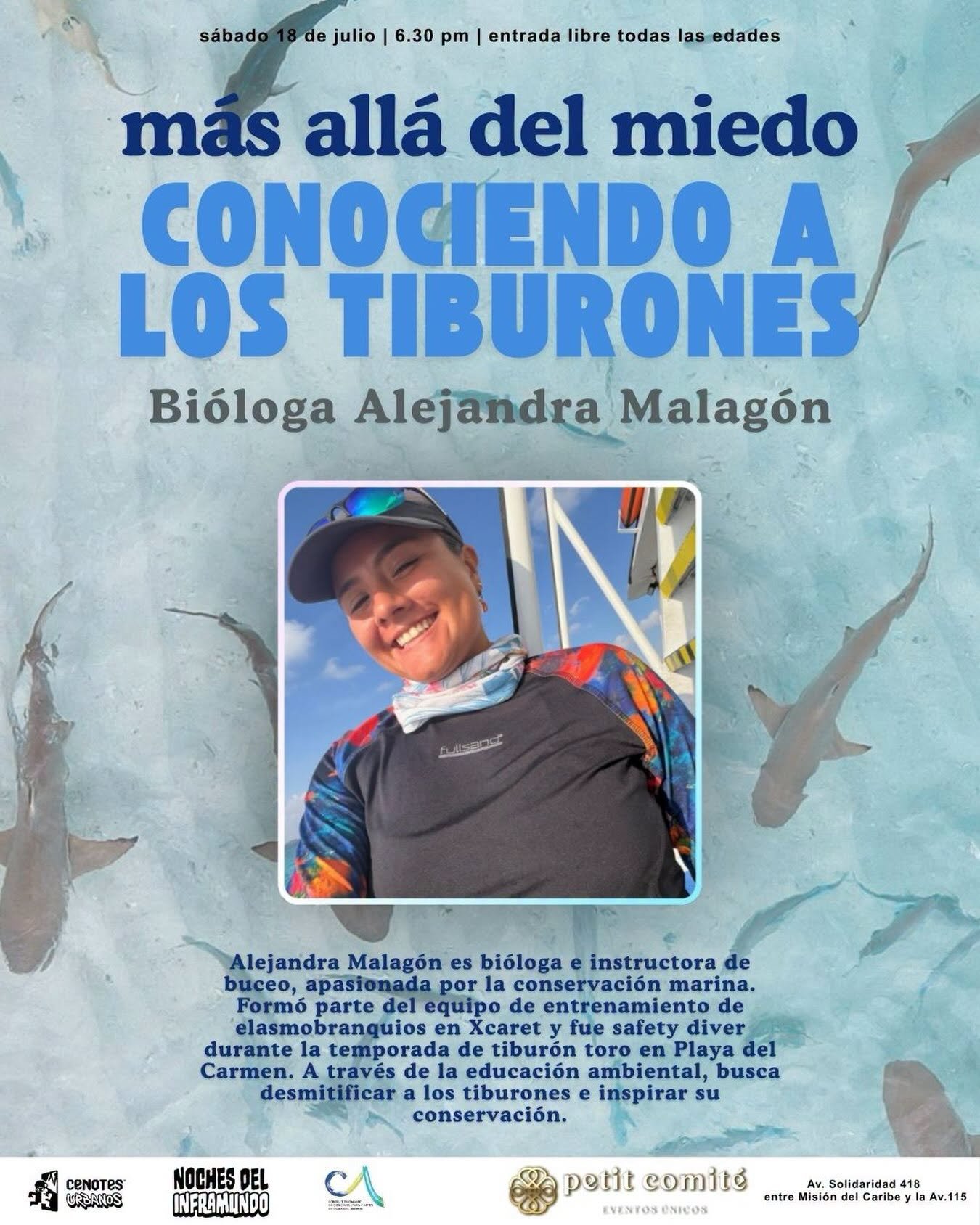
Cenotes Urbanos will host a new edition of its Noches del Inframundo environmental talk series on Saturday, July 18, at 6:30 p.m., with biologist and dive instructor Alejandra Malagón leading a discussion on shark biology, conservation and the often exaggerated fears surrounding one of the ocean’s most misunderstood predators. Admission is free, and the event is open to all ages.
Malagón brings practical experience to the subject. According to organizers, she previously worked with the elasmobranch training team at Xcaret and served as a safety diver during Playa del Carmen’s bull shark season, giving her firsthand experience with animals that frequently generate both fascination and controversy in the Riviera Maya.
The evening will cover shark physiology, the diversity of shark species, their role in maintaining marine ecosystems, the main threats they face and responsible ways to observe them in the wild. Malagón will also discuss conservation efforts and practical ways individuals can contribute to shark protection.
Sharks Are Far More Diverse Than Most People Realize
Sharks belong to a group of cartilaginous fishes known as elasmobranchs, which also includes rays and skates. Rather than being a single type of large predator, sharks include hundreds of species ranging from small bottom-dwellers to the enormous whale shark.
Their ecological roles also vary considerably. Some are apex predators, while others feed lower in the food chain. Large predatory sharks can help regulate prey populations and influence the behavior and distribution of other marine animals, contributing to the balance of reef and open-ocean ecosystems.
That makes shark conservation particularly relevant in Quintana Roo, where the Mexican Caribbean is home to several species and where shark tourism has become an important part of the local marine economy.
Playa del Carmen is especially known for its seasonal aggregation of female bull sharks, which arrive in local waters during the winter months. Divers travel from around the world for the opportunity to observe them, creating a direct link between shark conservation and tourism.
Fear Versus Reality
The event’s central question, “Are sharks really the villains of the ocean?”, addresses one of the most persistent problems facing shark conservation.
Popular culture has long portrayed sharks as indiscriminate man-eaters, but serious attacks on humans are rare compared with the enormous number of interactions that occur without incident. The larger conservation concern runs in the opposite direction: sharks face intense pressure from targeted fishing, accidental capture as bycatch, habitat degradation and the international trade in fins and other shark products.
Malagón’s presentation will focus on replacing fear with understanding, something organizers say is essential if the public is to support meaningful protection measures.
Part of the Noches del Inframundo Series
The event is organized by Cenotes Urbanos, a Playa del Carmen-based volunteer organization focused on cave exploration, science, citizen participation and conservation of the underground ecosystems of the Yucatán Peninsula.
Its Noches del Inframundo series was created as a free, open and informal space where members of the public can learn about nature and conservation. Previous talks have covered subjects ranging from cave exploration and beekeeping to wildlife photography, international volunteering and the dangers hidden within cave systems.
The series reflects Cenotes Urbanos’ broader approach to conservation through public education and community involvement. The organization has also carried out more than 130 cave cleanups and developed environmental programs for children and teenagers.
Event Details
The shark talk takes place Saturday, July 18, at 6:30 p.m. at the Petit Comité – Salón de Eventos in Playa del Carmen. Admission is free, and all ages are welcome. The location is available through the map link published by Cenotes Urbanos with the event announcement.
For a destination where bull sharks, whale sharks, reefs and marine tourism are part of everyday conversation, the subject is particularly close to home.
The evening’s message is a simple one: sharks are not merely animals to fear or photograph. They are part of the ecological machinery that helps keep oceans functioning, and protecting them ultimately means protecting the marine ecosystems on which coastal communities, fisheries and tourism all depend.
More Environment
- Maya Frog and Toad Shell Pendants May Reveal Ancient Trade Routes
- Heavy Rains to Soak Quintana Roo as Unstable Weather Moves In
- Brain-Eating Amoeba Found in Six Artificial Lakes in Mérida; Water Contact Restricted
- Semarnat Approves Artificial Reefs and Sand Relocation for Akumal Hotel
- Chetumal Plans 836 Million Pesos in Stormwater Works to Curb Flooding
More Playa del Carmen
- Playa del Carmen Health Center in Villas del Sol to Close Two Days for Maintenance
- Mara Lezama Delivers 288 Infonavit Homes in Puerto Aventuras as Quintana Roo Targets 76,000
- Playa del Carmen Bars New Developments Without Electrical Investment, Mayor Says
- Student Hospitalized After Alleged Drug Intoxication at Playa del Carmen Middle School
- Selvame MX Calls HAZUL Project With Artificial Beach a ‘Fantasy’ in Playa del Carmen