Mérida, Yucatán — Poultry companies Crío and Bachoco are facing escalating complaints from Maya communities in Yucatán over open-air manure dumping, water contamination, and farms built near schools and archaeological sites.
In January, the Federal Attorney for Environmental Protection (Profepa) expanded a criminal complaint against Crío after inspectors found the company had broken seals on a closure order and moved seized machinery at the pre-Hispanic site of Tzemé in the municipality of Kinchil. Seven months later, the Community Council of Kinchil, led by Federico May, said Crío was still dumping bird manure in the open in the same western area. The company also built a six-shed farm less than 600 meters from the protected zone and opened a new dump in June on six hectares of recently cleared jungle.
The Tzemé case illustrates a pattern that community groups say has continued for more than two years: sanctions against Crío and Bachoco have not stopped deforestation or the illegal dumping of poultry waste on Maya territory.
Tzemé: A History of Broken Seals and Missing Machinery
The case began in November 2025, when Profepa inspected Tzemé, a pre-Hispanic settlement listed by the National Institute of Anthropology and History (INAH), and confirmed unauthorized land-use changes. Inspectors sealed machinery and ordered a halt to all work. INAH later said heavy equipment operated by Crío had caused partial, irreversible destruction of pre-Hispanic platforms and foundations, and issued an additional order to stop earth removal.
Despite those orders, the Community Council documented that Crío continued leveling the site between December and January, sometimes at night. After Profepa confirmed the violation on January 9, it moved to seize the machinery. In a later visit, one vehicle was found without its seals and relocated, and a backhoe had disappeared from the property. That handling of seized assets prompted the expanded criminal complaint to the Federal Prosecutor’s Office four days later.
The legal action did not halt the project. In the first half of 2026, Crío activated the six-shed farm next to Tzemé, and in late June local groups found a new manure dump on freshly cleared land. It is the company’s third identified dump near Kinchil, on top of two that have operated since 2024 on a property seven kilometers west of town. Those two installations have been under a definitive closure order since June 2024.
Bachoco’s Missing Permits and Old Deforestation
While Crío’s conflicts are concentrated around Kinchil, Bachoco has expanded its water use with little public transparency. According to the Public Registry of Water Rights, Bachoco holds 54 active concessions in Yucatán for more than eight million cubic meters of groundwater in 2026, placing it among the ten largest water users in the state.
Yet no environmental permits for Bachoco appear in the National Transparency Platform, the state Sustainable Development Secretariat, or the federal Environment Ministry (Semarnat), despite legal requirements to register projects that involve land-use change or ecosystem risk. Only one environmental impact statement was found, for a farm in the municipality of Peto.
The only recent sanction against Bachoco — a temporary closure of the Teya 5 and Teya 6 farms at Hacienda Teya in Kanasín, ordered on December 26, 2025 — was for 23 hectares of deforested jungle. Satellite imagery from Copernicus and Google Earth showed the clearing had occurred more than 40 years ago, when the property belonged to Avícola del Sureste, a company Bachoco absorbed in 2001. Profepa did not file a criminal complaint and called the closure reversible.
Inspectors have also not addressed at least eight clandestine dumps that community groups have reported since 2024 in Kinchil and Halachó. Profepa has closed only two of them in two years.
Hunucmá Residents Report Health Problems
In Hunucmá, Bachoco operates more than 20 farms inside or on the edge of the urban area. One facility with nearly 100,000 broiler chickens sits less than 50 meters from homes in the San Eduardo and Santo Domingo neighborhoods and between 600 and 800 meters from two schools — Nachi Cocom elementary and Federico Chopin kindergarten — attended by about 360 children.
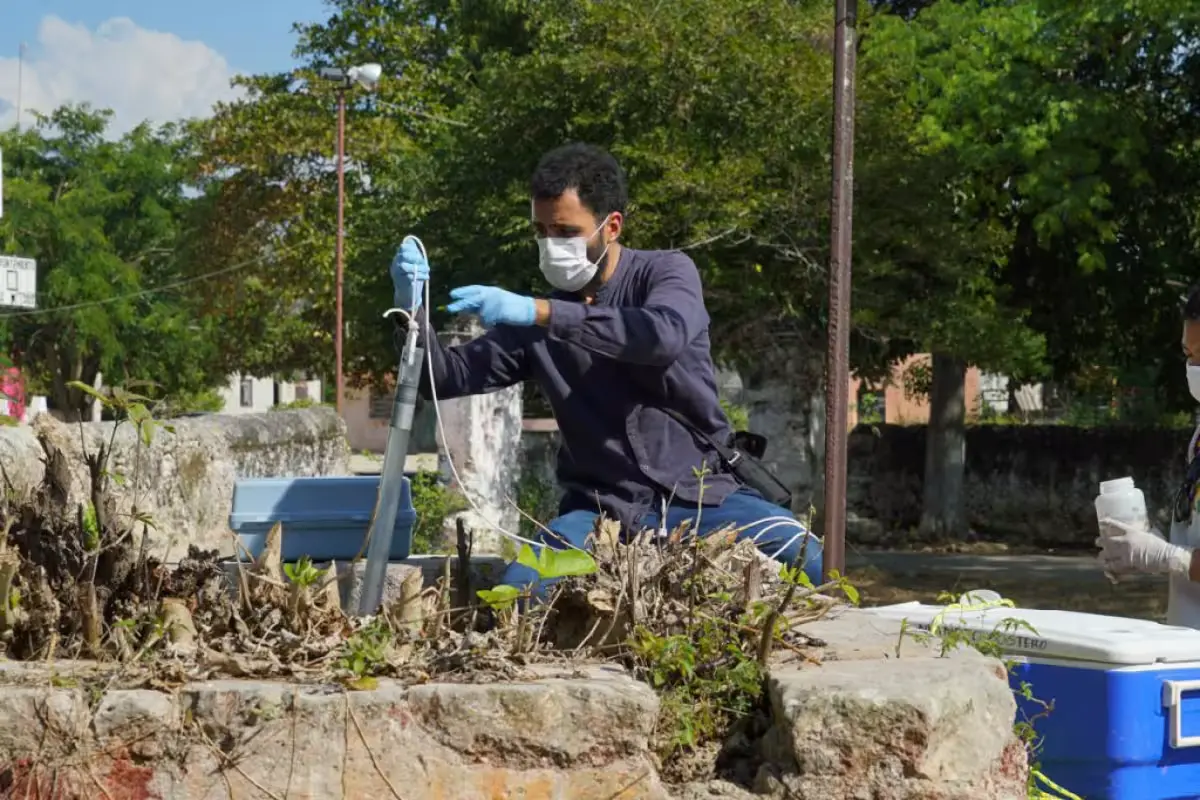
On April 7, 2026, organized residents filed a complaint with Profepa, Semarnat, and the National Water Commission (Conagua), backed by a year of community water sampling that found coliform bacteria in wells closest to the farm. Residents report gastrointestinal illnesses, skin allergies, and chronic respiratory problems among older adults, as well as the loss of beehives linked to flies from poultry waste. Two cenotes used for tourism are located less than 500 meters from the sheds.
The conflict also led to legal action against residents. Between 2022 and 2023, Bachoco filed criminal complaints against three residents of San Eduardo for alleged property damage after they removed drainage pipes the company had installed without permission on their land and opposed fences being built inside their yards. Those cases remain open, according to the community’s legal advisers.
Industry Dominance and Community Demands
Together, Crío and Bachoco control 60% of Mexico’s chicken market and maintain more than 90 active farms in 28 Yucatán municipalities. Their expansion comes as the state was ranked second in national growth for chicken production (4.6%) and egg production (3.6%) in December 2025, according to the federal Agriculture and Rural Development Secretariat.
For the Maya communities of Kinchil and Hunucmá, the cycle of unenforced closures and missing permits has become a single demand: that environmental sanctions stop being reversible paperwork and result in the actual shutdown of facilities that contaminate their air, water, and, in the case of Tzemé, their archaeological heritage.
More Environment
- Yucatán Peninsula Lost 285,580 Hectares of Jungle in 4 Years
- Quintana Roo Crews Clear 70,000 Liters of Water in Bacalar and Chetumal After Heavy Rains
- Yucatan Drafts Rules for Artificial Lakes After Worker Dies of Amoeba Infection
- Quintana Roo Wins SEMARNAT Approval to Restore 33.5 Km of Beaches
- Yucatán Monitors Low-Pressure System in Gulf of Mexico for Possible Cyclone