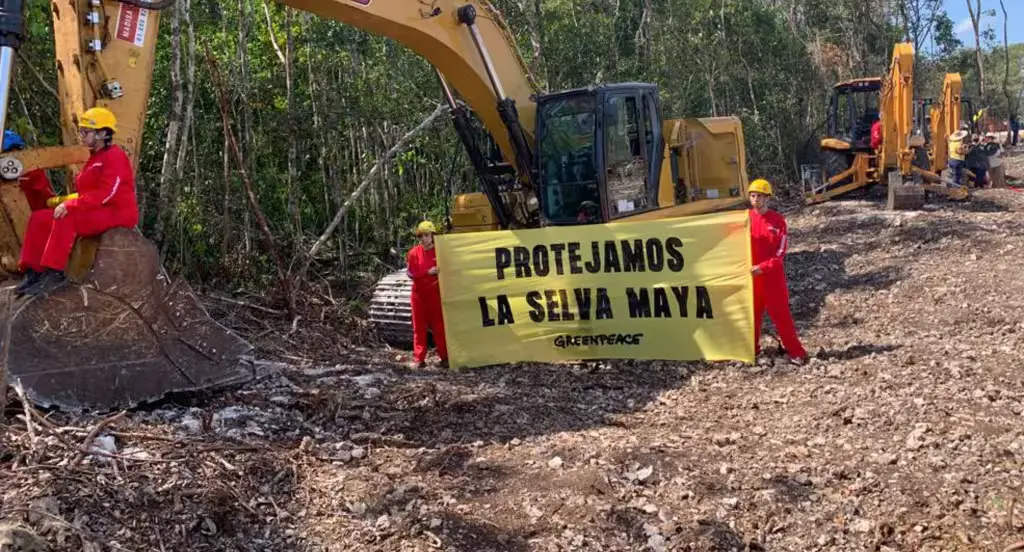
Mérida, Yucatán — The Yucatán Peninsula lost 285,580 hectares of jungle between 2019 and 2023, according to a federal government document that, for the first time, put an official figure on a crisis environmental groups had been warning about for years.
The figure — an average of 196 hectares cleared every day over those four years — appears in the Institutional Program 2026-2030 of the Center for Scientific Research of Yucatán (CICY), published April 29 in the Diario Oficial de la Federación, Mexico’s official gazette. Yucatán accounted for 110,076 hectares of that total, or 75 hectares a day, with Campeche and Quintana Roo making up the rest.
The number alone says little, ecologists argue. The Selva Maya, the second-largest tropical forest mass in the Americas after the Amazon, is not just a tally of hectares: it is habitat for animals with nowhere left to cross, a carbon store releasing millions of tonnes into the atmosphere, and a rainfall engine that refills the only freshwater system the region has.
The Jaguar’s Vanishing Corridors
The peninsula holds Mexico’s largest jaguar population outside continuous protected areas and contains 37 percent of the critical biological corridors identified nationally for the species, according to the National Alliance for Jaguar Conservation. One of the most important is the Balam Beh corridor in Campeche, created to link protected areas that highways, farms and tourism developments have gradually cut off from one another.
A spatial ecology study published in 2022 in the journal Animal Biodiversity and Conservation, based on jaguars tracked by satellite telemetry between 2013 and 2015, found the species needs between 100 and 172 square kilometers of continuous territory depending on the season, and prefers to move through jungle or secondary vegetation rather than disturbed land.
When that territory breaks into isolated patches divided by pasture, plantations or roads, jaguars are forced onto highways. Conservation groups have documented fatal collisions with vehicles along stretches where jungle was cleared for roads and the Tren Maya rail line, with cubs and pregnant females among the recorded victims in recent years.
“Jaguars don’t cross roads; roads cross their territory,” one specialist in the species’ conservation on the peninsula said.
The loss of connectivity does not affect jaguars alone. The same habitat supports prey such as deer and peccaries, along with birds and pollinators that depend on a continuous forest canopy. When the jungle shrinks to scattered fragments, the entire chain that relies on it — including the beekeeping operations of Yucatán communities — loses the native vegetation it needs.
Millions of Tonnes of Carbon
The Selva Maya is one of Mexico’s main carbon reservoirs. Land-use change across the three peninsula states is estimated to release between 4 million and 8 million tonnes of carbon dioxide equivalent each year, according to estimates cited by forestry specialists and reported in national media — comparable to the annual emissions of hundreds of thousands of cars on the road.
CICY itself calculated in a separate technical study of the Tren Maya route that the project removed 470,750 tonnes of carbon stored in vegetation along its path. That calculation, made with a forest carbon density map, illustrates the kind of exercise the center’s own institutional program should apply systematically to all forest loss on the peninsula — but which it does not currently include as a monitoring indicator.
Less Jungle, Less Rain, Less Water
The third effect is the hardest to see. Unlike other regions, the peninsula has no surface rivers; all of its fresh water depends on rain filtering through porous limestone bedrock.
Researchers at CICY and the Autonomous University of Yucatán have explained that recharge of that system depends on rainfall, and rainfall depends on the existence of large stretches of jungle. Vegetation captures moisture, releases it through evapotranspiration and helps sustain the regional precipitation cycle — a service that isolated patches of trees cannot replace, they say.
That is a separate problem from the contamination of the aquifer by agricultural runoff and agrochemicals, which this news organization has documented in cenotes along the Anillo de Cenotes. Here the issue is not dirty water but less of it: every hectare of jungle converted to pasture or plantation reduces, over the medium term, the rainfall available to refill the water table that supplies drinking water to Mérida and much of the state.
Recognition Without Protection
The CICY program acknowledges the scale of forest loss and sets agroforestry and ecological restoration research as a priority through 2030. But its own indicators do not directly measure hectares restored, corridors reconnected or tonnes of carbon recovered; they only raise the share of collaborative projects tied to climate mitigation and food security from 69 percent to 75 percent.
Meanwhile, deforestation continues. Recent estimates suggest Quintana Roo alone could lose around 15,000 more hectares of jungle in 2026, and environmental groups have documented more than 140,000 hectares lost across the peninsula in a single recent year — nearly half of all deforestation recorded in Mexico during that period.
Specialists in wildlife, carbon and the water cycle agree that official recognition of the crisis is a first step. What remains missing is a territorial goal capable of halting, hectare by hectare, a loss that already threatens the jaguar, the regional climate and the water the peninsula drinks.
More Business
- Cancún Residents Call Protest Against Aguakan Over Unsafe Roadworks on Avenida Colegios
- Cancún Real Estate Fraud Suspect to Face Trial at Liberty After Judge Rejects Pretrial Detention
- Park Hyatt to Open in Riviera Maya on December 3 With 148 Rooms
- Aeroméxico Admits Hack Exposed Passenger Passport Data
- Gunmen Shoot Up BBVA Bank Branch in Puerto Aventuras, Quintana Roo
More Quintana Roo
- Tropical Wave 36 Floods Northern Quintana Roo, Hits Tourism
- Yucatán Monitors Low-Pressure System in Gulf of Mexico for Possible Cyclone
- Cancún Airport Flight Operations Rise 4.4% at Start of October
- Canadian Tourism to Quintana Roo Grows Nearly 12% in 2026 as New Winter Routes Loom
- Quintana Roo Schools Shut Oct 30 Creating a Four Day Weekend