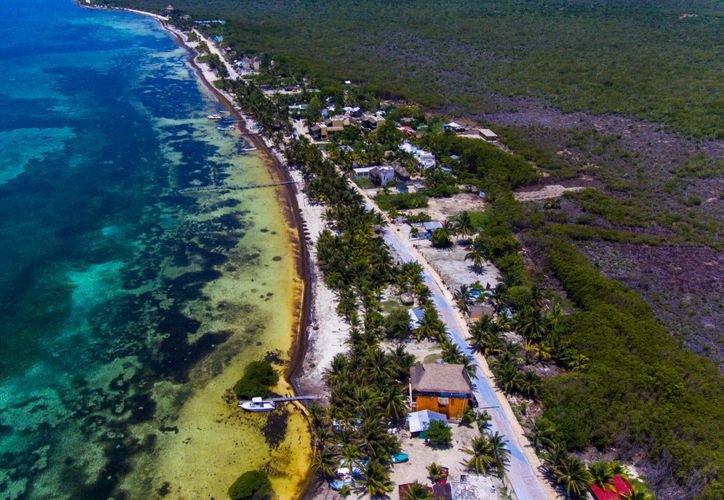
Mahahual, Quintana Roo — The beaches of Costa Maya are fighting a new enemy hidden among the sargasso: a plastic tide of 100 to 300 kilograms collected during each cleanup shift.
According to environmental monitoring led by Ana del Pilar Antillanca Oliva, activist and co-founder of the collective “Menos Plástico es Fantástico Mahahual,” the arrival of sargasso has become a “double contamination” phenomenon. Each wave of macroalgae acts as a giant net that captures and deposits tons of international waste on turtle nests and coral reefs.
Data collected on the ground show that Mahahual has become an involuntary dump for the Atlantic. The waste is not local; ocean currents and gyres transport plastic debris from more than 40 nations, which ends up tangled in the sargasso that washes ashore in Quintana Roo.
During cleanups and sampling by the association, labels, bottles, and packaging from countries as diverse as South Africa, Indonesia, China, the United States, Colombia, Venezuela, and various Caribbean islands have been systematically documented.
“Cleaning sargasso with heavy machinery without first separating these plastics shreds the waste, irreversibly turning macroplastics into microplastics and poisoning the sand in the long term,” Antillanca said.
Sampling by the community collective reveals the true impact and composition of this “plastic sargasso.” Single-use plastics account for up to 60% of arrivals, predominantly PET bottles from global beverage corporations and foreign plastic caps. Another 20% consists of fishing gear, such as ghost nylon nets, worn lines from transatlantic vessels, and polyurethane buoys that physically destroy coastal ecosystems. Hundreds of EVA or PVC rubber sandals and flip-flops are also recovered each shift.
The volume is so massive that local residents have started circular economy initiatives to shred the footwear and turn it into handicrafts.
The urgency of the pilot project in Mahahual, led by the civil association, lies in the fact that during peak sargasso seasons, between 100 and 300 kilograms of pure plastic can be found embedded in the algae.
Antillanca warned that heavy machinery used for rapid sargasso removal is pulverizing these international plastics, sowing billions of invisible microplastics in the fine sand of Mahahual. This threatens to permanently destroy the success of sea turtle nesting and the health of the coral reef barrier.
More Environment
- Screwworm Cases Detected in Two Dogs and a Horse in Tulum
- Playa del Carmen Recognized as International Bull Shark Zone
- Five Zones in Playa del Carmen Lose Urban Jungle to Construction Boom
- Hurricane Isaias Strengthens to Category 3 as Heavy Rain Hits Quintana Roo
- Hurricane Isaías to Bring Rain and Heat to Cancún and Playa del Carmen This Weekend