Cancún, Quintana Roo — Two New York state lawmakers are urging Mexican authorities to enforce environmental laws after touring the Maya Train’s Section 5 route, where they say they witnessed destruction of jungle and pollution of underground rivers in the Yucatan Peninsula.
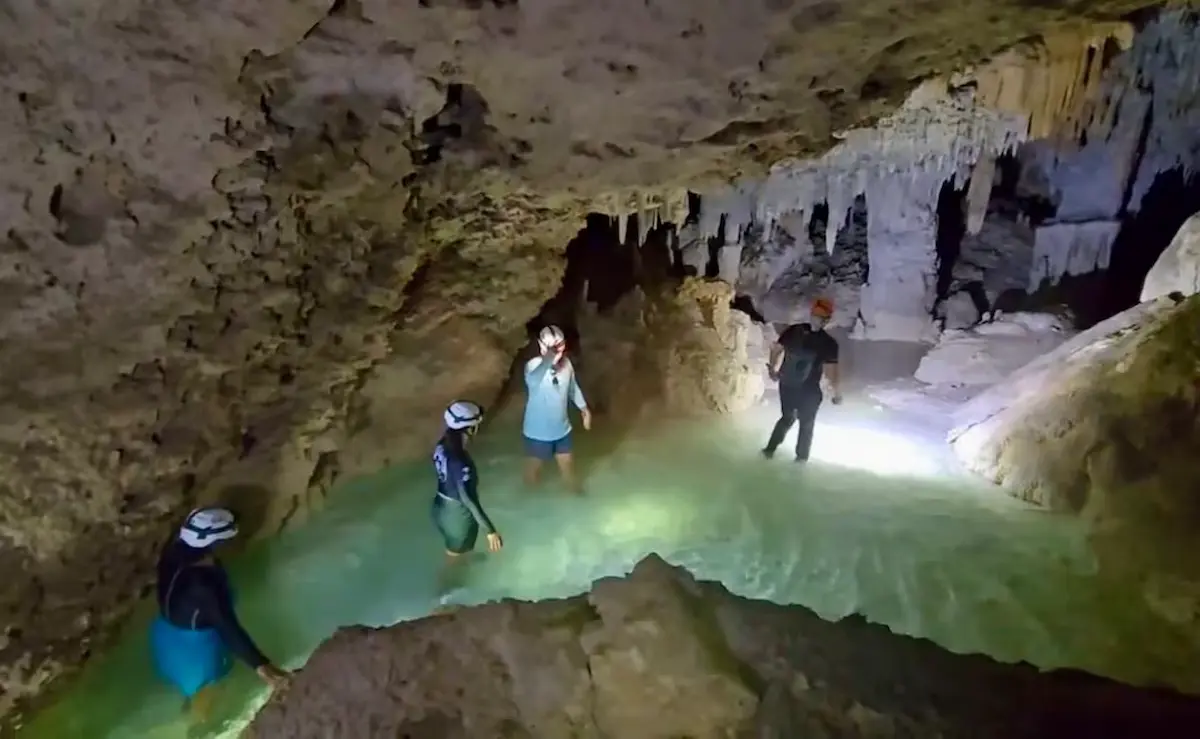
Assembly members Karines Reyes and Emerita Torres, both Democrats who represent districts in New York, arrived in the region on Aug. 28. During their visit they entered the Aktun T’uyul cave system, which lies beneath Section 5 of the railway between Cancún and Tulum. Support piers for the elevated train pierce the caves’ ceilings, and the legislators said the water in the system is no longer as clean as it once was.
Torres described the moment she noticed the first pylon while crossing an underground river. “It is absolutely incredible,” she said. “If you have never visited an underground river, you think it is something out of a storybook. It is beyond anything you imagine exists in the world. You see such clean, crystalline, blue water and the depth inside those caves, and as we went deeper we started to see the changes.”
“I got goosebumps,” she added. “We were crossing the river, and I looked to my right and saw the first one — that metal structure — then three more in a row. You see where it pierces the roof of the cave, and you can see the impact it has on the water, which is no longer as crystalline or clean. You cannot imagine what it felt like to be there when they were breaking something so sacred.”
Reyes described the tour as “a visit of contradictions” because of the contrast between the cave’s natural beauty and the train overhead. “It does not make sense to do this to a cave, to an ecological system so important for everyone, for the people,” she said. “I don’t know how to justify a train like this.”
Reyes stressed the need for environmental impact studies and enforcement of legal frameworks. “Those studies are so important, because now we see there is a train, but there are these pylons in the middle of such important caves, and it is irreversible,” she said. “Compliance with the law is so important, because otherwise these megaprojects operate with impunity.” She noted that Mexico has been brave in passing “very strong” environmental laws and said U.S. lawmakers have a lot to learn from that example.
Their working trip also included meetings with Mexican legislators in Mexico City, Quintana Roo Gov. Mara Lezama, and civil society organizations in Playa del Carmen. Representatives of the Maya Territory Defenders’ Assembly Múuch’Xíimbal, the Mexican Center for Environmental Law (CEMDA), the Grupo Ecologista del Mayab, Moce Yax Cuxtalt and the Sélvame del Tren movement described land dispossession in Yucatán as authorities impose solar parks, wind farms and industrial pig farms on Indigenous communities, along with the persecution, harassment and disappearances of territory defenders.
The groups also said the Maya Train has fragmented wildlife habitat and brought organized crime and militarization to the region, increasing violence and insecurity in Indigenous Maya villages. The lawmakers heard about health problems linked to massive sargassum seaweed arrivals and their economic toll on destinations such as Playa del Carmen and Tulum, as well as the declining health of dolphins held in a Cancún dolphinarium amid a legal dispute over their ownership. Activists also mentioned the state government’s refusal to expand the protected area of the Xcacel-Xcacelito sea turtle sanctuary by 2.5 kilometers beyond its current 100-meter strip to the federal highway.
The organizations linked those issues to what they called the dismantling of institutions that protect citizens, pointing to judicial reforms that produced “compliant judges,” the weakening of transparency mechanisms, hostility toward the press and open violations of environmental law.
More Environment
- Activists Protest Pig Mega-Farms in Yucatán, Demand Crackdown on Pollution
- Quintana Roo to Pitch Sustainability in Reworked International Tourism Push
- Cancún Seaweed Firm Ensol Caribe Eyes Expansion Into Dominican Republic and Belize
- Environmentalists Warn Tulum Jungle Road Could Open Door to Real Estate Expansion
- Only Four Sargassum Fishing Permits Processed in Mexico, Imipas Says