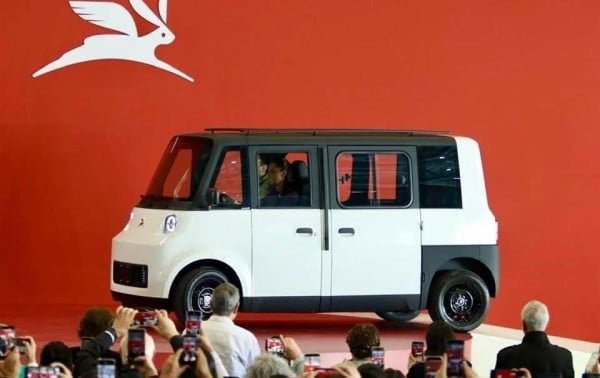
Mexico City — The Mexican government is preparing a competition to select private companies to partner in producing the Olinia electric vehicle and is drafting regulatory changes to allow the development of mini-vehicles, President Claudia Sheinbaum announced Thursday.
Sheinbaum said the project has entered the production phase and aims for mixed investment, involving companies with existing manufacturing and distribution capabilities.
“Now we are in the production phase. The goal is to have mixed investment, so it’s not just a vehicle produced by the Mexican state, but also investment from other companies,” Sheinbaum said during her morning press conference. “We are in a process to launch a kind of competition to see who would be in a position to partner.”
Participating companies must have distribution agencies in different regions of the country and experience in vehicle manufacturing, she added.
The president also announced that changes are being prepared to regulations essential for the development of Olinia and other electric mini-vehicles.
“Also, a change or some changes in some regulations that are essential for the development of mini-vehicles, both Olinia and other electric mini-vehicles, and that will allow progress,” Sheinbaum said.
The Olinia project was announced as a national assembler of compact electric vehicles, with three planned models: a two-seater for personal mobility, a neighborhood transport vehicle, and a last-mile delivery unit.
The government has said the vehicles would cost between 90,000 and 150,000 pesos (approximately $4,700 to $7,800) and could be plugged into standard electrical outlets, aiming to expand access to electric mobility.
When asked about interest from the government of Puebla state in purchasing 5,000 Olinia units, Sheinbaum said there is potential demand not only from governments but also from private individuals who have shown interest in the project.
“And if there is a lot of demand, not only from governments, but also from people who liked the vehicle,” she said.
More Economy
- Quintana Roo Warns Against Unchecked Hotel Growth as It Courts Brazil and Colombia
- Tren Maya Lost 5 Billion Pesos in Six Months as Operating Costs Soar
- Cancun’s Night Bike Ride Returns to Avenida Bonampak on October 3
- Volaris to Suspend Tulum Airport Flights, Second Mexican Carrier to Pull Out
- Proposed 351.80-Peso Non-Resident Fee Hike Threatens Tulum Tourism Recovery in 2027