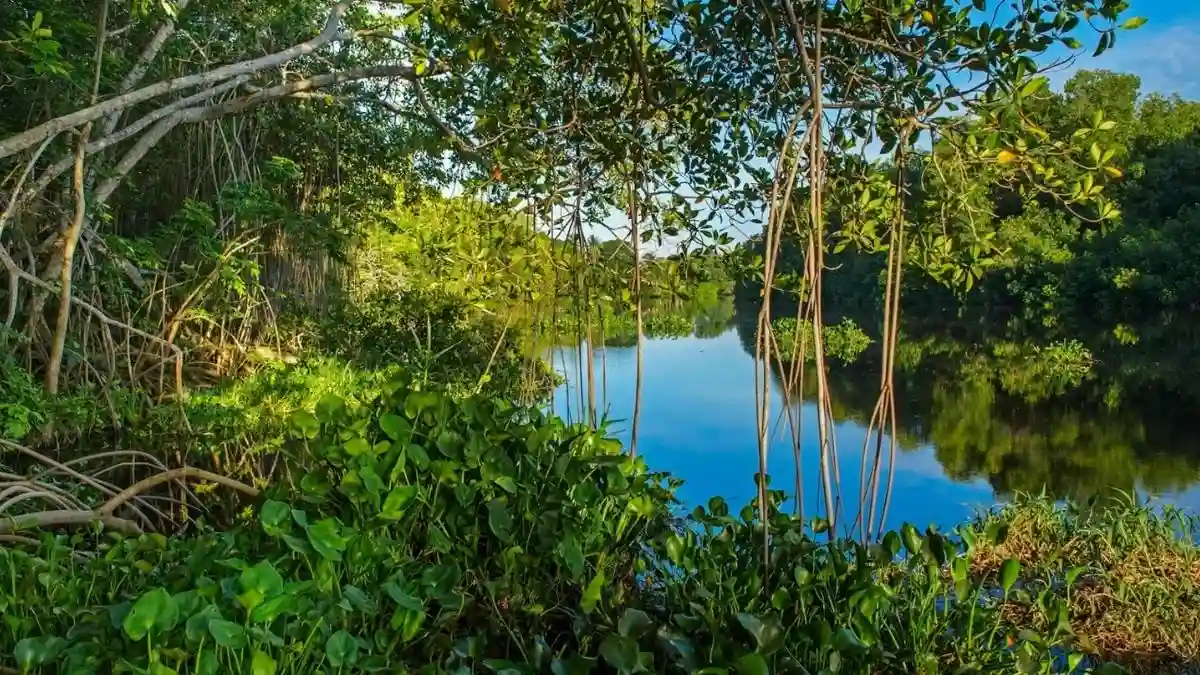
Mexico City — The area of disturbed mangrove in Mexico — coastal ecosystems with dead, stressed, or regenerating vegetation — increased more than fivefold between 2020 and 2025, from 9,680 to 52,130 hectares, according to the latest assessment by the National Commission for the Knowledge and Use of Biodiversity (CONABIO).
The Yucatán Peninsula, where tourism and real estate development has boomed, accounts for nearly half of the damaged area. In its report Manglares de México: actualización y dinámica espacial 2025, published in July, CONABIO recorded 23,204 hectares of disturbed mangrove in Campeche, Quintana Roo, and Yucatán — 44.5% of the national total. Nayarit holds 32.3% (16,834 hectares) and Campeche 24% (12,539 hectares).
Tourism and real estate development blamed
Sergio Madrid Zubirán, director of the Mexican Civil Council for Sustainable Forestry, said hurricanes can damage mangroves but the ecosystems generally recover. The situation changes, he said, when bulldozers clear vegetation for housing or hotel projects.
“There is a wide variety of causes, but an important one we documented is the growth of real estate and tourism projects,” Madrid Zubirán said. “When the developers’ bulldozer passes through, there is no way the mangrove forest can regenerate.”
According to figures cited by the specialist, about 1,000 real estate projects were identified in Quintana Roo between 2020 and 2025, while Yucatán recorded roughly 650 north of Mérida. In October 2025, Miguel Ángel Lemus, president of the Association of Real Estate Developers of Quintana Roo, estimated that about 1,000 medium- and high-end residential projects were under construction in the state, calling the industry’s growth “dizzying.”
Most of that development is concentrated in coastal municipalities. Tulum leads with more than 500 projects, followed by Cancún with over 200, Playa del Carmen with 184, Puerto Morelos with 20, Cozumel with 15, and Isla Mujeres with six, according to the Civil Council.
Enforcement questioned
Mexico’s Federal Attorney for Environmental Protection (PROFEPA) has documented illegal projects on coastal ecosystems. On Oct. 6, 2025, the agency closed two properties in Chicxulub Puerto, Yucatán, for filling wetlands with rock material and removing mangrove vegetation without the required environmental impact authorization. PROFEPA said irregular settlements and illegal works in the area’s mangroves have been a recurring problem for more than two decades.
The Civil Council questioned why institutions have failed to stop the destruction despite years of records. “The degradation documented by CONABIO did not occur in the absence of environmental institutions, but under the weak or negligent action of authorities that for years have had the information, legal powers, and instruments to protect these ecosystems,” Madrid Zubirán said.
Nayarit and Campeche: most damage, few restoration sites
Nayarit and Campeche together hold 29,373 hectares of disturbed mangrove — 56.3% of the national total. Nayarit saw the sharpest jump, from 2,736 hectares in 2020 to 16,834 in 2025, representing four out of every five disturbed hectares in the North Pacific region.
Despite this, CONABIO has identified only two potential restoration areas in Nayarit and six in Campeche out of 103 areas nationwide. Documented causes include hydrological changes from dredging and river straightening, pollution, deforestation, agriculture, livestock, aquaculture, salt production, tourism, and hurricanes.
Restoration without addressing causes may fail
Madrid Zubirán warned that replanting mangroves without tackling the underlying cause of degradation is unlikely to succeed. If the damage stems from altered water flow, pollution, or land filling, those issues must be solved first.
Mexican law already prohibits removing, filling, or transplanting mangroves under Article 60 Ter of the General Wildlife Law, with limited exceptions for restoration and conservation projects. The country’s total mangrove area stands at 877,464 hectares.
Yet Madrid Zubirán said CONABIO has not conducted a detailed analysis of causes, and warned that Mexico risks losing its mangrove patrimony if the current pace of development continues. Funding priorities also raise concerns: of the 212 billion pesos the government allocated in 2026 for climate change mitigation and adaptation, the Defense Department received 89 billion pesos, while environmental agencies — including the water commission (CONAGUA), the environment ministry (SEMARNAT), PROFEPA, and the forestry commission (CONAFOR) — received just over 7 billion pesos.
More Environment
- Hurricane Simon Threatens Puerto Vallarta as Category 4
- Mexico’s Environment Agency Rejects Four Major Tourism Projects in Quintana Roo
- Sargassum Closes In on 53 Quintana Roo Beaches as Tulum and Puerto Morelos Take the Worst Hit
- Semarnat Denies Environmental Permit for GL Dreams Subdivision in Puerto Morelos
- Caribbean Sargassum Becomes Fertilizer for Global Beer Brands
More Quintana Roo
- Morena Launches 11 Municipal Races in Quintana Roo: Who’s In?
- Rafael Marín Confirms Morena Bid for Cancún Mayor in 2027
- Quintana Roo Tops Mexico’s Human Trafficking Cases, Sheinbaum Warns
- Buen Fin 2026 Set for November 13-17 With Five Days of Deals in Cancún
- IMSS Launches Winter Vaccination Drive in Quintana Roo With 263,000 Doses