Felipe Carrillo Puerto, Quintana Roo — For more than 25 years, Margarita Chan Uicab has guided women through pregnancy and childbirth, keeping alive a body of knowledge she learned inside her own family and now hopes to pass on to a new generation.
“Ki’imak óolal uchik a tal a ximbalto’on,” she says in Maya as she welcomes a visitor into her home in one of the neighborhoods of this municipal seat — an expression that means “we are glad you came to visit.”
25 Years of Traditional Practice
Chan describes her work in her native language: “Ts’o’ok 25 años in kan yeet’,” she explains, referring to a form of massage, or “sobar,” used to help position the baby and encourage a healthy birth.
“Twenty-five years have passed in this practice that I love and do with faith,” she says, recalling her long career as a traditional midwife.
Over those years, Chan says she has also made predictions without any of the instruments of modern medicine. When a pregnant woman asks, she can tell her the sex of the baby before birth — and she says she has never been wrong.
Welcoming a new life through traditional midwifery is, for her, one of the most satisfying experiences there is. A birth becomes an event that draws in the whole family and creates a special atmosphere, she says.
Yet that tradition has not always coexisted easily with institutional medicine.
Bridging Two Kinds of Knowledge
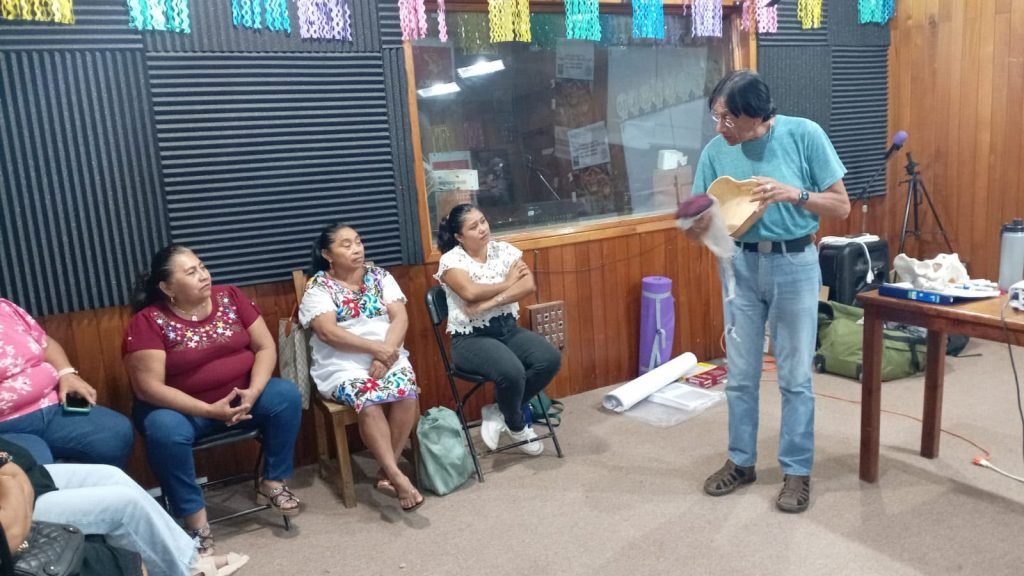
Dr. Gabriel García Salyano, who works with the U.S.-based Global Pediatric Alliance, said in an interview that the living conditions of traditional midwives are often marked by a lack of services and support from the state and from society at large.
He argues that traditional knowledge and the learning that comes from books, universities and medical training need to be brought together and understood as complements rather than rivals.
“I have realized that it is a mistaken attitude. We need to articulate, understand and bring both types of knowledge closer together. It is not that one goes against the other — most of the time they complement each other, and by working with community midwives we can give a great deal of strength to the other medicine,” he said.
The specialist also stressed the historical importance of midwives in the care of women.
“We also have to recognize that midwives are our predecessors. We doctors come from midwives — they are our grandmothers,” he said.
A Tradition That Refuses to Fade
Quintana Roo is home to 138 traditional midwives, working in the municipalities of Felipe Carrillo Puerto, José María Morelos and Cancún. Like Chan, many practice under difficult conditions, but the knowledge continues to pass from one generation to the next.
In 2025, 20 midwives received international certificates after completing a six-month training course taught by Global Pediatric Alliance. The curriculum covered comprehensive prenatal care, community and medical responses to obstetric and neonatal emergencies, family planning, and gender violence and gender inequality as factors affecting maternal health.
Even before taking part in that course, Chan had said that the lack of certification was one of the barriers traditional midwives face in preserving skills that have been steadily dwindling.
A Doctor’s Rebuke During the Pandemic
One of Chan’s most difficult memories dates to the COVID-19 pandemic, when pregnant women began seeking out midwives more often out of fear of catching the virus in hospitals.
She recalls, speaking in Maya, that a doctor from Sanitary Jurisdiction No. 03 scolded her for supposedly putting lives at risk by attending a birth without a certificate.
“We fight so that women can have natural births and avoid cesarean sections, and they treat us badly,” she said in Maya.
The experience did not make her quit. She kept working and began training her own daughters so the knowledge would stay in the family.
“Now I am teaching my daughters, who also take part in the courses that international organizations invite us to. The most recent one was in Cancún,” she said.
Teaching the Next Generation
Passing on that knowledge is essential if traditional Maya midwifery is to survive. In Chan’s case, the process is already under way with her daughters, among them Virginia Guadalupe, who is emerging as part of a new generation of women working to keep the practice alive in Felipe Carrillo Puerto.
The midwives prepare women for a natural birth, but when they detect a complication they say they must refer the patient to a hospital for medical care.
Chan says every birth she has attended has been successful — an unblemished record built over 25 years spent accompanying women through one of the most important moments of their lives.
More Culture
- Cave Divers Find Ancient Animal Bones in Yucatán Cave
- 146 Artisans Bring Mexico’s Folk Traditions to Xcaret Folk Art Fair
- Pre-Hispanic Bee House Unearthed in Tulum Sheds Light on Ancient Maya Homesteads
- Tulum’s Feria de la Cancha Maya to Gather Five Ceremonial Centers
- Maya Language Advocate Martiniano Pérez Angulo Dies at 67 in Quintana Roo
More Zona Maya
- Community Tourism Brings Income to Sacalaca With Small Groups and Cenote Protection
- Felipe Carrillo Puerto Weighs Access Fee for Puerta al Mar
- Mayan Seeds in Quintana Roo Studied for Nutrition and Diabetes Potential
- Contemporary Maya Sculpture Installed in Sacalaca Cenote to Draw Community Tourism
- Farm and Cattle Expansion in Quintana Roo Squeezes Native Wild Bees