
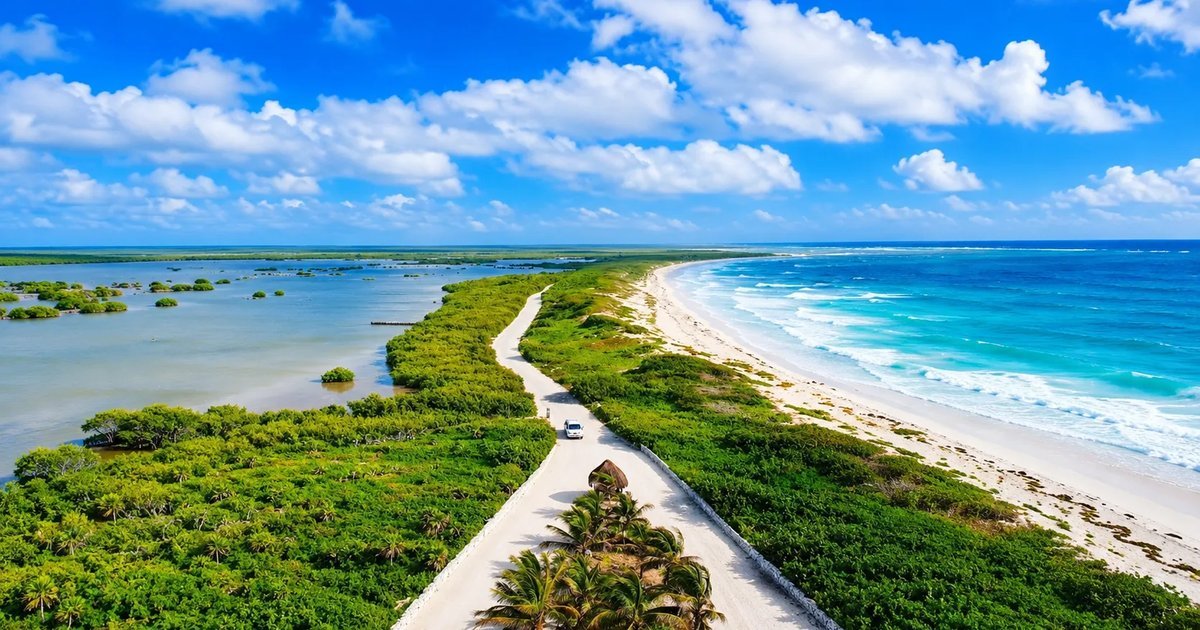
Cancún, Quintana Roo — Mexico’s Environment and Natural Resources Department (Semarnat) has rejected Incaribe, a 387-unit housing complex proposed along the Punta Sam–Cancún road, according to the agency’s published list of resolutions.
The development, filed by Liverte Desarrollos, S.A.P.I. de C.V., carried an estimated investment of 250 million pesos and would have required clearing nearly 8,000 square meters of coastal vegetation.
Semarnat logged the decision in file 23QR2024U0086, with a resolution dated Oct. 22, 2026. The company had submitted the application on Sept. 23, 2024 under the agency’s unified B procedure.
Three Towers on a 19,633-Square-Meter Lot
The project was planned for lot 49-02, block 36, superblock 86, in Cancún, within the municipality of Benito Juárez. The site covers 19,633.82 square meters.
As proposed, Incaribe would have consisted of 387 apartments spread across three nine-story towers labeled A, B and C, with parking in two underground levels. Amenities included swimming pools, terraces, a restaurant, a gym, a café, play areas, coworking spaces and locker rooms.
The plan also called for a 50-meter wooden pier, 2 meters wide and 100 square meters in area, built on 20-centimeter pilings using regional hardwood. The pier was to be constructed in the final phase, after site preparation and the residential buildings.
Protected Species Recorded in the Area
The company’s environmental filing identified six species listed under Mexican standard NOM-059-SEMARNAT-2010 within the regional environmental system: the black iguana (Ctenosaura similis), the bare-throated tiger heron (Tigrisoma mexicanum), the least tern (Sternula antillarum), the white-fronted parrot (Amazona albifrons), the olive-throated parakeet (Eupsittula nana) and the mangrove vireo (Vireo pallens).
Within the lot itself, however, only the black iguana was recorded — a species classified as threatened. The filing distinguishes between animals observed across the wider region and those found directly on the construction site.
To address potential environmental damage, the developer proposed a flora and fauna rescue, relocation and dispersal program, a mangrove monitoring and conservation program, and an environmental surveillance program. The document shows these measures were proposed, not that they were carried out.
Land-Use Change Covered 40% of the Site
The project required a land-use change on forested terrain covering 7,995 square meters — 0.7995 hectares, or roughly 40.7% of the total lot. The study classified the vegetation as secondary tree cover within coastal scrub.
Construction was planned in three stages: site preparation tied to the land-use change, then the residential towers, and finally the rustic wooden pier.
Surveyors also found exotic plant species on the property, including Terminalia catappa, known as the tropical almond. The developer said it would remove them during site preparation and take steps to prevent the introduction of non-native plants and animals.
More Development
- Quintana Roo Flags 18 More Isla Mujeres Developments Sold Without Permits
- Tulum Landlords Slash Rents as Tourism Crisis Leaves Properties Empty
- Property Sales Fall Up to 40% in Quintana Roo as Economic Crisis Bites, AMPI Warns
- Complaint Filed With PROFEPA Over Mangrove Clearing at Isla Mujeres Residential Project
- Isla Mujeres Closes Nine Real Estate Developments Over Irregular Land Sales
More Cancun
- SOC Places 136.6 Million Pesos in Business Loans in Quintana Roo
- Cancún Opens Pump It Up ‘Big One’ Tournament With More Than 700 Competitors
- Cancún to Offer Six Free Driving and Road Safety Courses
- Cancún Taxi and Airport Transport Drivers Clash Over Passengers in Front of Tourists
- Cancún Construction Blocks Blue Crab Migration Routes to the Sea
