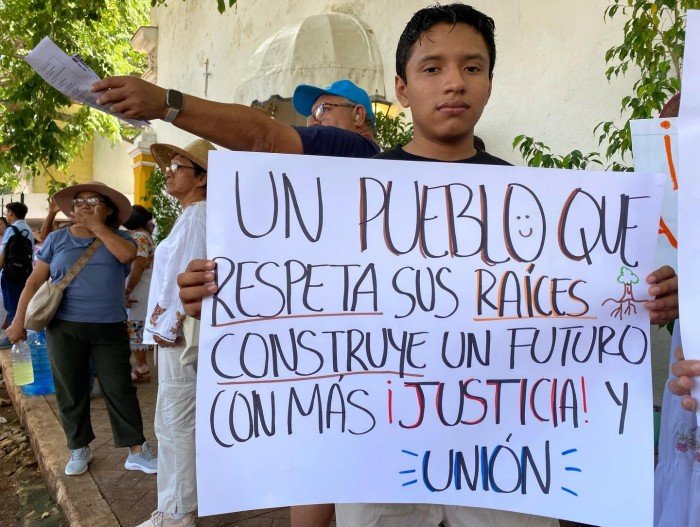
Mérida, Yucatán — Maya residents and organizations from Yucatán, Campeche and Quintana Roo are warning that parts of Mexico’s proposed General Law on the Rights of Indigenous and Afro-Mexican Peoples could undermine their right to self-determination, autonomy, territorial defense, consultation and access to justice.
In a document sent to President Claudia Sheinbaum and Adelfo Regino Montes, director general of the National Institute of Indigenous Peoples (INPI), the communities laid out their concerns and proposed changes to the initiative.
While they acknowledged advances in the bill, including its gender perspective, protection of traditional knowledge and recognition of traditional land possession, they said several provisions are incompatible with how Maya communities in the Yucatán Peninsula organize themselves.
Recognition and registration
One of their main concerns is the procedure for recognizing communities as subjects of public law. The groups questioned whether the INPI should be the body deciding which communities meet the requirements to be included in the National Catalog.
They argued that a community’s existence and rights should not depend on an administrative registry or on having formal documents such as bylaws or statutes.
Consultation and consent
The use of the term “significant impact” to determine when indigenous consultation is required is another central point of contention. The communities said this condition could allow the state to decide which effects are important enough to warrant consultation.
They asked for the term to be removed and for consultation to be mandatory whenever a measure, project or activity could affect their rights. They also requested legal recognition of “self-consultations,” processes organized by the communities themselves to deliberate and express their collective will on decisions affecting their territories.
Indigenous guardianships
The signatories also proposed incorporating the concept of “indigenous guardianships” to recognize community-based practices for protecting territories, natural resources and traditional knowledge. They cited care of bees and meliponiculture, seeds and native corn, cenotes, water, the jungle and forest areas.
They also questioned provisions allowing exceptions for the use of natural resources in “strategic areas,” noting that numerous territorial conflicts are tied to water, electricity, minerals and other resources.
Access to legal protection
The communities raised concerns about potential barriers to filing amparo petitions, a legal protection mechanism. The bill would require such petitions to be filed through community authorities or representatives and, in certain circumstances, by 20 percent of community members.
They warned this could hinder access to justice when the authorities or representatives themselves allow or facilitate projects that harm collective rights. They asked for direct mechanisms to take cases to court and for amparo petitions related to environmental damage to be allowed while the damage is ongoing.
Finally, they urged the legislation to recognize that “there is no single valid form of organization for indigenous peoples,” since Maya communities maintain diverse systems of authority, orality and decision-making that are not necessarily reflected in administrative documents.
The statement, dated August 12, was signed by Maya residents from communities in Yucatán, Campeche and Quintana Roo, as well as by the Colectivo Maya de los Chenes, Muuch-Kambal and the Utsil Kuxtal Human Rights Center.
The signatories said they want their observations considered during debate on the bill so the new law becomes “a real tool for defending the self-determination of the peoples and not a mechanism for legitimizing dispossession.”
More Government
- Mexico’s Cofepris Issues Health Alerts Over Counterfeit Granulox, Buscapina, Bedoyecta and Saizen
- Navy Transfers Injured Woman as Isla Mujeres Hospital Maxes Out
- Drought Reaches All 11 Municipalities in Quintana Roo
- Search Operation for Missing People Deployed in Felipe Carrillo Puerto
- Horseshoe Crabs in Isla Mujeres Face Threat From Bait Fishing in Laguna Chacmuchuch