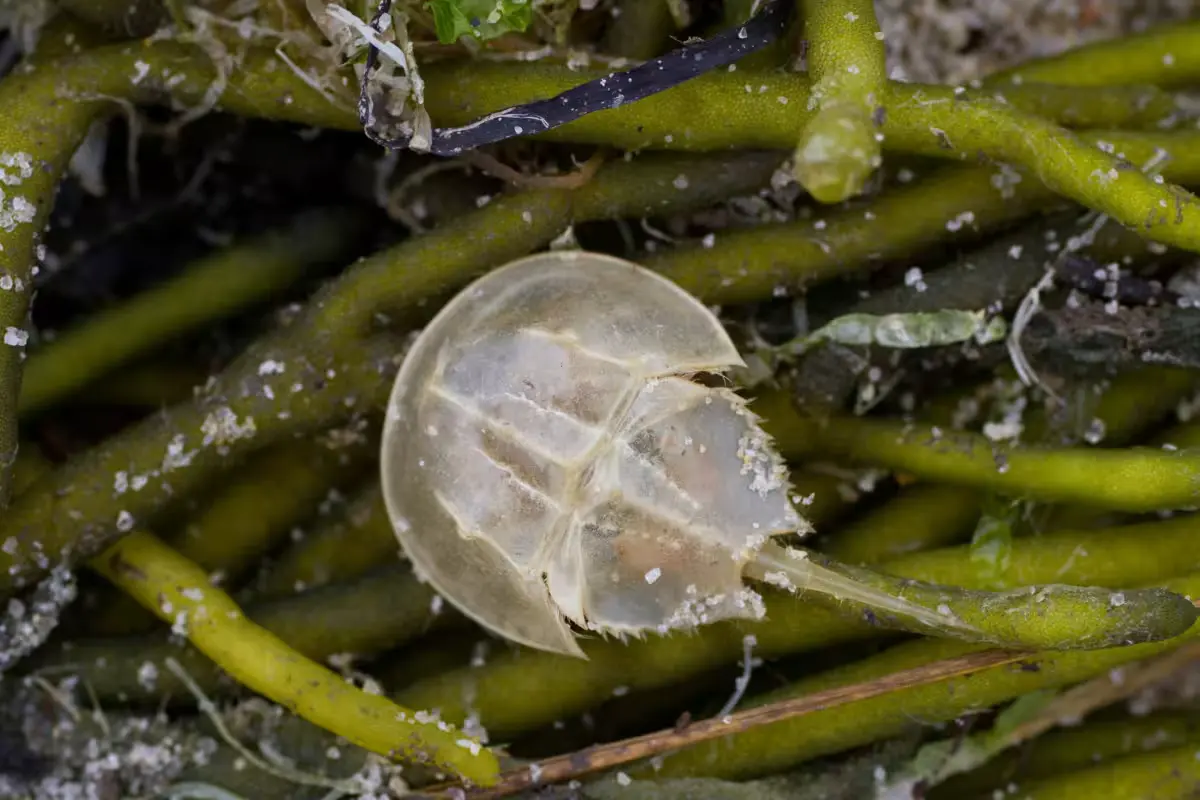
Isla Mujeres, Quintana Roo — The capture of horseshoe crabs for use as bait in octopus fishing is threatening one of the last remaining populations of the species in Laguna Chacmuchuch, a lagoon on Isla Mujeres where human activity is still limited.
According to the Colegio de la Frontera Sur (Ecosur), overharvesting by local fishers poses a danger to the species, whose protection is established under Mexican environmental standard NOM-059-Semarnat.
The fishermen Carlos, Joaquín and Manuel said they respect the species and called for stricter surveillance by the Mexican Navy, the National Commission of Aquaculture and Fisheries (CONAPESCA), and the Federal Attorney’s Office for Environmental Protection (PROFEPA).
Under NOM-059-Semarnat, the species Limulus polyphemus — known in Quintana Roo as the cacerolita de mar, as mex in Maya, and as the “sea cockroach” among local fishers — lives naturally in the Laguna Chacmuchuch system and the adjoining Isla Blanca.
Antimio Cruz, of the Colegio de la Frontera Sur, said the species’ main threats are hotel development along the coast and systematic capture by fishers who use it as bait to catch octopus in Campeche, Yucatán and Quintana Roo.
“Many people don’t know that this animal has been protected since 2010 by an official Mexican standard,” he warned.
The species typically hides in the sand and mud of shallow waters, where it finds conditions to feed and reproduce — an adaptation that has allowed it to survive for more than 350 million years, the researcher said in his report.
Fossils of practically identical organisms date back 100 million years, predating the appearance of the dinosaurs. Even so, current populations of this living fossil are declining rapidly in one of its last two refuges, the Yucatan Peninsula.
While Mexico has no legal industry for exporting or extracting the animal’s valuable blue blood, used to obtain amoebocyte lysate, the species faces heavy pressure from regional poaching, with crabs taken to be used as bait in octopus fishing across the Yucatan Peninsula and Campeche.
The Laboratory of Ecotoxicology and Animal Ecophysiology reported that a lineage that survived five mass extinctions now faces a modern contaminant: microplastics. In a scientific paper, Mitzi Yanin Ayala examined how juvenile specimens in the Atlantic respond to chronic exposure to polyethylene particles of different sizes.
More Environment
- Drought Reaches All 11 Municipalities in Quintana Roo
- Tulum Residents Demand Comprehensive Water Quality Study for La Veleta
- Tulum Circula Advises More Than 120 Businesses on Separating and Tracking Waste
- Yum Balam Management Review Must Include Chiquilá Ejido, Commissioner Says
- Punta Venado Caught Between New Hotels and the Calica Legal Fight