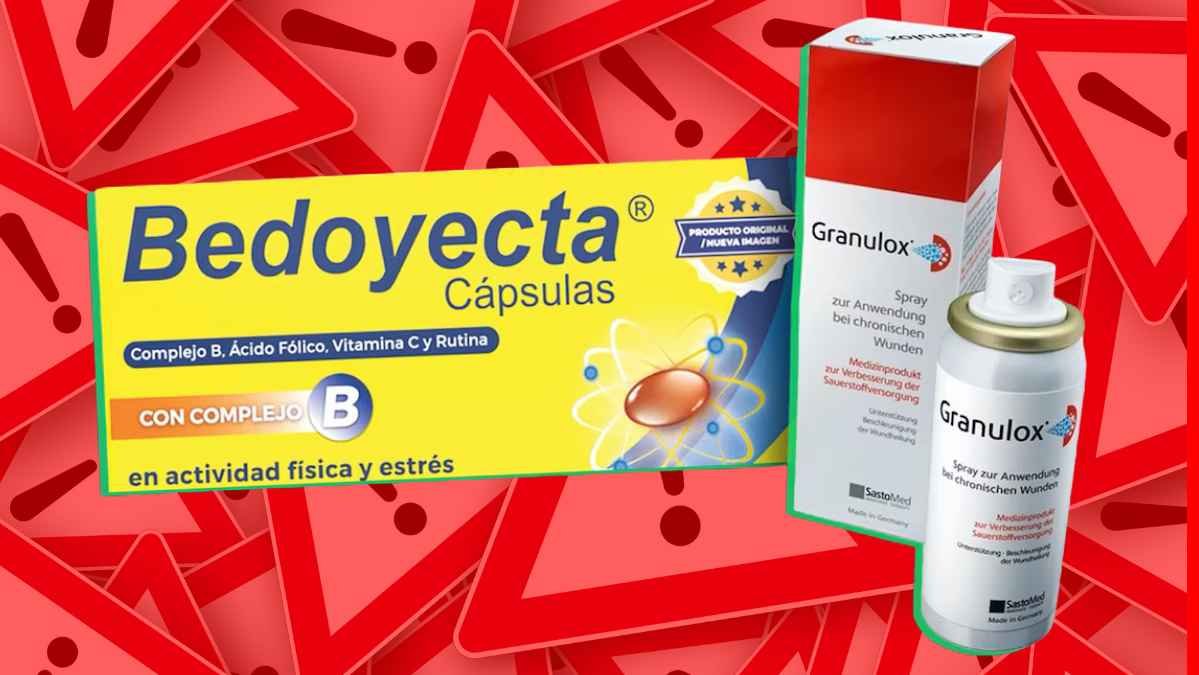
Mexico City — Mexico’s federal health regulator has issued sanitary alerts for four medicines sold in the country after detecting falsification or adulteration, warning that the products could pose a risk to patients.
The Federal Commission for the Protection against Sanitary Risks (Cofepris) flagged irregularities in various lots and expiration dates of Granulox, Buscapina Compositum, Bedoyecta and Saizen 20 mg. Because the conditions under which the products were manufactured, stored, transported or distributed are unknown, the agency said it cannot guarantee their quality, safety or effectiveness.
Granulox
In the case of Granulox, a 12-milliliter aerosol used to treat wounds, Cofepris found that lot 16115143 had been adulterated. The lot’s original expiration date was November 2019, but product marked with a December 2026 expiration was found in circulation.
The agency said the altered date could compromise the product’s composition, performance and even its sterility. It urged the public not to buy or use Granulox bearing that lot number, regardless of the expiration date printed on the packaging.
Buscapina Compositum
Several counterfeit lots of Buscapina Compositum 10 mg/250 mg tablets were identified, including CMXA001, whose original expiration date was January 2024. The 24-tablet box presentation found among the falsified products does not officially exist for this medicine.
Authorities also reported irregularities in lots CNXA001, CMXA007, MXA007 and C57411, linked to modified expiration dates or inconsistencies with the manufacturer’s records.
Bedoyecta
The third alert covers Bedoyecta, a complex of B vitamins, folic acid, vitamin C and rutin. The lots identified as counterfeit are 230593 and 230589, both marked with a November 2026 expiration date.
The company holding the sanitary registration told Cofepris it has no records of packaging or distributing those lot numbers. The agency asked consumers to avoid buying, consuming or using them.
Saizen 20 mg
For Saizen 20 mg (8 mg/mL), an injectable somatropin solution, the regulator found anomalies in several lots. Lot BA054637 originally expired in November 2020 but was later found marked with an October 2028 expiration, and the product also failed sterility tests.
Lots BA010812 and KW010374 were not distributed by the registration holder, according to information provided to Cofepris. Lot KW010374 also failed sterility testing.
Those cases add to international notifications about counterfeit Saizen in lots BA088217 and AB003660, whose expiration dates appear as April and July 2027, respectively.
What Consumers Should Do
Cofepris recommended that anyone who identifies these products or lots not buy or use them and file a sanitary complaint if they see them being sold.
People who have already used any of the flagged products should stop and report any symptoms, discomfort or adverse reactions through the appropriate pharmacovigilance channels.
The agency also urged the public to buy medicines only from authorized establishments. For online purchases, it advised verifying that the seller has a physical address in Mexico and the corresponding sanitary documentation. Pharmacies and distributors should source stock only from authorized suppliers and keep documents proving the products’ legal origin, Cofepris said.
More Government
- Navy Transfers Injured Woman as Isla Mujeres Hospital Maxes Out
- Drought Reaches All 11 Municipalities in Quintana Roo
- Search Operation for Missing People Deployed in Felipe Carrillo Puerto
- Horseshoe Crabs in Isla Mujeres Face Threat From Bait Fishing in Laguna Chacmuchuch
- Playa del Carmen Beachgoers Denounce Charges of Up to 800 Pesos for Umbrellas and Lounge Chairs