Cancún, Quintana Roo — The accelerating loss of reefs across the Caribbean has pushed scientists toward ecological restoration strategies, including assisted coral reproduction programs aimed at restoring the health of these ecosystems.
Researchers such as Rodolfo Raigoza Figueras, who heads the Corporate Conservation Division at Grupo Xcaret, are leading efforts to reverse the damage and preserve marine biodiversity, working at a frantic pace given the severity of the crisis.
“It is estimated that by 2050 we will have lost almost all coral cover in the world… If you come to Cozumel in two years, you will no longer see the same reef. Faced with this, laboratory restoration becomes urgent,” he said.
A 15-minute spawning window
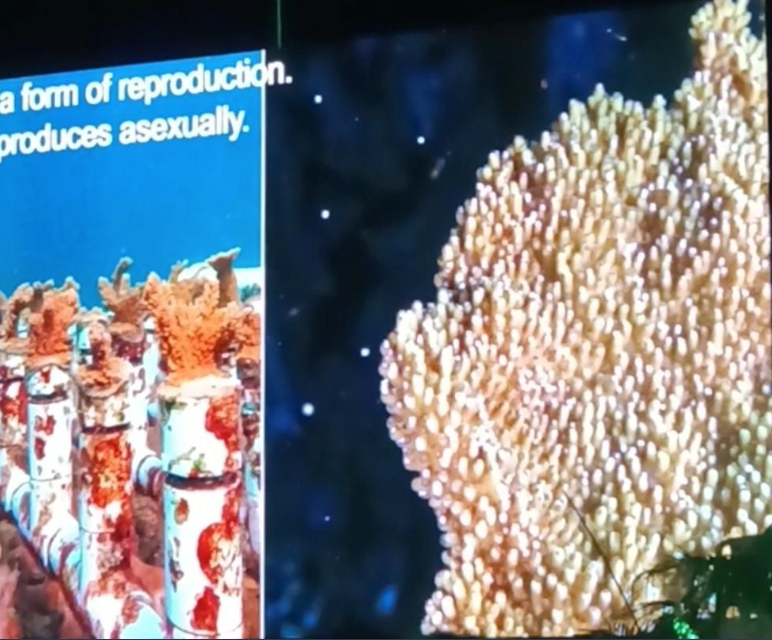
In the case of elkhorn coral (Acropora palmata), a species that gives the reef its three-dimensional structure, the coral reproduces by fragmentation, but scientists also take advantage of its once-a-year sexual reproduction. It occurs six days after the August full moon, when the corals synchronize their spawning for 15 minutes in the darkness of night.
During that brief window, Raigoza said, trained divers descend with floating nets and collection jars, hoping to capture the moment the polyps open. The team collects the gamete bundles before they disperse in the ocean current.
The biological material is then taken to the laboratory to grow viable fragments, which are eventually replanted in degraded reef areas.
Raigoza Figueras said the work is not at odds with sustainable tourism. The model relies on partnerships with the National Autonomous University of Mexico (UNAM) and the Mexican Institute for Research on Sustainable Fisheries and Aquaculture (INIPAS), along with monitoring of key species such as sea turtles and pink conch.
Bringing research together with sound practices, he said, is the main path to securing the future of Caribbean reefs.
Protecting species, he insisted, shows that responsible travel is essential to safeguarding marine biodiversity, which means the challenge lies in how tourism activity is carried out.
More Environment
- Quintana Roo Bolsters Sargassum Strategy With Satellite Monitoring and Research
- Stationary Front to Bring Rain Across Yucatán on Tuesday
- Documentary on Puebla River Defenders Screens Free in Cancún
- Cancún Announces October Environmental Days With Cenote Cleanups and Recycling Drive
- Activists Protest Pig Mega-Farms in Yucatán, Demand Crackdown on Pollution