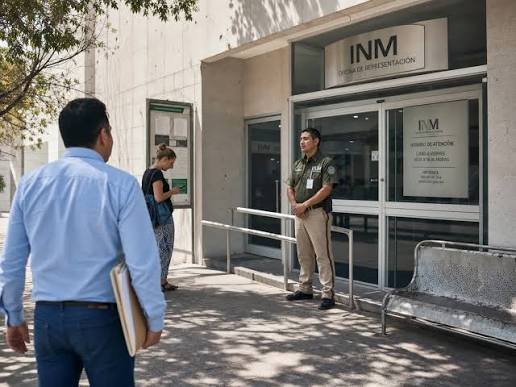
Cancún, Quintana Roo — Employees of Mexico’s National Migration Institute (INM) in Quintana Roo have publicly accused the agency’s state offices of harboring a corruption network, alleging extortion of detained foreigners, influence peddling, favoritism, harassment and the misuse of government vehicles and expense funds.
The workers also described a parallel market around migration procedures in which outside fixers charge between 2,500 and 3,500 pesos simply to secure an appointment that the INM provides free of charge.
The employees released the allegations anonymously, saying they fear reprisals and have been subjected to constant threats and abuse. Names in the complaint are given in the abbreviated form used in Mexico for people who have not been formally charged.
Allegations Span Five Locations
The complaint covers offices in Cancún, Playa del Carmen, Cozumel, Chetumal and the Tulum International Airport.
In Chetumal, workers allege extortion of detained foreigners, workplace favoritism, administrative irregularities and ties between officials and nightlife venues. In Playa del Carmen, questions center on the regularization of Cuban citizens and the appointment business. In Cancún and Cozumel, the accusations focus mainly on intermediaries who profit from scheduling appointments and handling paperwork. At the Tulum airport, migration officers are said to be dispatched in the early hours in vehicles that employees describe as mechanically unsafe, without receiving their travel allowances on time.
The workers say the structure tied to previous management has not been dismantled and that people linked to it remain in positions of influence over personnel, budgets and migration procedures. They claim the national INM commissioner, Sergio Salomón Céspedes Peregrina, is already aware of the allegations.
Former Office Chief Left, Network Allegedly Remained
Workers attribute the departure of Carlos Manuel Bandala González, head of the INM’s representation office in Quintana Roo, to the internal pressure. He is described in the complaint as linked to the group that held sway inside the agency.
However, as of Sept. 6 the institute’s public directory still listed Bandala González as head of the Quintana Roo office, an administrative discrepancy the INM has yet to clarify officially.
The complaint names Jonathan N., described as an operator close to Bandala González and to another official identified as Carlos N., as a central figure. He is accused of abusing his position to harass female colleagues and of maintaining relationships with workers who allegedly received job benefits.
Others named in the same circle include Norma N., in charge of the medical office; Aureny N., head of the psychology area and assigned to the actuarial department; Ileana N., a federal migration agent B; Zuleyma N., a federal migration agent C; and Itzel N., who previously served as deputy director of migration control and verification at the Chetumal sub-office. Itzel N. is described as Jonathan N.’s former partner and was later dismissed from her post, a removal the workers link to alleged corruption.
She and Carlos N. are also accused of running establishments where Cuban and Colombian women were allegedly placed for sexual exploitation. Two Chetumal nightspots, Vaider and Las Primas, are named in the complaint. Those allegations have not been verified and would require investigation by the appropriate authorities.
Extortion Allegations at the Chetumal Migrant Station
The most serious accusations focus on the Chetumal migrant detention station and its deputy director, identified as Heiser N.
Workers say Heiser N. had a relationship with Giuliany N., a migration affairs adjudicator who served as administrative liaison for the office’s financial and material resources division, and that the two have a daughter. He is also described as romantically involved with the office psychologist.
According to the complaint, Heiser N. presented himself as a protégé of Carlos N., a connection that allegedly let him operate with impunity inside the station. Detained foreigners were reportedly extorted for large sums in exchange for release without spending even one night in custody. Part of the alleged mechanism involved failing to report certain detentions to the institute’s central offices, allowing releases after payment.
The workers say the proceeds allowed Heiser N. to build assets far beyond his means. His salary is listed at roughly 47,554 pesos a month gross, and the complainants are calling for a review of his financial declarations.
Favoritism, Double Shifts and Threats
Officials named in the complaint are accused of using their rank to benefit associates, mainly female employees who were allegedly excluded from field operations and granted other privileges.
Those who did not align with the internal groups or their alleged business interests were reportedly assigned double shifts and schedules that were not respected. Workers also say transfer threats were used as leverage to punish employees and eventually push them out.
The complaint extends to staff of the private security firm Armour King S.A. de C.V., whose employees allegedly faced repeated delays in payment without corrective action. Some cleaning staff are said to have had relationships with members of the group under scrutiny, a matter the complaint says should be examined to determine whether it produced hiring or pay benefits.
Appointments Sold for Up to 3,500 Pesos
The complaint describes a lucrative business built around the difficulties foreigners face when filing paperwork directly.
Applicants who bring their files to an office face strict document reviews, and even minor issues — a stray comma or inconsistent capitalization — can stall the process, forcing them to correct the paperwork and book a new appointment online.
Users struggle to find available slots in the system, while outside fixers known locally as “zopilotes,” or vultures, offer appointments for 2,500 to 3,500 pesos, the workers say. Those fees cover only the slot; additional charges follow for handling the procedure itself. Several such intermediaries operate near the offices, targeting foreigners whose applications were rejected or who cannot find an opening.
Workers suspect some of the fixers are connected to people inside migration services, acting as external operators who collect clients, take payment and do the work off-site so that money is never requested inside the buildings. The proceeds would then be split among those involved, according to the allegations.
The complaint acknowledges a distinction between official government fees, which apply to certain migration procedures, and the money demanded for an appointment, which is free and requires no intermediary.
Workers Ask Federal Government to Step In
The employees have asked for intervention from Céspedes Peregrina, Interior Secretary Rosa Icela Rodríguez Velázquez and President Claudia Sheinbaum Pardo.
They argue the conduct described does not match the principles of the governing party’s so-called Fourth Transformation project and say central offices already know part of what is happening in Quintana Roo.
“We, the workers of the National Migration Institute in Quintana Roo who are not part of this corruption, make this public denunciation while protecting our identity because of the fear we feel over the constant threats and abuses we suffer, in the hope of being heard, that the pertinent investigations are carried out and that action follows accordingly,” the complaint states.
The allegations open several avenues for documentary review, from detention and release records, Cuban regularization files and asset declarations to payrolls, travel allowances, invoices, contracts, vehicle maintenance logs, staff transfers and operation assignments. Investigators will also have to determine whether the appointment trade is an independent business run by fixers exploiting applicants’ difficulties, or whether, as the workers claim, there is a link between the intermediaries and INM personnel who clear appointments and procedures in exchange for money.
More Government
- Playa del Carmen Councilor Pushes for Direct Federal Funds for Indigenous Communities
- Bird Populations Decline in Quintana Roo’s Maya Zone, Academics Warn
- Deer Trapped in Playacar Fence Rescued After Social Media Reports
- Cancún Restaurant Owners Press for Tax Incentives to Revive Avenida Yaxchilán
- Playa del Carmen Adds Lifeguard Stations and Patrol Vehicles as Swimmers Ignore Red Flags
More Cancun
- Hotel Occupancy in Quintana Roo Drops Below 60 Percent
- Mara Lezama Brings ‘La Voz del Pueblo’ Hearing to Cancún’s Villas Otoch Paraíso, Serving 1,200 Residents
- Crews Remove More Than 1.6 Tons of Trash From Cancún’s Nichupté Mangroves
- Visitax Collection Will Continue at Cancún Airport, Governor Mara Lezama Says
- Quintana Roo Truckers Threaten to Block All Four Lanes of Cancún’s Boulevard Colosio