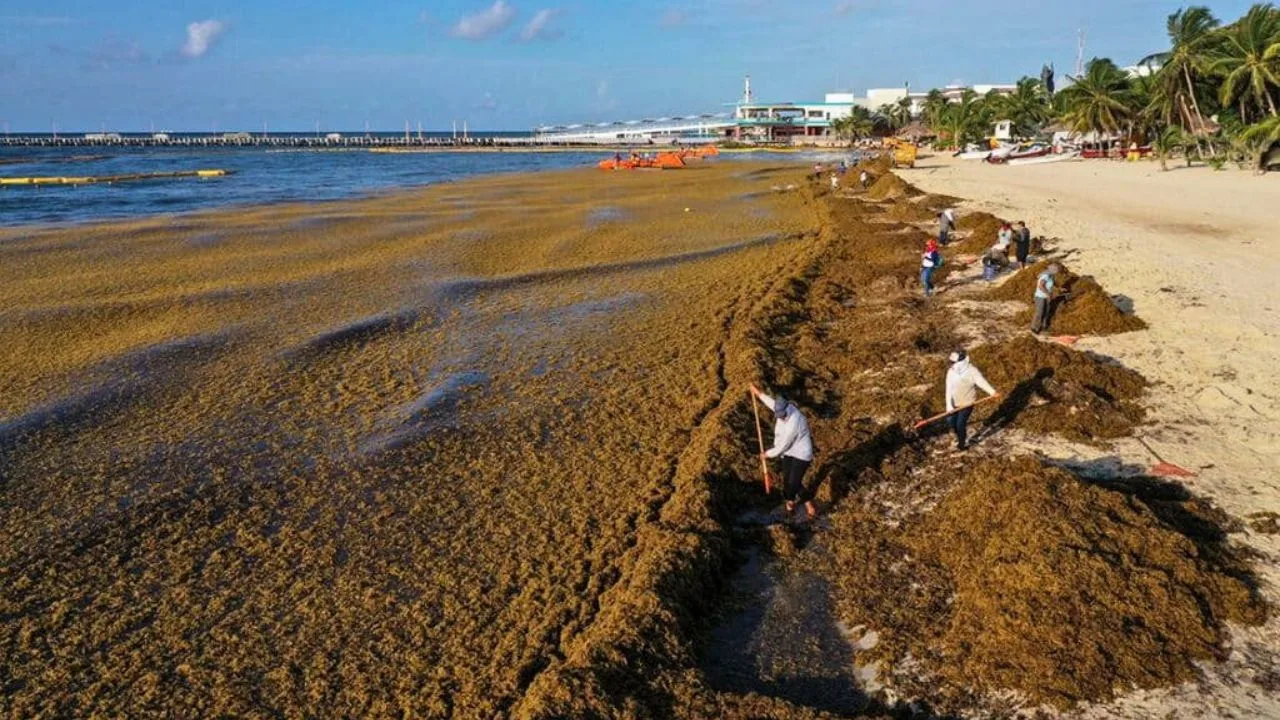
Cancun, Quintana Roo — Mexico’s federal government has announced a large expansion of sargassum-control operations in Quintana Roo, promising new collection vessels, additional containment barriers and processing facilities intended to keep more of the seaweed from reaching the shoreline.
The central promise is straightforward: intercept a greater share of the sargassum while it is still floating offshore, collect what enters shallow water and remove any remaining deposits from beaches before they decompose.
President Claudia Sheinbaum described the federal commitment as approximately 2 billion pesos. A presentation accompanying the announcement placed the wider package of projects and equipment at roughly 2.6 billion pesos, apparently including related state programs and longer-term infrastructure.
The distinction matters because the government has not yet released a detailed public budget showing how every peso will be divided, when each contract will be awarded or when all the equipment will become operational.
What will happen first?
The first phase is valued at 768.7 million pesos and is intended to increase the system’s collection capacity to about 1,870 metric tons per day.
It includes:
- Two tugboats to move collection equipment and recovered sargassum.
- Six additional coastal sargassum-collection vessels.
- Approximately 1.5 kilometers of movable or “dynamic” barriers.
- Up to 50 kilometers of coastal containment barriers.
- Expanded collection crews and support equipment.
- Improved monitoring to determine where the largest mats are moving.
The work will concentrate initially on Cancún, Puerto Morelos, Playa del Carmen, Tulum and Mahahual. Those areas account for roughly 40 to 50 kilometers of heavily visited coastline, according to the federal presentation.
Authorities have not promised that barriers will form an uninterrupted wall along all 50 kilometers. They are expected to be positioned at selected beaches and offshore interception points according to currents, winds, navigation conditions and forecasts of incoming sargassum.
Quintana Roo already has a network of vessels and barriers. At the beginning of 2026, the Navy reported operating one ocean-going sargassum ship, 11 coastal vessels, four amphibious collectors, 16 support boats and 9.5 kilometers of containment barriers. Another six kilometers of barriers had already been planned before the latest announcement.
The new purchases would therefore expand an existing operation rather than create an entirely new system.
When will residents see a difference?
Sheinbaum first announced on July 17 that an expanded plan would begin within 15 days and would be coordinated by the Navy and federal Tourism Ministry.
That timetable refers to the start of the expanded operation, not the arrival of every promised vessel or the installation of all 50 kilometers of barriers.
Existing crews, Navy vessels, municipal workers and privately operated equipment can be redeployed immediately. New boats, tugboats and specialized barriers will require procurement, construction, delivery, testing and trained operators. The government has not published completion dates for those purchases.
As a result, the public should expect a gradual increase in capacity rather than an immediate transformation of all five destinations.
There are also practical limits. Floating barriers work best in relatively protected coastal water. They may have to be repositioned or removed during storms, strong currents and the winter cold-front season. The Navy routinely withdraws sections for maintenance when weather conditions could damage the equipment.
Collection at sea is only part of the system
Officials divided the plan into four operating stages:
- Collection in open water before large mats approach the coast.
- Collection in shallow water behind or near containment barriers.
- Beach cleanup when sargassum reaches shore.
- Transportation, treatment and final use or disposal.
The priority is offshore collection because fresh floating sargassum is easier to handle and has greater potential for industrial use. Once it accumulates on the beach, it mixes with sand and garbage and begins to decompose.
Decomposition can release hydrogen sulfide, the gas responsible for the rotten-egg odor associated with heavy accumulations. At sufficiently high concentrations or after prolonged exposure, the gas can cause eye and respiratory irritation, headaches and nausea.
Offshore collection must still be carried out carefully. Floating sargassum provides shelter and feeding habitat for fish, sea turtles and other marine life, meaning vessels cannot simply remove every visible mat without environmental controls.
What happens to the collected sargassum?
A major part of the strategy is to stop treating collected sargassum solely as waste.
The state is developing the Centro Integral de Saneamiento y Economía Circular, or CISEC, along with a proposed 38-hectare circular-economy development zone in Puerto Morelos. Companies and researchers would use the material to produce biogas, biofertilizer, biochar, construction materials and other products.
State officials previously said CISEC could begin operating during the second half of 2026, with some reports identifying December as the target. However, that date remains a projection, and full commercial processing will depend on permits, construction, investment and quality-control standards.
Processing presents its own difficulties. Sargassum collected in the Caribbean can contain salt, sand and elevated concentrations of arsenic or other elements. It must therefore be tested and treated before being used in agricultural products, animal feed, cosmetics or materials that could expose people to contaminants.
A federal initiative known as Caribe Circular has projected that as much as 2 million tons could eventually be converted into useful materials by 2028, potentially creating 3,500 jobs. That is a development target, not a guarantee that all sargassum collected during the current season will be processed.
An important correction to the reported figures
The figure of approximately 90,000 metric tons cited by Environment Secretary Alicia Bárcena referred to sargassum estimated to be floating in the region, not 90,000 tons being collected or reaching Quintana Roo every day.
During a July 16 briefing, Bárcena estimated that about 9,000 tons a day could reach the coastline during the most severe period and said the government wanted to collect between 2,500 and 6,000 tons offshore.
Those estimates can change rapidly because currents and winds determine how much sargassum passes offshore, lands on beaches or moves elsewhere in the Caribbean.
What remains unanswered
The plan is the largest federal commitment yet to sargassum management in Quintana Roo, but several implementation details are still missing.
The government has not published a destination-by-destination barrier map, delivery dates for the new vessels, annual operating costs or a complete division of responsibilities among the Navy, state government, municipalities and hotels. It has also not explained how performance will be measured or what percentage of incoming sargassum it expects to stop.
The regional meeting scheduled for October 1 and 2 in Cancún will bring together Caribbean governments, the European Union, scientists and technology providers. It may help define common monitoring, financing and processing standards, but it will not replace the immediate cleanup work required throughout the 2026 season.
For residents and businesses, the practical measure of success will be visible: how much sargassum is intercepted, how quickly beach deposits are removed and whether the collected material reaches authorized processing or disposal sites instead of being left to decompose elsewhere.
More Environment
- Mexican Army Nears Completion of 16-Kilometer Jungle Road Over Tulum’s Sac Actún Cave System
- Akumal Halts Turtle Swim Tours Through September
- Mexico Assigns $110 Million Navy Budget to Fight Sargassum in Quintana Roo
- Mérida Opens First Green Corridor to Fight Climate Change
- El Niño Keeps Atlantic Hurricane-Free, Setting Record for Latest First Storm in Decades
More Quintana Roo
- Quintana Roo Civil Protection Warns Against Fireworks Ahead of Independence Day
- Quintana Roo to Pilot Child Protection Protocol for Tourism Sector in October
- Sheinbaum Announces 187 Primary Care Clinics and Major Projects in Quintana Roo
- Quintana Roo Records 29,413 Sea Turtle Nests at Season’s Midpoint
- Quintana Roo Reports 1,200 Screwworm Cases as Officials Await Sterile Fly Release