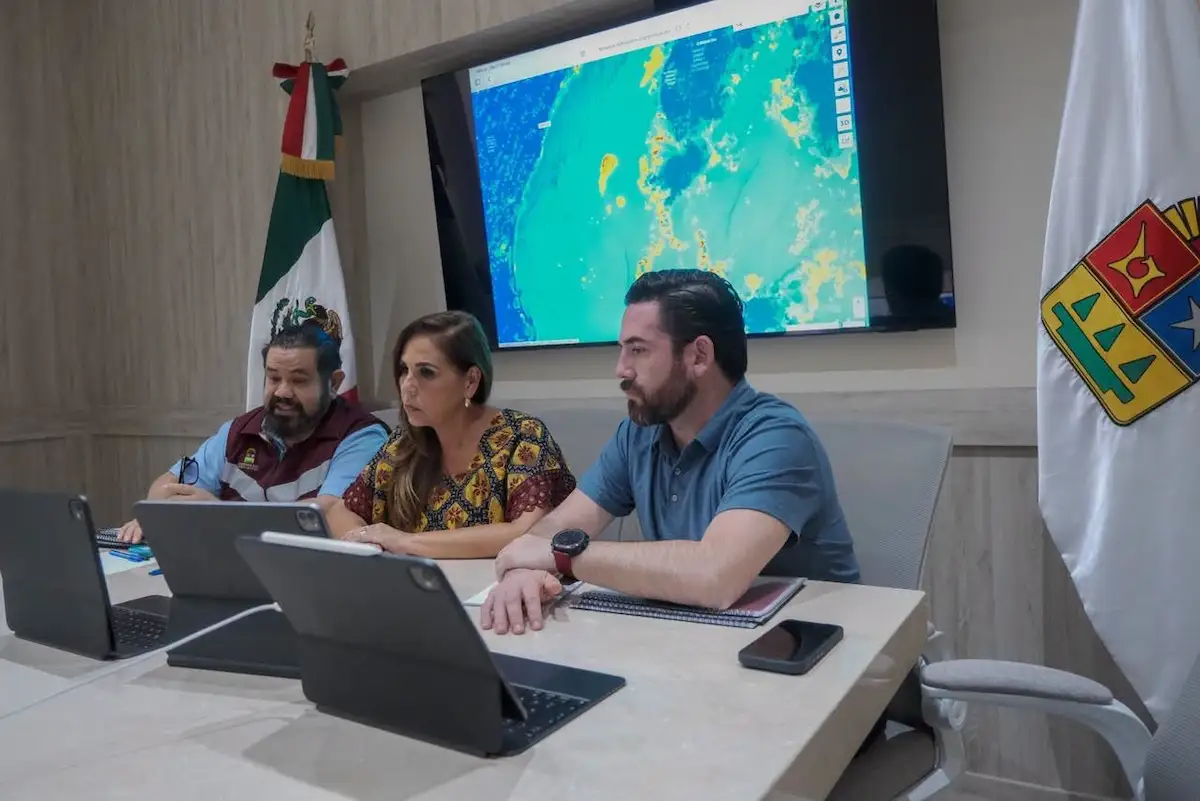
Quintana Roo — Governor Mara Lezama met with federal and state officials to review progress on Mexico’s national strategy for tackling sargassum, agreeing to expand collection capacity and install more coastal barriers.
The meeting brought together representatives of the Mexican Navy (Semar), the Secretariat of Science, Humanities, Technology and Innovation (Secihti), the National Commission for the Knowledge and Use of Biodiversity (Conabio), the National Tourism Promotion Fund (Fonatur) and the Quintana Roo state government.
Lezama said the participants agreed to continue installing coastal barriers, strengthen collection work with additional sargassum-collecting vessels and improve the transfer of the seaweed to final disposal sites, while also promoting its use and the value that can be recovered from it.
Two New Working Groups
The governor said two new working groups will be formed, with the state taking part permanently and in coordination with municipal governments, to track each action closely.
Officials also plan to develop an early warning system based on the state’s monitoring center, which would allow authorities to anticipate the arrival of sargassum and respond in time.
More Environment
- Reported Snail Collection Raises New Concern for Bacalar Lagoon
- Heavy Rain Floods Streets and Catches Pedestrians Off Guard in Playa del Carmen
- Sargassum Eases on Northern Quintana Roo Beaches, but Southern Stretches Still Overwhelmed
- Fonatur Prepares Two-Stage, $108 Million Sargassum Plan for 2027
- Secrets Marina Seeks Semarnat Approval for 7,933-Square-Meter Beach Club in Puerto Morelos
More Quintana Roo
- More Than 480,000 Quintana Roo Students Get Long Weekend for Revolution Day
- Buen Fin 2026 in Quintana Roo: Property Tax Fines Waived, but No Driver’s License Discounts
- Quintana Roo Registry Lists 193 Irregular Real Estate Developments
- Quintana Roo Launches Green Distinctive Certification for Tourism Businesses
- Researchers Unveil 3D Replica of Ice Age Bear Skull Found in Quintana Roo Cave