
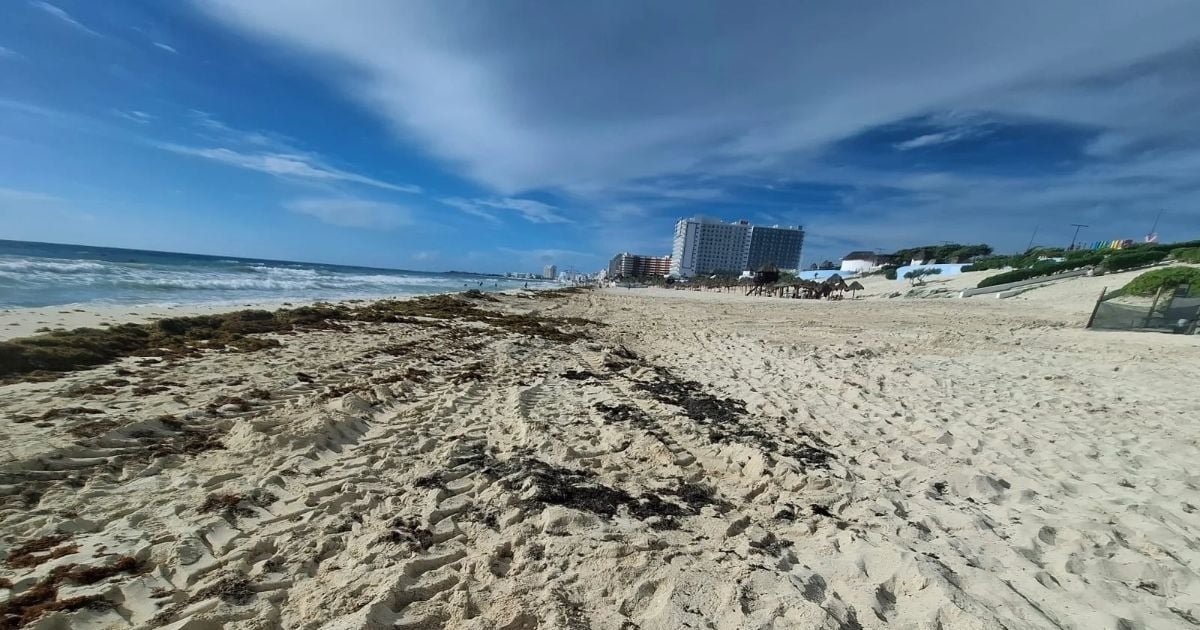
Cancún, Quintana Roo — Playa Delfines, the last large stretch of public beachfront on Cancún’s Hotel Zone that still opens onto the Caribbean, is facing a serious conservation crisis, according to environmental groups who report heavy machinery parked on the coastal dune and apparent failures in the protection of sea turtle incubation enclosures.
Katerine Ender Córdova, a lawyer, environmental activist and legal representative of the Movimiento Social en Pro de los Derechos del Pueblo, said she filed three legal actions on Oct. 13: two formal complaints — one with the Federal Prosecutor’s Office (FGR) over crimes and damage to biodiversity in a Natural Protected Area, and another with SEMARNAT and PROFEPA — along with a request for accountability addressed to the Ecology Department of the Benito Juárez municipality.
The complaints name Texius México, S.A. de C.V., a firm commercially linked to América Móvil and contracted to maintain fiber-optic networks, accusing it of bringing excavators and heavy equipment directly onto the coastal dune during the critical hatching phase.
“We went to the site and saw the machines on the sidewalk, right in front of the property where the Gran Solaris project was going to be built. We urged them not to bring machinery onto the dune because we are in the middle of hatching season. There are serious omissions that alter biological information and the species’ philopatry cycle,” Ender said.
Inspections and witness accounts gathered by the group point to operational irregularities: no biologists or trained personnel present at the enclosures during the early morning hours, changes to the dune’s profile and improper handling of newly hatched turtles.
According to residents’ accounts, the hatchlings were collected in buckets and kept inside the public restrooms at the Playa Delfines lookout before being moved in vehicles, in violation of protocols that require releasing them at the nesting site.
The FGR has opened an investigation file and begun the corresponding expert inspections. In parallel, the activists will ask the Public Works Department and SEMARNAT to review the legal status of the Gran Solaris property, which has been closed since 2020, seeking the definitive annulment of outdated environmental impact statements and the restoration of the ecosystem.
More Environment
- Semarnat Denies Permit for Beach Restoration Project in Puerto Morelos
- Cancún Hoteliers Push to Reactivate Beach Recovery Trust
- Experts Warn of Climate Crisis in Mexican Caribbean, Urge Urgent Action
- Scientists Say Sargassum Must Be Stopped in the Atlantic, Not on Cancún’s Beaches
- Mexico’s Environment Ministry Denies Permits for Kantal Megaproject North of Playa del Carmen
More Cancun
- Same-Sex Couples in Cancún Face Hurdles Certifying Concubinage
- Cancún–Isla Mujeres Boat Cooperatives Sink Under Heavy Losses as Only 20 of 130 Vessels Stay Active
- Vacation Rental Host Confronts Visitax Charge at Cancún Airport
- Graffiti Artists Erase Cancún’s ‘Wall of Corrupt Politicians’ as Activists Prepared to Restore It
- Cancún Named World’s Most Active City in World Wellness Weekend 2026