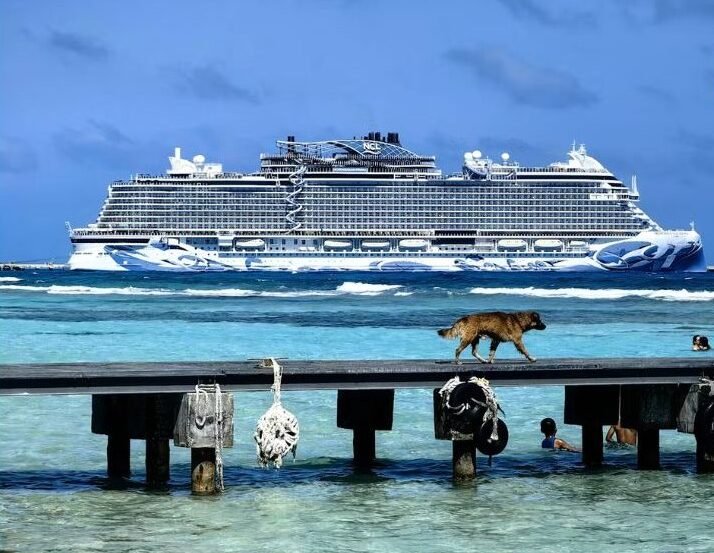
Mahahual, Quintana Roo — The cruise industry is one of the most important sectors for tourism in Mexico and the Mexican Caribbean, but the economic benefits rarely reach the ports that host the ships, according to experts and local residents.
José Antonio Barragán Ojeda, a professor at the National Autonomous University of Mexico (UNAM), described the cruise business as an oligopoly, with most profits staying with a handful of international lines while destinations like Mahahual continue to lack basic infrastructure and services.
The controversy over Royal Caribbean’s proposed Perfect Day water park at the Costa Maya port brought the issue to national attention. Although the project was canceled after environmental and social concerns, it exposed an uncomfortable reality: Mahahual has received thousands of visitors for years without seeing significant improvements for its residents.
Mass Tourism Without Local Development
Deteriorated or unpaved streets, frequent power outages, garbage collection problems, deficient urban services, and insufficient infrastructure contrast with the image of prosperity associated with international tourism. For many residents, the development promises made when the Costa Maya port was established remain unfulfilled.
Cruise tourism is one of the fastest-growing segments worldwide and in Mexico. Data from the federal Tourism Secretariat indicate that 3.6 million passengers arrived in the country during the first quarter of 2026, nearly 10% more than in the same period last year. However, the growth does not necessarily translate into well-being for the communities where the ships dock.
Barragán Ojeda began studying this phenomenon during discussions related to the Tren Maya and tourism development processes in the Yucatan Peninsula. His research led him to conclude that the cruise industry functions as an oligopoly.
Although many commercial brands exist, most of the market is controlled by a few corporate groups. Royal Caribbean, Carnival, and Norwegian together hold about 85% of the global industry; adding Disney covers virtually the entire market. This concentration gives the lines enormous economic power and leverage in negotiations with tourist destinations.
Cruise Passenger Spending vs. Traditional Tourism
According to the researcher, the problem is that profits concentrate with those companies, while host ports receive a much smaller share of the economic benefits.
In theory, millions of passengers represent an opportunity to boost local economies, but in practice, the economic spillover is usually limited.
The numbers support this claim. When Barragán Ojeda analyzed official data, he found that before the pandemic, a cruise passenger spent an average of about $60 during a port visit. In 2025, that figure rose to around $85 per passenger. In contrast, a traditional international tourist spends about $1,200 during their stay in Mexico.
The difference stems from the cruise business model itself. On board, passengers have virtually everything included: accommodation, food, drinks, entertainment, shows, pools, bars, and recreational activities. As a result, when the ship arrives at destinations like Mahahual or Cozumel, many travelers have little incentive to buy local products and services.
“Cruises are not a means of transportation; they are the destination itself,” the academic said. Port calls are part of the package and usually last only a few hours. During that time, visitors may buy souvenirs, crafts, or take short tours, but they hardly generate an economic impact comparable to that of a tourist who stays several days in hotels, restaurants, and shops in the region.
Moreover, the predominant profile of cruise users contributes to this dynamic: foreign adults aged 45 to 70, many of them retirees, who have time for long trips and tend to avoid additional expenses after paying for all-inclusive packages.
Environmental Impacts of Cruise Tourism
The model also raises questions about its environmental impacts. Various specialists and local organizations have warned about polluting emissions from the use of heavy fuels, as well as the generation of liquid and solid waste.
In an area characterized by reefs, mangroves, and fragile coastal ecosystems, these concerns take on special relevance.
Members of the Salvemos Mahahual collective have pointed out that cruise ships produce significant emissions of carbon dioxide, sulfur oxides, and nitrogen oxides, in addition to large amounts of wastewater. All of this increases pressure on ecosystems that already face additional threats, such as the massive arrival of sargassum seaweed in the Mexican Caribbean.
For Barragán Ojeda, the case of Mahahual demonstrates the need to more rigorously evaluate the true impact of this activity. Although official statistics highlight the sector’s steady growth, the experience of this community shows that the massive arrival of cruise passengers does not guarantee better living conditions.
Perfect Day and the Debate Over Tourism Investment in Costa Maya
The cancellation of Perfect Day also highlighted the importance of incorporating community voices in decisions about new tourism investments.
The debate opened questions about who actually gets the profits from cruise tourism, who assumes the environmental and social costs, and what mechanisms can ensure that economic benefits remain in the territories.
After more than twenty years as one of the main cruise ports in the Mexican Caribbean, Mahahual remains an example of the gap between the promises of tourism development and the daily reality of a community that, despite the constant arrival of international visitors, continues to wait for the benefits it was promised.
More Economy
- Mexico City, Cancún and Puerto Vallarta Top Searches for Independence Day Weekend
- Coparmex Backs Bid to Add Bacalar to Chetumal Airport Name
- Unpaid Municipal Debt Worsens Garbage Crisis on Holbox
- US Pushes Rules of Origin for AI Hardware in USMCA Talks With Mexico
- Cancún Airport Posts Worst Day in Decades as Tourism Slump Deepens