
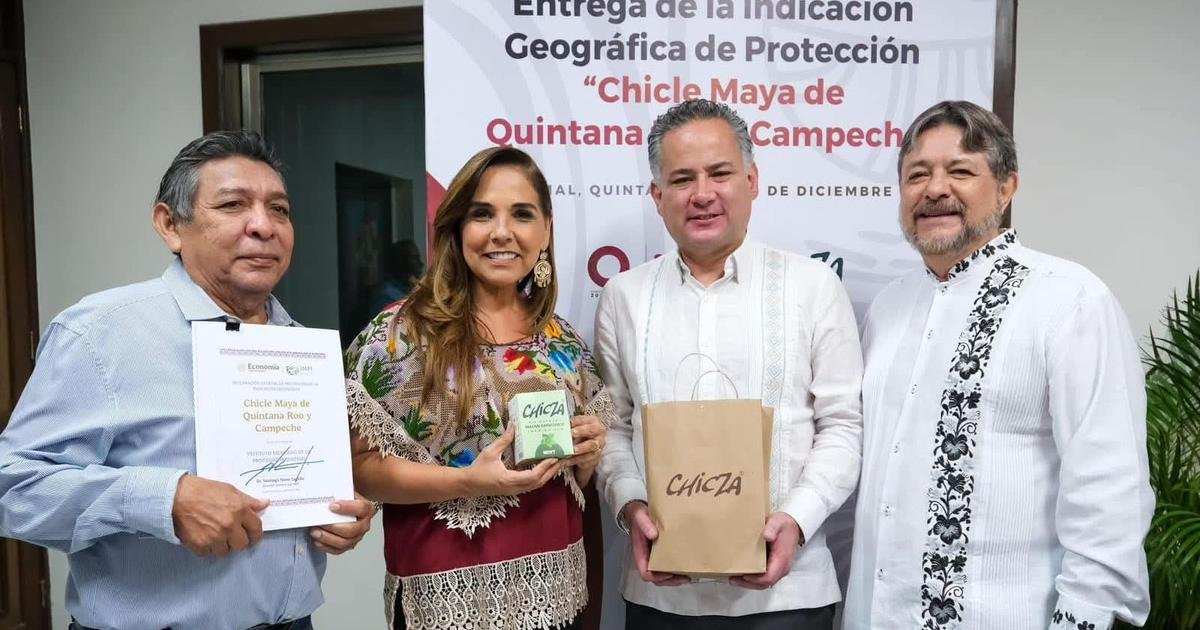
Chetumal, Quintana Roo — Two years after the Mexican Institute of Industrial Property (IMPI) granted geographic indication protection to Maya chicle from Quintana Roo and Campeche, the chewing gum still has no international registration, according to the Consorcio Chicza. Producers discovered the gap when they tried to enforce the certification in Europe.
Manuel Aldrete, the consortium’s director general, said the missing paperwork limits the chances of using the designation as a commercial tool to set natural gum apart from products made with synthetic bases. The recognition took six years of lobbying to secure, he added.
“We were the ones who promoted the initiative because we were looking for a tool to strengthen commercial activity, marketing, branding and the identity of chicle in European markets,” Aldrete said.
He recalled that the application went through six years of review before officials determined that the applicable protection was a geographic indication rather than a denomination of origin. Once that was settled, the recognition came together in roughly three months after state and federal authorities stepped in.
That progress has not yet translated into the international backing producers expected. Aldrete said one of Belgium’s leading retail chains recently told them it could not advertise the Maya chicle certification as long as the product did not appear on the relevant international platform.
“We were very surprised that one of the main distribution chains in Belgium told us we couldn’t advertise the geographical indication certification,” he said.
The company learned this week that the product was absent from the international register — one day after the second anniversary of the publication of its protection and decree in Mexico.
Certification aims to verify origin and traditional methods
The geographic indication is meant to certify that the chicle comes from the jungle of Quintana Roo and Campeche and is obtained from the latex of the chicozapote tree using traditional methods. The designation is registered with the World Intellectual Property Organization (WIPO) and the World Trade Organization (WTO). Its absence from the international listing, Aldrete argued, undercuts a marketing strategy built around demand for natural alternatives and raw materials of verifiable origin.
Aldrete also questioned why administrative procedures are not moving fast enough to turn legal recognition into economic benefits for producing communities.
“If officials don’t have the sensitivity to understand the problems we are facing and how they can help, it becomes difficult for things to move in favor of civil society and, above all, the national economy,” he said.
Consorcio Chicza has begun consulting its legal advisers in Mexico City to determine what procedure to file with the authorities. The organization is weighing a formal document — either a request or a complaint — demanding an explanation for the missing international listing.
So far, Aldrete said, the consortium has received no official answer on why the recognition does not appear on the public registry. The international step is covered by the protection declaration published by IMPI, which states that the institute will carry out the corresponding procedures under the treaties and trade agreements in force in Mexico.
More Culture
- Tulum Cemetery Full: 150 Unregistered Graves Face Exhumation
- Quintana Roo’s 150-Meter Day of the Dead Mural Eyes Guinness Bid
- Young Birders Hit 98 Species in Southern Quintana Roo
- Free Film Festival to Bring 40+ Movies to Southern Quintana Roo
- Cancún Offers Free Shuttles and Announces Road Closures for Janal Pixán 2026
More Zona Maya
- Huay Chivo: The Maya Monster Nobody Wants to Meet After Midnight
- In Maya Villages, the Bix Extends Day of the Dead Farewell to Souls Left Alone
- Bodega Aurrera to Open as José María Morelos’s First Department Store
- Teachers in Tulum Protest Poor Road Conditions to Chanchén Primero and Xulul
- Quintana Roo to Add ‘Puerta al Mar’ in Felipe Carrillo Puerto to Its Tourism Lineup
