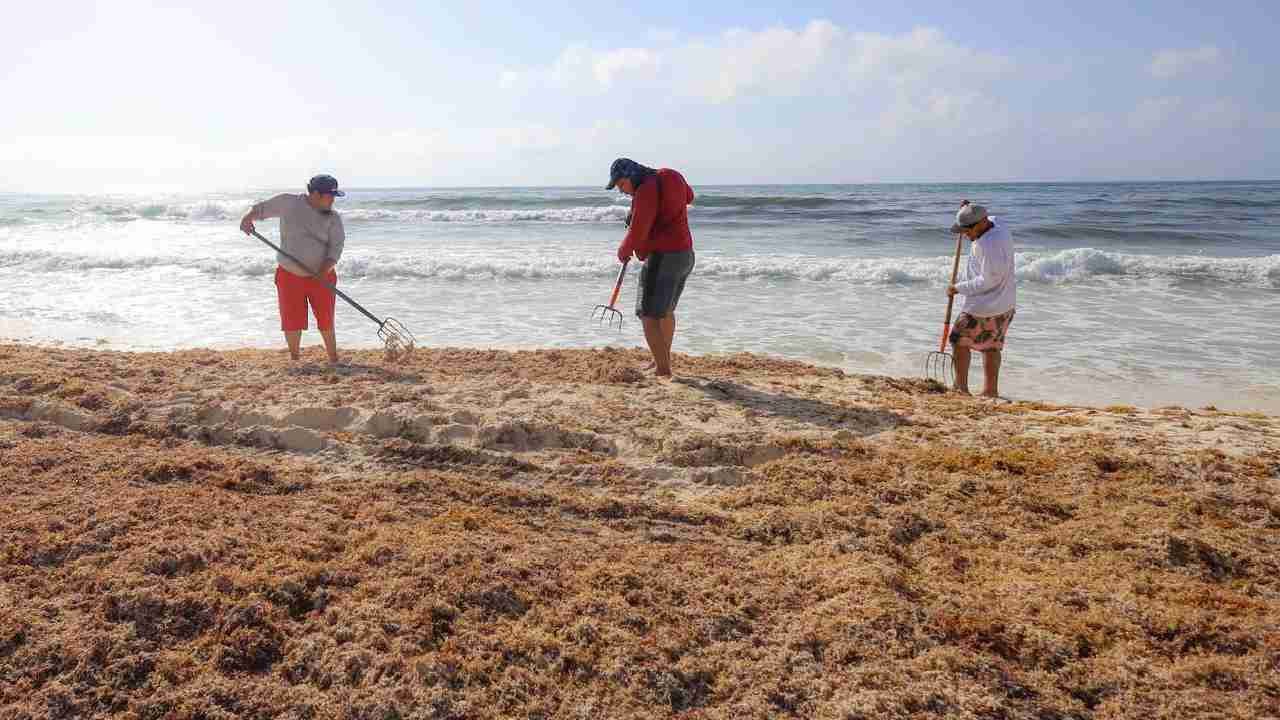
Cancún, Quintana Roo — Cancún’s municipal government has collected a record 28,140 metric tons of sargassum from local beaches between January and August, nearly doubling the amount removed during the same period last year, officials said.
Arturo Javier Quintero Díaz, head of the municipality’s Public Services Department, said the figure represents about 24.2% of the 116,443 tons collected across Quintana Roo so far this season, according to the state’s Environment and Ecology Secretariat (SEMA).
Near-Double the Pace of 2025
By the end of May, Cancún had already removed 16,000 tons of the seaweed — a volume similar to the total collected during all of 2025. Quintero Díaz said the city could hit 30,000 tons by the end of August.
The response has relied on coordination among the city’s beach zone authority (Zofemat), civil protection, and public services teams, along with permanent clean-up crews and heavy machinery.
In August alone, about 4,400 tons have been collected, up from just over 3,600 tons in July. Delfines, Coral, Ballenas, and Marlín beaches are among the most affected. Between 250 and 300 workers are involved in the clean-up effort.
Statewide Sargassum Effort
Across the state, Solidaridad — the municipality that includes Playa del Carmen — leads in sargassum removal with 40,602.97 tons, accounting for 34.9% of the state total. SEMA also reported that 11,955 meters of anti-sargassum barrier have been installed, out of a projected 16,030 meters.
More Environment
- Quintana Roo’s Beaches Are Disappearing Up to 14 Meters a Year
- Rabies Found in Fox That Scratched Baby in Cancún
- Cozumel’s Reefs Get a 3D Map Divers Can Explore Before Entering the Water
- Documentary Exposes 30 Years of Pollution in Cancún’s Chacmuchuch Lagoon
- Crocodile Surprises Tourists Swimming at Cozumel’s El Cielo Sandbar
More Cancun
- Cancún Brings Electricity to Three Popular Neighborhoods With 358 New Meters
- Quintana Roo Identifies 780 Irregular Settlements, Prepares Regularization Strategy
- Canada Drives Mexican Caribbean Demand for Final Quarter of 2026
- Funeral Services in Cancún Can Top 100,000 Pesos, Workers Say
- Coparmex Quintana Roo Prepares Businesses for Shorter Workweek