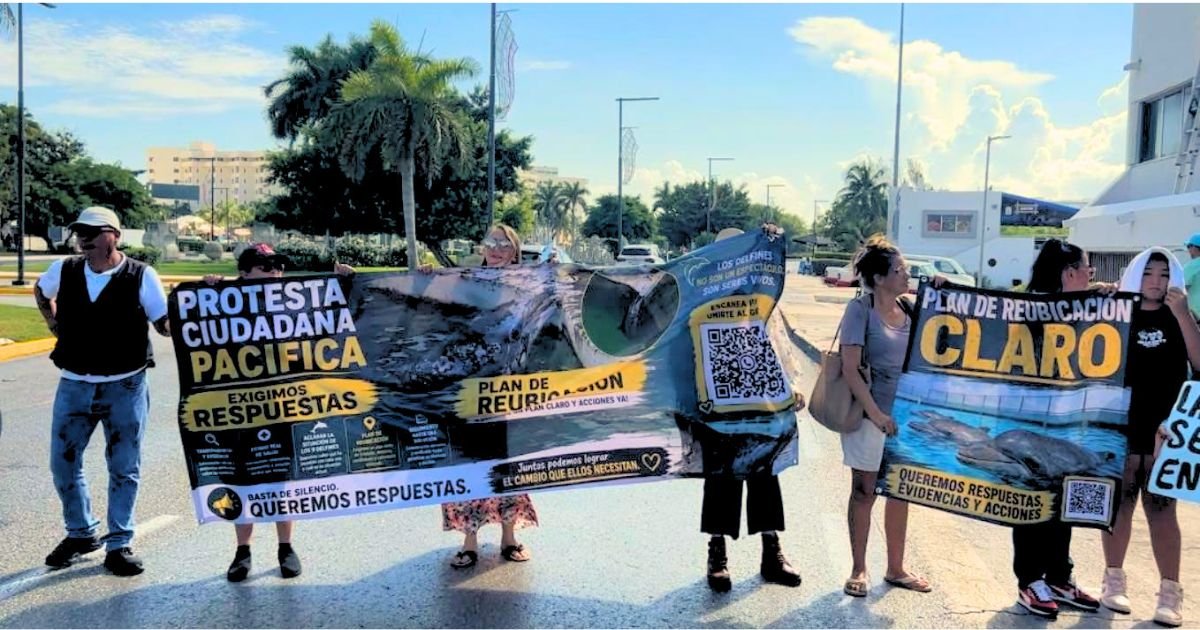
Cancún, Quintana Roo — Animal-welfare advocates partially blocked traffic in Cancún’s Hotel Zone on Friday while demanding firm dates for the relocation of nine dolphins being held at a closed facility near the former Ventura Park.
The demonstration took place outside the local offices of the Secretariat of Environment and Natural Resources (Semarnat). Protesters delivered a letter requesting detailed information about the dolphins’ medical care and a clear timetable for moving those healthy enough to withstand the journey.
The road was partially obstructed during the protest, affecting traffic through the area. Contrary to claims circulating on social media, there was no verified closure of the entire Hotel Zone.
The nine dolphins, named Solei, Oceanía, Mincho, Diego, Squalo, Flex, Apolo, Solomon and Satu, remain inside the former Dolphin Discovery facility in Punta Nizuc. The property has also operated under the names Dolphin Connection Cancún and Dolphinaris Cancún.
Activist Alia Sánchez said the group no longer wants general assurances that the animals will eventually be moved.
“We want a clear relocation plan with a date,” she said. “We have been hearing intentions like that for a year.”
Dolphins have serious health problems
The animals are not simply awaiting transportation. Federal environmental authorities have confirmed that all nine have chronic medical conditions and guarded prognoses. Some are older animals whose health could make relocation dangerous.
The Federal Attorney for Environmental Protection, known as Profepa, says only six are currently considered candidates to begin preparing for a possible move. That preparation could take months and does not guarantee that every candidate will eventually be cleared.
Mincho, Solei and Oceanía have been identified as the three most medically fragile animals.
A medical evaluation commissioned for Profepa documented eye disease, respiratory and gastrointestinal problems, anemia, malnutrition, dental damage and other chronic conditions among the group. Mincho reportedly has cancer of the tongue in addition to other health problems.
Profepa has confirmed that all nine dolphins have some form of eye disorder, seven have conditions affecting the tongue or other oral tissue and one has significant skin abnormalities. Testing also detected pathogens including E. coli and salmonella.
However, the widely shared claim that all nine dolphins have stopped eating has not been confirmed. Profepa says their individual feeding is being monitored as part of their daily care.
Facility closed after a history of dolphin deaths
Ventura Park suspended operations in January 2025. Profepa temporarily closed the adjoining dolphin facility in October of that year and placed the surviving animals under federal protection.
The intervention followed inspections that uncovered serious welfare concerns and a high mortality rate. According to information released by Profepa, 16 dolphins died at the facility between June 2018 and August 2025.
No dolphin has died there since the October 2025 closure, the agency says. Water quality has reportedly improved, and additional medical and environmental measures have been ordered.
Those measures include round-the-clock veterinary monitoring, afternoon enrichment activities, permanent shade over the pools, an expert review of the water circulation and life-support systems and modifications to concrete edges that could cause injuries.
Profepa acknowledges that the current tanks are not an appropriate permanent home. It maintains, however, that moving medically fragile dolphins prematurely could kill them.
“We know that transferring them to a semi-open marine enclosure would be an improvement, but first we must ensure that the transfer does not cost them their lives,” Profepa head Mariana Boy Tamborrell said in an agency report. The federal assessment describes the health concerns and preparations for a possible transfer.
Mincho’s case helped change Mexican law
Mincho became a national symbol of dolphin welfare concerns after a video showed him striking a concrete platform during a performance at the Barceló Maya Grand Resort in February 2025. Profepa later suspended activities at that dolphinarium and moved him to the Cancún facility.
His case helped build support for the wildlife-law reform commonly called the “Mincho Law.”
Published in Mexico’s official gazette on July 16, 2025, the reform prohibits captive breeding of marine mammals except for conservation purposes. It also restricts physical interactions with dolphins already in captivity and requires cetaceans to be moved from concrete tanks into sea pens or open-water installations.
Operators were given up to 18 months after submitting mandatory animal inventories to complete those transfers, following protocols established by Semarnat. The complete reform and transition requirements are available through Mexico’s Chamber of Deputies.
The law does not mean dolphins raised in captivity can simply be released into the ocean. Many depend on humans for food and medical care and may lack the skills needed to survive independently. Sea pens are proposed as an intermediate or permanent alternative, providing natural seawater, tides and greater space while keeping the animals under professional care.
Protesters want dates and public accountability
Advocates are asking Profepa and Semarnat to publish the health status and treatment plan for each dolphin, identify which animals can safely be moved and name the facility or sea enclosure being considered.
They also want the federal government to explain what will happen to the three dolphins considered too sick for immediate relocation.
A representative of the protest group was received inside the environmental offices while demonstrators remained outside. A copy of the petition had previously been delivered to Semarnat offices in Mexico City.
No relocation destination or departure date had been publicly confirmed as of Friday. The immediate dispute is therefore not over whether the dolphins should eventually leave the concrete tanks. Profepa and the activists largely agree on that point. The unresolved question is how quickly a move can happen without placing already fragile animals at even greater risk.
More Environment
- Playa del Carmen to Review Legal Status of Chen Zubul Property
- Quintana Roo Braces for Four Days of Heavy Rain and Flooding
- Sheinbaum Allocates 2 Billion Pesos to Fight Sargassum in Quintana Roo
- Five Ejidos Seek Alliance to Protect Chichankanab Lagoon in José María Morelos
- Maya Frog and Toad Shell Pendants May Reveal Ancient Trade Routes
More Cancun
- Cancun Tourism Slumps 7% as Industry Leaders Urge Marketing Overhaul
- Cancún’s Huayacán and 135 Avenue Roadworks Reach 65% Completion
- Cancun Planetarium Renovation Reaches 50 Percent, December Reopening Expected
- Cancún Prepares Janal Pixán 2026 at Puerto Juárez, Aims to Double Attendance
- MOBI Route 17 in Cancún to Offer Free Service From October 19 to 26