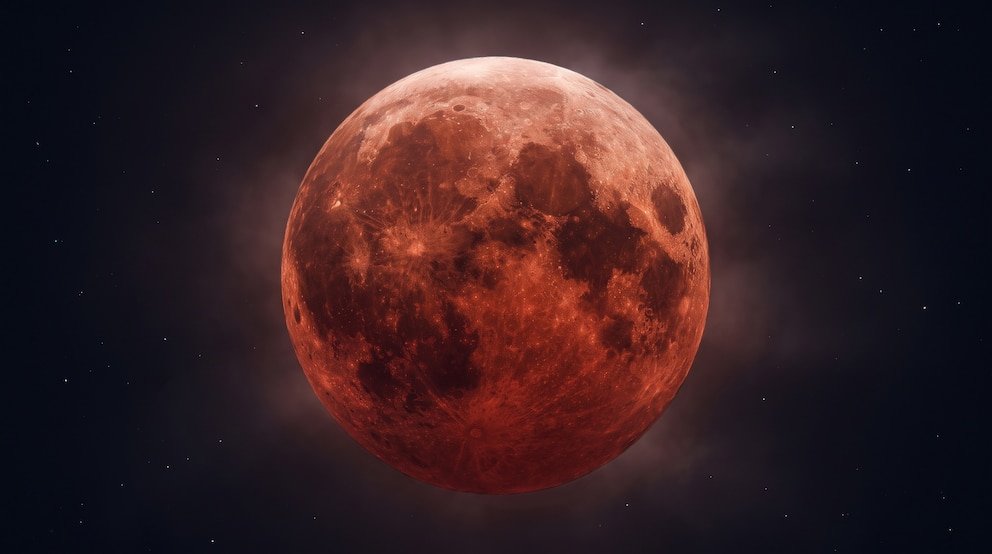
Mexico City — A partial lunar eclipse will sweep across Mexico on the night of August 27, turning the moon a striking reddish hue often called a “Blood Moon.”
Earth’s atmosphere acts like a filter during the eclipse, scattering blue light and letting predominantly red light pass through. That red light is projected onto the lunar surface, producing the characteristic fiery tint.
The phenomenon will be visible with the naked eye in all 32 states, though exact timings vary depending on time zone.
Key times for central Mexico
In the central time zone — which includes Mexico City, the State of Mexico, Puebla, Veracruz, Jalisco and most of the country — the eclipse follows this schedule:
- Penumbral phase begins: 7:23 p.m.
- Partial phase begins: 8:33 p.m.
- Maximum eclipse: 10:12–10:13 p.m.
- Partial phase ends: 11:51–11:52 p.m.
- Penumbral phase ends: 1:01 a.m. on August 28
Times by region
Pacific zone (Baja California, Sonora, Sinaloa, Nayarit): subtract two hours from central times. For example, in Baja California the penumbral phase begins at 5:23 p.m. and maximum eclipse occurs at 8:12 p.m.
Northwest zone (Chihuahua, Baja California Sur): subtract one hour. Penumbral phase begins at 6:23 p.m. and maximum eclipse at 9:12 p.m.
Southeast zone (Quintana Roo): add one hour. Penumbral phase begins at 8:23 p.m. and maximum eclipse at 11:12 p.m.
Tips for viewing the eclipse
To get the best view, authorities and astronomy organizations recommend:
- Check the weather forecast and look for a clear night, since cloud cover can block the view.
- Choose a location away from light pollution, such as rural areas, national parks or elevated spots outside cities.
- Wear comfortable clothing appropriate for nighttime temperatures.
- Arrive at least 30 minutes early so your eyes can adjust to the darkness.
- Bring a blanket, folding chair or bench for comfortable viewing.
- Use binoculars or a simple telescope to observe details on the lunar surface, though the eclipse is visible without equipment.
- Set up a camera with a tripod if you want to photograph the event, and adjust exposure for the different phases.
- Check the exact times for your time zone; in central Mexico the maximum occurs around 10:12 p.m.
- Avoid using a phone or bright flashlights so your night vision isn’t affected.
For more details, organizers recommend following guidance from Mexico’s National Institute of Astrophysics, Optics and Electronics (INAOE) and NASA.
More Lifestyle
- Quintana Roo Opens Addiction Rehabilitation Center in Cozumel
- Funeral Services in Cancún Can Top 100,000 Pesos, Workers Say
- Childhood Obesity in Quintana Roo Up 18.5%, Diabetes Cases Rise
- Feria Yucatán Xmatkuil 2026: Free Concerts and Full Lineup for November 6-29
- Isla Mujeres Cultural Night Blends Music, Dance and Breast Cancer Awareness