
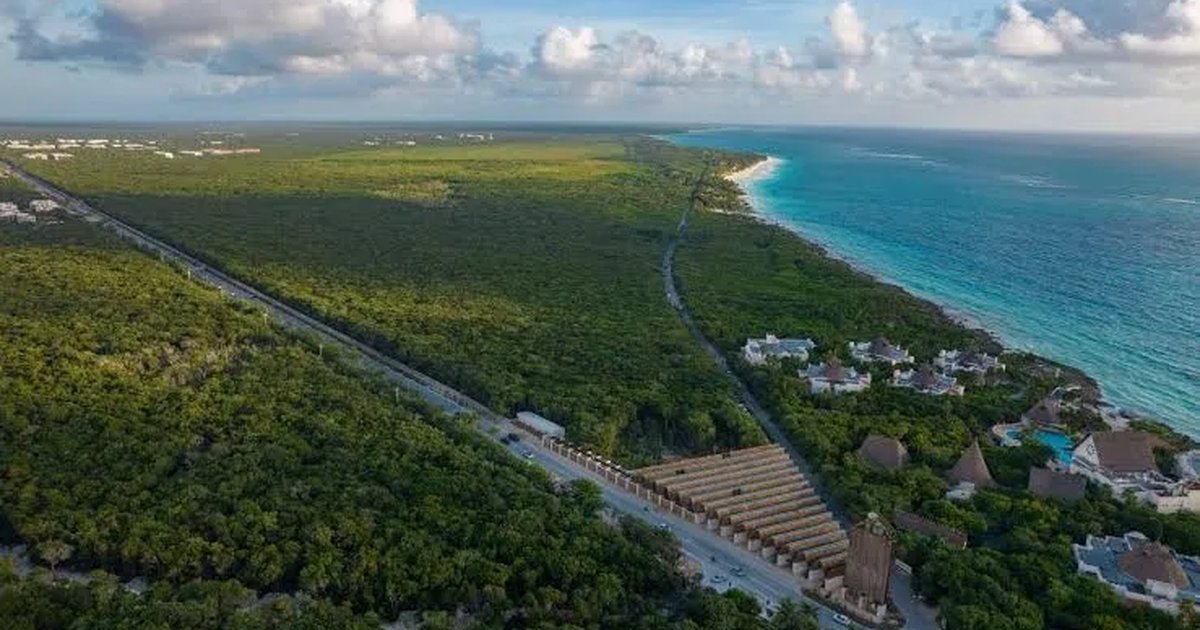
Tulum, Quintana Roo — Grupo Mundo Maya has asked the federal Environment Department (Semarnat) for permission to build a 158-space parking lot inside Parque del Jaguar, a request that would place almost the entire site within a preservation zone of the Tulum National Park.
The central figure in the company’s environmental impact statement is that 99.26% of the proposed land sits in a preservation subzone of the federally protected area.
The project, titled “Works to Improve Operations at Parque del Jaguar, Tulum, Quintana Roo (Parking Lot),” would take up one hectare beside the park’s south entrance, near Avenida Cobá and the road to Boca Paila.
Of the 10,000 square meters requested, 9,926 fall inside the Preservation subzone. Only 74 square meters are located in the public-use category covering entry roads.
Spaces, Solar Panels and Footpaths
The design calls for 78 standard uncovered spaces, 68 spaces under photovoltaic canopies, seven spots for people with reduced mobility and five bays for buses.
It also includes vehicle entrances, pedestrian walkways, ramps, lighting, surveillance cameras, planters and 300 solar panels.
The parking area and its functional surfaces would cover 8,665 square meters. The remaining 1,335 square meters would be given over to green areas and planters.
Study Acknowledges Damage to Vegetation and Wildlife
The filing acknowledges that the work would involve clearing vegetation, stripping topsoil and reshaping the ground.
Among the environmental effects it identifies are the loss of plant cover, the displacement of wildlife, habitat fragmentation and harm to specimens of species listed under NOM-059-Semarnat-2010, Mexico’s roster of protected species.
It also flags soil compaction, reduced water infiltration, changes to runoff patterns and alterations to the landscape.
While the assessment rates the overall impact as moderate, it concedes that some effects could be locally severe during site preparation and construction.
Why the Location Is Contentious
Tulum National Park is a federal protected area whose management plan sets out separate subzones to regulate which activities are allowed. The Preservation subzone exists to protect ecosystems and keep their ecological conditions intact.
Nearly the entire footprint of the requested parking lot falls within that category.
The consultants behind the study argue the project is compatible with the applicable environmental rules, provided the corresponding conditions are met and the necessary permits are issued. That conclusion belongs to the applicant and does not represent a favorable ruling from Semarnat.
The location leaves the regulator with a central question: whether infrastructure built to receive tourist vehicles fits within the restrictions of a preservation zone.
A 50-Year Operating Request
The applicant is Grupo Aeroportuario, Ferroviario, de Servicios Auxiliares y Conexos, Olmeca-Maya-Mexica, S.A. de C.V., which trades as Grupo Mundo Maya and holds airport and rail concessions in the region.
The company argues the lot would bring order to the arrival of visitors at the south access of Parque del Jaguar, cut down on vehicle maneuvering and make it easier to transfer to tours inside the park.
The project description sets two and a half months for preparation and construction and requests an operating life of 50 years. The document’s own opening summary, however, states six months of construction and 25 years of operation — figures that do not match the chapter that follows.
The proposal includes prevention, mitigation and environmental monitoring measures to address the impacts identified.
The document reviewed is an application for environmental assessment and does not establish that Semarnat has approved the construction. The agency must now weigh the project against the rules governing Tulum National Park and decide whether to grant authorization.
More Development
- Playa del Carmen Kicks Off Eight-Park Renovation Under Parquemanía Program
- Profepa Orders 25 Closures Over Illegal Land Clearing in Quintana Roo
- Explorers Connect O’Ho Tucha and Sac Aktún Cave Systems in Tulum
- Puerto Morelos Mayor Blanca Merari Tziu Reviews Paving Work in Leona Vicario
- Semarnat Approves Club 8 Beach Club in Puerto Morelos With Strict Environmental Conditions
More Tulum
- Tulum to Host Sixth Employment Fair With 524 Job Openings
- Tulum Council Approves Request for 75 Million Peso Credit to Cover Operating Costs
- United Airlines to End Tulum Flights in January 2027, Offers Refunds
- Tulum Construction Sector Sees Gradual Recovery After Tren Maya and Airport Boom
- Quintana Roo Promotes Underwater Tourism at DEMA Show 2026 in New Orleans