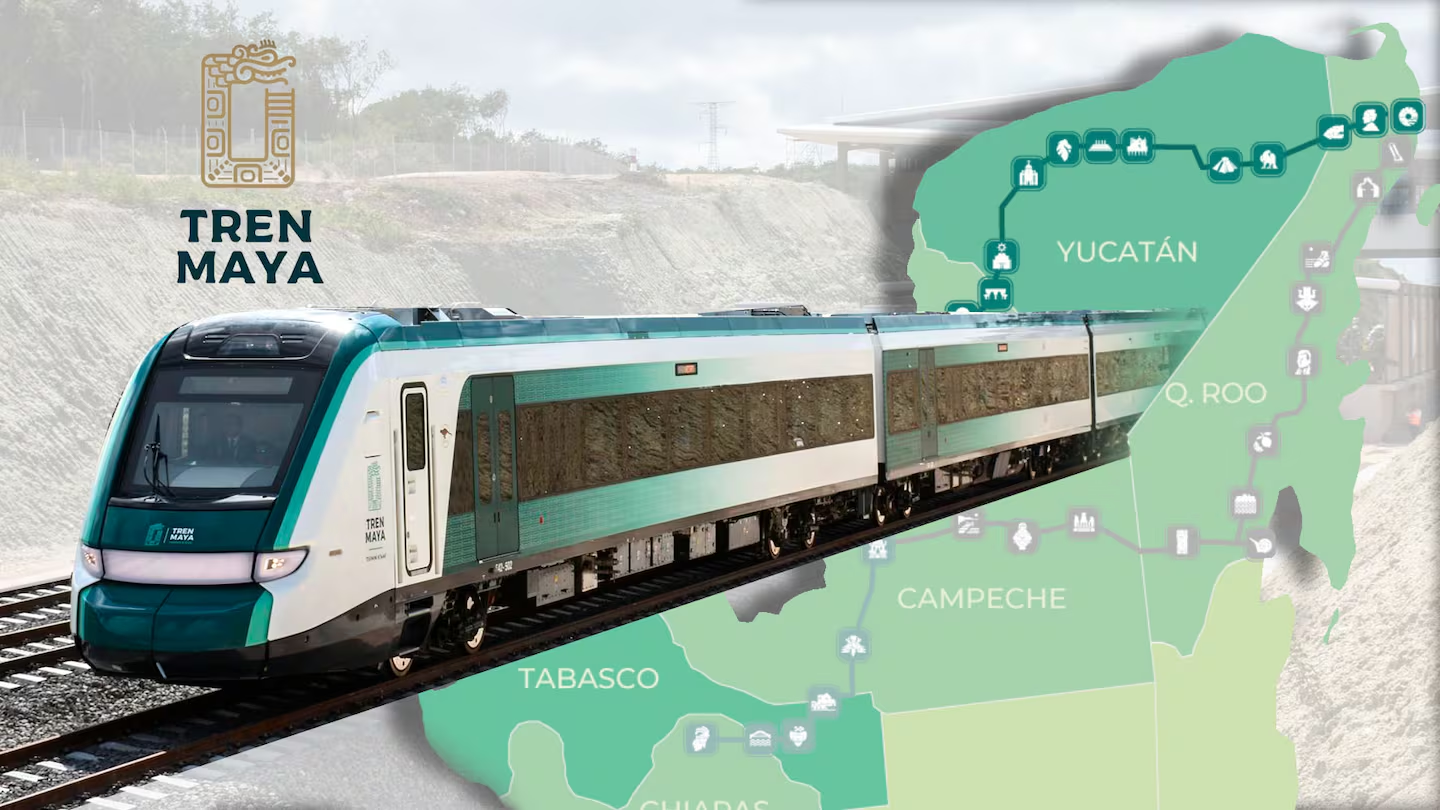
Mérida, Yucatán — The Yucatán Congress voted by a majority to donate six state-owned properties totaling 56 hectares to Tren Maya S.A. de C.V., the state-majority company building the railway, in a decision that drew sharp criticism from the opposition over the lack of appraisals and cost figures.
The land sits in the communities of Poxilá and Bolón, in the municipality of Umán. Under the approved decree, the parcels are to be used for the Tren Maya project, and the company must comply with rules on environmental conservation and the protection of archaeological and cultural sites.
PRI Lawmaker Challenges the Terms
The measure drew opposition from PRI lawmaker Gaspar Quintal Parra, who questioned why Congress would hand over the land free of charge without knowing its current value or how much the state paid to acquire it.
“We are not discussing whether we are for or against a train. What we are really discussing is something far more concrete: whether this Congress should authorize 56 hectares that belong to the people of Yucatán to be given away to a company, without the decree telling us what they cost the state, what they are worth today, what concrete economic benefit Yucatán residents will receive, or why a donation is a better option than any other legal instrument. For that reason, my vote will be against it,” he said.
Quintal Parra noted that the decree itself states that on May 20, 2025, the director general of the Tren Maya asked the Yucatán government for the donation of the 56 hectares — but that the state acquired the properties afterward.
He said five parcels in San Antonio Poxilá were purchased by the Instituto para la Construcción y Conservación de Obra Pública en Yucatán (Incopy), the state public works institute, on August 13, 2025, while the Bolón property, covering more than 33 hectares, was acquired on February 19, 2026.
“In other words, the Tren Maya’s request came first, and then the Yucatán government bought the land it now intends to give away. That sequence deserves an explanation,” he said.
He also criticized the decree for omitting an updated appraisal of the properties and the total cost of their acquisition for the state.
Morena Defends the Donation
Defending the measure, Morena lawmaker Eric Edgardo Quijano González said the request has a technical and legal basis and that the land will be used to continue the rail project.
“With these actions we guarantee the social function of their destination, since we also include a reversion mechanism,” he said.
He explained that if the donated properties are used for a purpose other than the one authorized, or are not used for the intended objective, ownership can return to the state.
“That way, Yucatán’s patrimony is protected and permanently subject to the general interest of the people of Yucatán,” he said.
The decree takes effect the day after its publication in the official gazette of the Yucatán state government.
Human Rights Council Appointments and Other Business
In the same session, the full chamber unanimously approved the call to appoint four members of the Consultative Council of the Yucatán State Human Rights Commission (Codhey). They will serve three-year honorary terms.
Lawmakers also approved reforms to the regulations governing the Legislative Branch Law concerning electronic voting through the legislature’s computer system, and ratified the appointment of a magistrate to the Administrative Justice Tribunal.
New Bills Sent to Committees
Several proposals were referred to committees, including measures to strengthen the state adoption system and to declare the Yucatecan guayabera intangible cultural heritage. Others would set rules on pedestrian crossings, guarantee comprehensive health care during perimenopause, menopause and andropause, and declare smoked meat an emblematic traditional dish of Temozón.
Morena lawmaker José Julián Bustillos Medina introduced a bill to reform the state law protecting people involved in criminal proceedings, so that the State Prosecutor’s Office and the anti-corruption prosecutor incorporate a gender perspective when setting protection measures.
PAN lawmaker María Teresa Boehm Calero proposed reforms to the Health Law to strengthen maternal and neonatal care, emphasizing that it be continuous, timely, safe and comprehensive, and improving coordination for pregnant women and newborns who need specialized services.
Fellow PAN lawmaker Sayda Melina Rodríguez Gómez put forward a proposal to amend the Health Law on perinatal mental health, creating mechanisms for the early detection of postpartum depression and other mental health disorders during pregnancy and the postpartum period, and guaranteeing care and follow-up.
Citizens’ Movement lawmaker Abigail Uc Canché proposed changes on the use of and access to the Maya language in legislative work. Her initiative would extend the time allotted for remarks delivered in Maya and require the translation of the most relevant matters put to a vote.
Gaspar Quintal Parra also introduced a bill on digital sexual violence and the use of artificial intelligence to create, alter or distribute sexualized content without consent. The proposal sets obligations for educational institutions, including accessible and confidential reporting channels, risk assessments, protection measures, referrals to authorities, and access to psychological, legal and educational support.
Lawmakers Bayardo Ojeda Marrufo and Alba Cob Cortés also spoke from the floor, and Ana Cristina Polanco Bautista presented a point of agreement on civil protection legislation, which the assembly admitted for a second reading.
The next session is scheduled for Thursday, September 24, at 11 a.m.
More Government
- Playa del Carmen Launches ‘Parquemanía’ to Revive Public Parks
- Playa del Carmen Council Approves New Unit for Older Adults
- Quintana Roo Expands Tourist Police Force With Specialized Training Programs
- CURP Digital vs CURP Biométrica: What Mexico’s New ID Means for Online Bank Accounts
- Playa del Carmen Mayor ‘Very Upset’ With Parking Meter Operator Playaparq