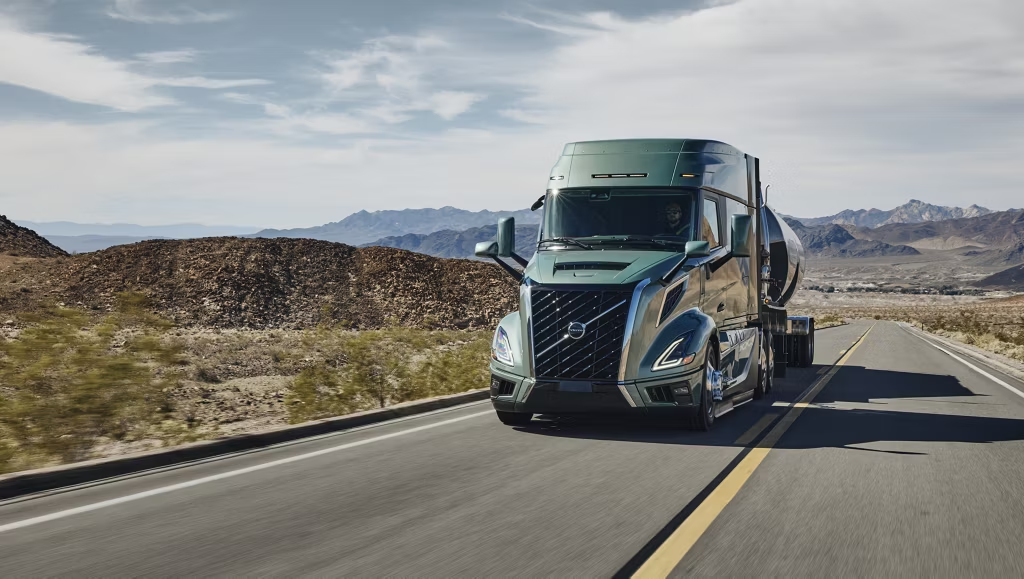
Nuevo León, Mexico — Volvo has begun exporting trucks from its new manufacturing plant in northern Mexico, sending its first four locally built tractor-trailers to customers in Canada.
The inaugural shipment left Ciénega de Flores on Aug. 19. The Volvo VNR 300 day-cab trucks traveled along the new La Gloria-Colombia highway to the Colombia-Laredo border crossing, where they entered Texas before continuing to Ottawa and Kingston.
Mexican vehicle logistics company MEXLOG is handling the delivery. State officials said export volumes are expected to increase gradually, although Volvo has not publicly announced a production target for the plant’s first year.
The four trucks are designed for regional hauling and urban delivery rather than long-distance routes requiring sleeper cabs. They feature diesel engines producing up to 455 horsepower, automated transmissions and a shorter, lighter design intended to improve visibility and maneuverability in crowded loading areas and city streets.
While the first shipment is small, it marks the beginning of commercial exports from one of Mexico’s most closely watched new manufacturing investments.
Volvo originally announced the plant in 2024 with an investment of approximately $700 million. The project was designed as a complete assembly facility for Volvo Trucks and Mack Trucks, including cab-body production and painting, rather than a plant limited to components or final finishing. The investment was later increased to approximately $1 billion, according to Mexico’s Economy Ministry.
Nuevo León officials describe the 200,000-square-meter facility as Volvo’s largest truck plant in the world. The state expects it to eventually support between 2,000 and 2,500 direct jobs, along with additional employment among suppliers, transportation companies and industrial-service providers. Those are projections, however, and Volvo has not yet released current staffing figures.
The location was selected in part because of its proximity to the United States, an established automotive workforce and access to supply chains serving northern Mexico and Texas. Volvo said the plant would complement, not replace, its existing U.S. production facilities in Virginia and Pennsylvania.
The added capacity is intended to support Volvo and Mack sales in the United States and Canada, along with Mack sales in Mexico and Latin America. The company has said the Mexican plant will give it greater flexibility and make it easier to supply customers in the western and southwestern United States.
The first Canadian delivery also gives the Colombia-Laredo crossing a role in Volvo’s North American distribution system. The newer border route provides an alternative to more congested crossings in the Laredo area and connects directly with the La Gloria-Colombia highway.
Volvo arrives in an industry Mexico already knows well. Manufacturers in the country produced 14,675 heavy vehicles in July alone and exported 13,117, according to data from Mexico’s national statistics agency INEGI and industry group ANPACT. July exports were up 66.7 percent from the same month in 2025, although production and exports had been weaker earlier in the year.
The plant is also opening during an unsettled period for North American trade. Mexico’s truck industry remains heavily dependent on the U.S. market, while tariffs and the 2026 review of the USMCA trade agreement have created uncertainty for manufacturers planning cross-border production.
For Volvo, the first Canadian shipment is therefore more than a ceremonial delivery. It confirms that the plant has moved from construction and equipment testing into commercial production, with finished Mexican-built trucks now entering the North American market.
More Economy
- Starbucks Exits Tulum: Why the Hotel Zone Is Losing Its Buzz
- Cancún Brings Electricity to Three Popular Neighborhoods With 358 New Meters
- Funeral Services in Cancún Can Top 100,000 Pesos, Workers Say
- Riviera Maya Forum Pushes Caribbean Mexico Toward Regenerative Tourism
- Coparmex Quintana Roo Prepares Businesses for Shorter Workweek