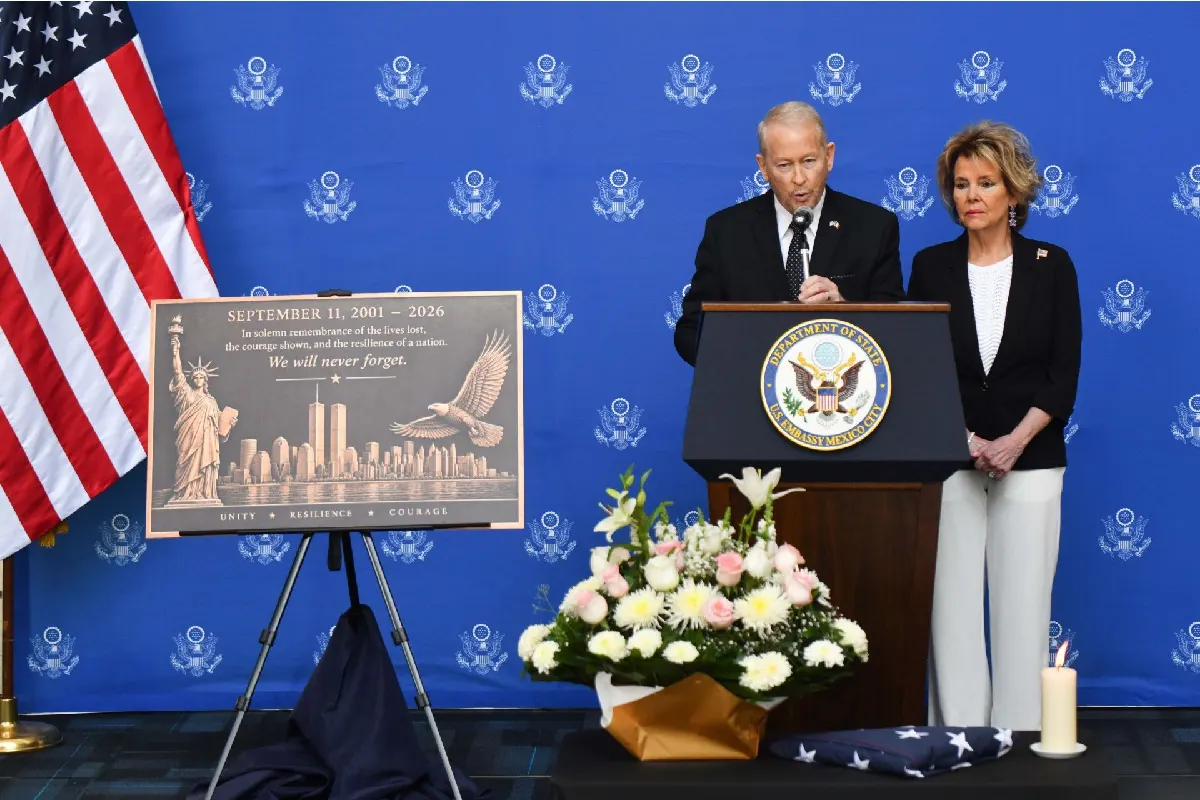
Mexico City — U.S. Ambassador to Mexico Ronald Johnson said Friday that drug cartels pose a threat to free societies, tying their designation as foreign terrorist organizations to the dangers Washington faces 25 years after the Sept. 11, 2001 attacks.
Speaking at the unveiling of a commemorative plaque in the central courtyard of the U.S. Embassy in Mexico City, Johnson said President Donald Trump “has recognized the threat posed by the cartels” and has designated them as foreign terrorist organizations.
The ambassador argued that these groups do more than traffic drugs, using violence and pressure to control communities.
“These are not simply drug trafficking organizations. They use murder, violence, corruption and intimidation to control entire communities and impose their will,” he said.
Johnson said cartels also threaten and harm ordinary people, and suggested terrorism can take many forms, urging vigilance against current threats.
“So terrorism can change its methods and its appearance, but we must never blind ourselves to what it really is,” he said.
A 9/11 Tribute
The reference to cartels formed part of Johnson’s remarks at the commemoration of the Sept. 11, 2001 attacks, a series of four coordinated jihadist suicide attacks carried out in the United States by the terrorist group Al Qaeda.
The ambassador said honoring those who died in the attacks also means keeping in mind the threats the United States faces today.
“Honoring those we lost on Sept. 11 means remembering the threats we faced then and staying vigilant against the threats we face today,” he said.
Five floral offerings were placed during the ceremony. The fifth was dedicated to Los Topos, the Mexican rescue group that took part in the recovery efforts after the attacks.
“Americans stood firm and united. Our allies and friends stood by our side. Mexico was with us too. And some more than others: members of Los Topos and other Mexican volunteers,” Johnson said.
Diplomatic Tension and Mexico’s Response
Johnson’s remarks on cartels came a day after U.S. Secretary of State Marco Rubio wrapped up a tour of Colombia, Ecuador and Peru, where he discussed cooperation with regional governments on fighting drug trafficking and organized crime.
During his stop in Quito, Rubio said Mexico’s fight against drug cartels “is nowhere near enough,” even as he acknowledged the country has confronted those organizations. He also warned that the United States would take on criminal groups “one way or another.”
President Claudia Sheinbaum responded to those comments and attributed the statements by U.S. officials to the electoral context in the United States.
“Each in their own territory, each in their own election,” the president said during her morning news conference.
Sheinbaum also said U.S. officials have sent contradictory messages about Mexico’s efforts against cartels.
“One day they say, ‘No, Mexico is doing its job very well and we coordinate very well.’ And the next day: ‘No, but they are not doing enough,'” she said.
Limits of Military Cooperation
Rubio also said during his tour that the United States will not take military action against drug traffickers in Latin America without the approval of its allies. He explained that Washington has “the capacity to act unilaterally” but prefers to work with its partners, which he considers “the most effective way to do it.”
“We will not do anything our partners do not ask us to do. This is a democracy,” he said.
The secretary of state also said, however, that U.S. armed forces “will still blow up boats if necessary.”
Trump Marks 9/11 at the Pentagon
Johnson’s message in Mexico coincided with the ceremony Trump led Friday at the Pentagon for the 25th anniversary of the Sept. 11 attacks.
The U.S. president chose not to attend commemorations in New York and took part in the ceremony at the Pentagon, where he said the United States will not forget the attacks and will keep fighting.
“Today we renew the sacred oath we first made in their names a quarter of a century ago. We will never, ever forget. That is why we fight today,” Trump said.
The president added: “We have no choice. There can only be victory. We fight hard. We fight to win.”
Defense Secretary Pete Hegseth said during the event that the battle against jihadism continues, listing among current threats “Islamic terrorists abroad and in our own country.”
Hegseth also referred to Iran, saying the United States had acted against that country over the previous six months and calling it “the world’s most prolific state sponsor of terrorism.”
The war with Iran began in February with U.S. and Israeli strikes, according to the information provided. Seven months later, the conflict had spread across the region through Iranian retaliatory attacks on Gulf neighbors and actions by its Houthi allies against Saudi Arabia.
More Government
- Hotel and Business Groups Warn 35.8% Non-Resident Fee Hike Threatens Quintana Roo Tourism
- Latinus Audio: Businessman Says He Gave Money to Marina del Pilar’s Campaign
- US Northern Command Praises Mexico’s Anti-Drone Efforts
- Trump Says US Will Not Exit USMCA and Promises ‘Great Relationship With Mexico’
- Chetumal’s Barrio Mágico Project to Temporarily Relocate 50 Street Vendors