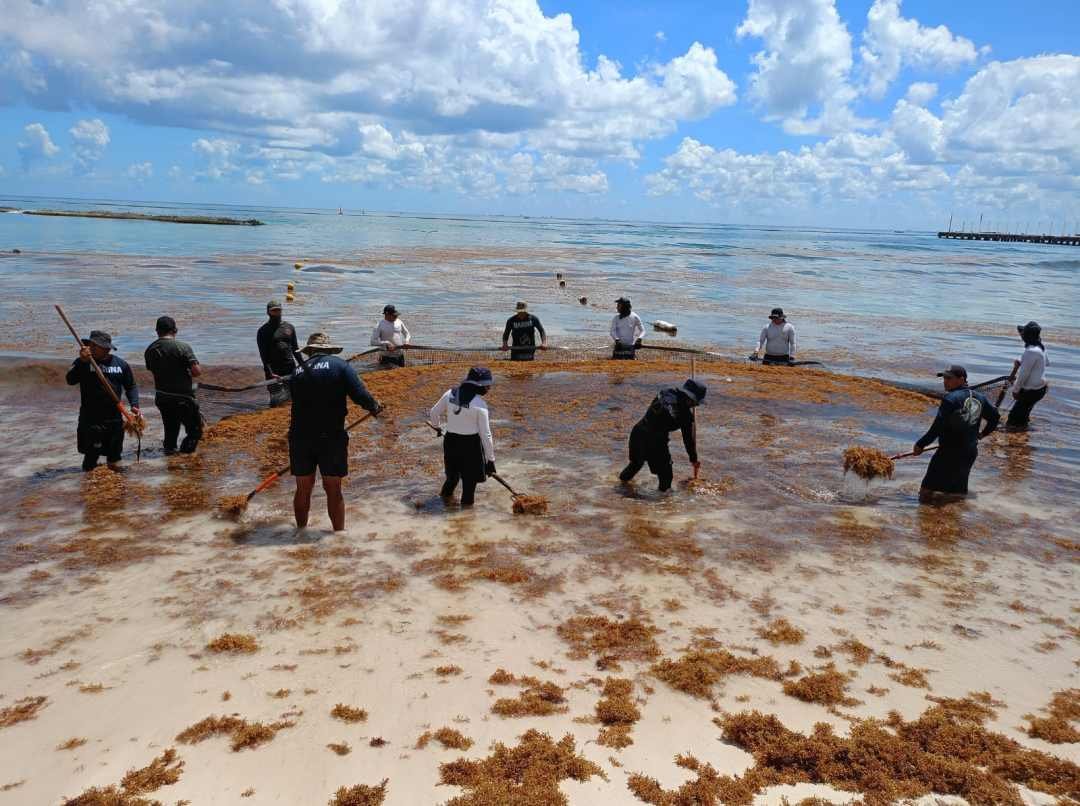
Mexico City — The massive arrival of sargassum on Quintana Roo’s coasts is not only an environmental and tourism problem but also a health risk for the workers who clean the beaches daily, according to a new international study involving the National Autonomous University of Mexico (UNAM).
Researchers found that workers collecting sargassum on beaches in Puerto Morelos, Playa del Carmen, and Mahahual suffer from ailments ranging from headaches and dermatitis to difficulty breathing and nail loss, due to prolonged exposure to hydrogen sulfide (H2S) released by the decomposing seaweed.
The study, conducted with support from the University of São Paulo and Canada’s New Frontiers in Research Fund, monitored 35 sargassum workers using portable sensors placed at chest level to measure toxic gas concentrations in real time during their shifts.
Results showed that 46.9% of workers experienced itching and burning skin; 43.8% suffered headaches; 37.5% reported dermatitis and fatigue; while others reported dizziness, nausea, eye irritation, nasal congestion, and respiratory problems.
The research warns that risk increases significantly when sargassum accumulates for several days and begins to decompose, emitting hydrogen sulfide — a toxic gas recognizable by its rotten egg smell. In some cases, measurements detected concentrations exceeding limits set by Mexican and international standards.
Rosa Rodríguez, a researcher at UNAM’s Institute of Limnology and Marine Sciences, explained that cleanup work can last up to nine months a year, with eight-hour shifts six days a week, increasing cumulative exposure risks.
Specialists recommended urgent protective measures, including mandatory use of safety equipment and respirators, continuous toxic gas monitoring, staff rotation, and permanent medical surveillance for sargassum workers.
The problem comes amid forecasts of one of the most severe sargassum seasons in the Mexican Caribbean. Researchers estimate that up to 40 million metric tons of biomass could accumulate in the Atlantic this year, increasing environmental, economic, and health impacts in Quintana Roo.
More Lifestyle
- Hundreds of Riders Expected for Tulum’s Fourth Federated Horseback Ride
- Quintana Roo Plans Two Wastewater Plants and Two Aqueducts for Cancún and Playa del Carmen
- Playa del Carmen Ranks Second in HIV Cases in Quintana Roo, Official Says
- Cancún Taco Festival Aims to Revive Local Economy in Low Season
- Screwworm Cases Detected in Two Dogs and a Horse in Tulum