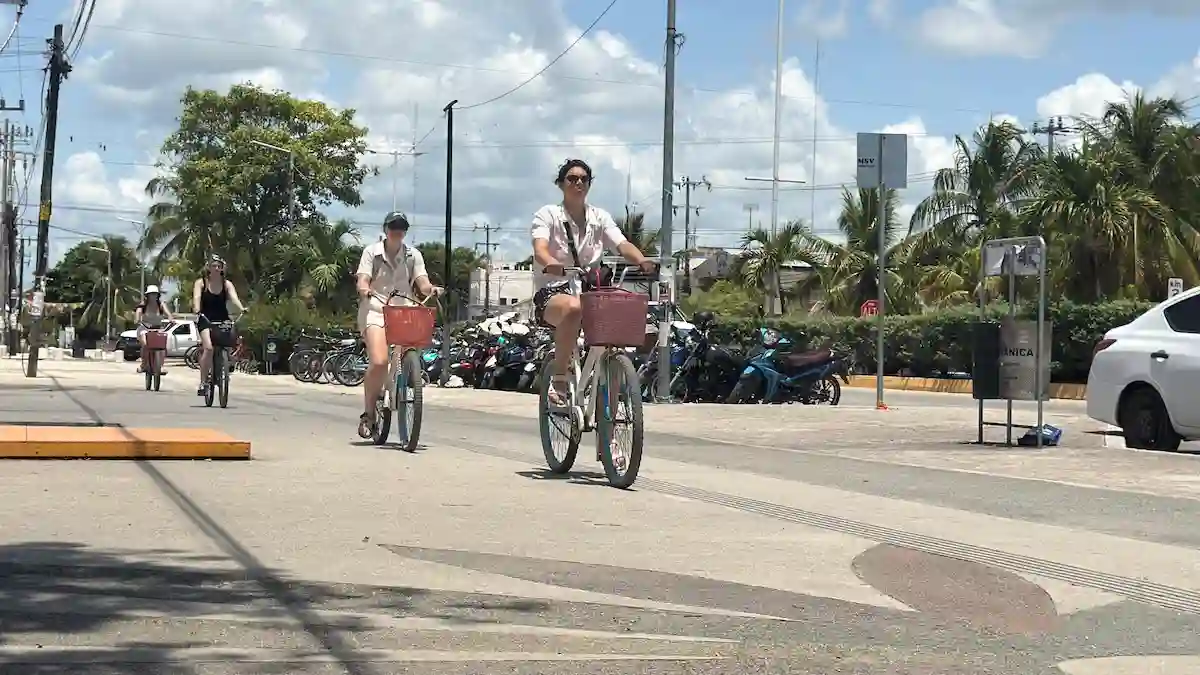
Tulum, Quintana Roo — Specialists and representatives of the construction sector are urging Tulum’s municipal government to dust off the Plan de Movilidad Activa de Tulum (PACTUM), the city’s active mobility plan, and begin developing executive projects that can improve conditions for pedestrians and cyclists as the municipality continues to expand.
Speaking on World Pedestrian Day, commemorated Sunday, August 17, Fernando Aznar Pavón, former president of the College of Engineers and Architects of Tulum, said the municipality has had the technical document since 2022 and that it is time to recover its proposals, set priorities and start implementing the actions it outlines.
“I think it is time to resume the famous PACTUM so that projects and analyses can begin and priorities can be set,” Aznar Pavón said. He added that the plan can serve as a basis for defining mobility interventions and identifying which ones need attention first.
PACTUM was developed by the federal Secretariat of Agrarian, Territorial and Urban Development (Sedatu) in coordination with the German Development Cooperation (GIZ) and the Tulum city council. Published on November 10, 2022, the instrument emerged from participatory diagnoses involving authorities, private-sector representatives, civil society organizations and activists.
Its main goals include promoting walking, cycling and other forms of active mobility through accessibility criteria, road safety, connectivity, universal design, traffic calming and intersection improvements. The plan lays out stages ranging from diagnosis and executive projects to resource management, execution and public outreach.
Aznar Pavón stressed that turning the proposals into infrastructure requires more than drawings. “An executive project is not just making the plan. You have to carry out the socioeconomic analysis, the financial analysis, calculate costs and have the complete project so you can request resources,” he said.
He called on the Tulum city council, civil organizations and professional associations to coordinate efforts to update the proposals and complete the necessary studies, noting that professional colleges are willing to provide technical support and help create projects that can later attract public funding, external funds or private investment.
The appeal comes as PACTUM itself identified problems linked to Tulum’s rapid growth, including fragmented urban expansion and infrastructure gaps that make non-motorized travel difficult and push residents toward car use. Under Mexican mobility law, pedestrians hold the highest priority in the transportation hierarchy, and Aznar Pavón said Tulum now has the technical foundation to put that principle into practice.
“I invite organizations and the municipality itself to pick it back up and start working on the projects,” he concluded.
More Development
- Fonatur Weighs Options for Contested Malecón Tajamar Land in Cancún
- Pending Urban Development Plan Stalls Real Estate Growth in Cruz de Servicios, Playa del Carmen
- Developer Proposes 425-Hectare Resort With Artificial Beach North of Playa del Carmen
- Tulum Rethinks Real Estate Growth Over Risks to the Great Maya Aquifer
- Quintana Roo Warns Against Unchecked Hotel Growth as It Courts Brazil and Colombia
More Tulum
- Riviera Maya Hotel Chief Calls Tulum Airport ‘Critical’ as Airlines Exit
- Tulum Hosts Nine US Universities and Team Mexico at NCAA Division II Golf Shootout
- Tulum Residents Identify Five Sites Where Homeless People Gather
- Volaris to Suspend Tulum Airport Flights, Second Mexican Carrier to Pull Out
- Tulum Launches Credentialing Program for Parque del Jaguar Tourism Workers