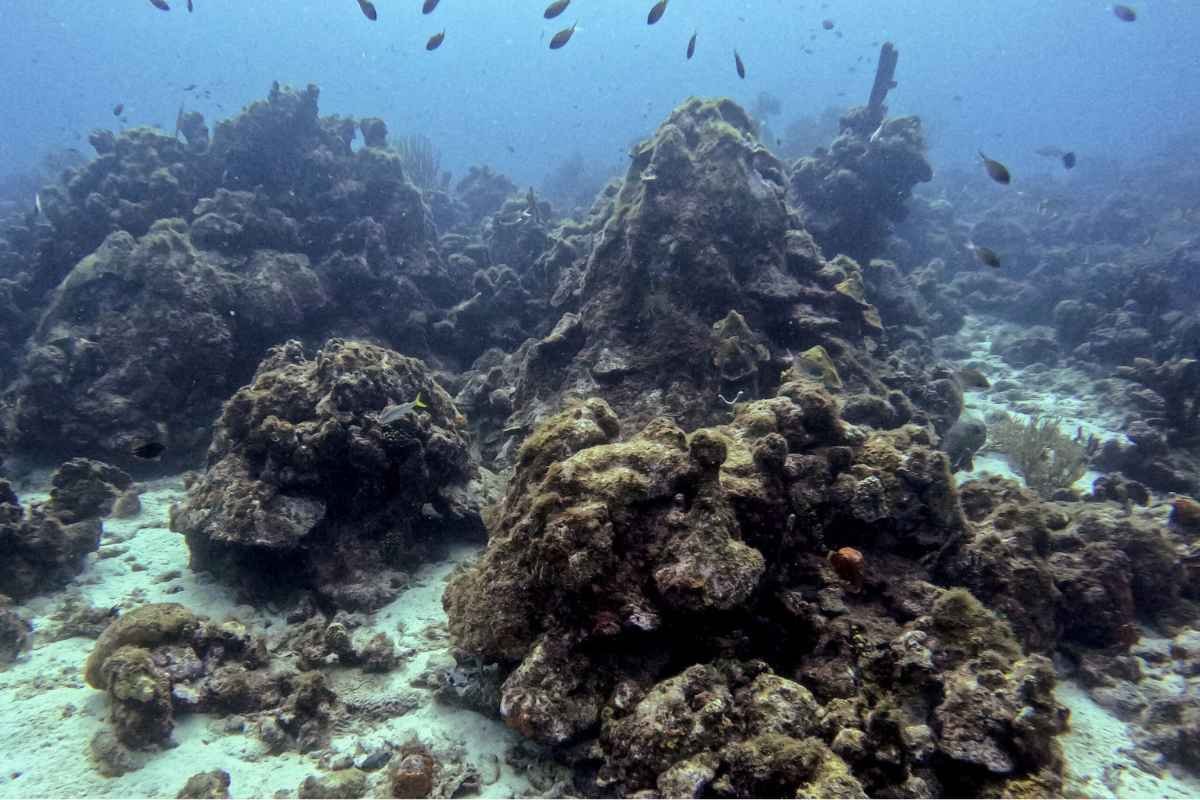
Quintana Roo — The coral reefs off Quintana Roo belong to an ecosystem that the International Union for Conservation of Nature (IUCN) has classified as critically endangered, in its first global assessment of coral reefs, published Oct. 22.
The Mesoamerican Reef System, which runs along the coasts of Mexico, Belize, Guatemala and Honduras, is among the ecosystems facing the highest level of threat, the scientific body found.
The assessment warns that 96% of the 127 reef ecoregions studied worldwide are critically endangered, mainly because of ocean warming and marine heatwaves.
The classification does not mean the reefs have already disappeared. It means they face an extremely high risk of losing their ecological functions over the next 50 years.
A system that shields the coast
The Mesoamerican Reef includes coral formations off Quintana Roo tourist destinations such as Puerto Morelos, Cozumel and the Costa Maya.
These ecosystems provide shelter, food and breeding grounds for numerous marine species. They also help protect the shoreline from wave action and underpin economic activity tied to fishing and tourism.
The new IUCN Red List of Ecosystems evaluated ten Caribbean coral ecoregions. All ten landed in the critically endangered category once ocean-warming projections were factored in.
Without those future scenarios, six of the ten already met the critically endangered threshold based on changes observed over the past five decades. The gap shows that projected warming substantially raises the risk for reefs that still retain part of their ecological function.
What threatens the reefs
Rising sea temperatures are the main factor identified in the assessment.
Marine heatwaves trigger bleaching episodes, during which corals lose the microscopic algae that live in their tissues and supply much of their energy. When high temperatures persist, corals can die and stop building the structures that hold the reef together.
The research also points to pollution, coastal development and overfishing of the species that keep the ecosystem in balance — notably parrotfish, which graze on algae, and groupers, which help regulate food chains.
Declines in those populations can allow algae to spread over corals and make it harder for reefs to recover after a bout of heat stress.
96% of assessed reefs rated critically endangered
The international study covered 127 tropical and subtropical ecoregions across more than 80 countries and territories. Its findings:
- 122 ecoregions, or 96%, were classified as critically endangered.
- One ecoregion, in the western Galápagos Islands, was considered collapsed.
- Four ecoregions were left without a definitive classification because of insufficient data.
- All ten Caribbean ecoregions reached the critically endangered category.
More than 250 specialists contributed to the analysis, which drew on historical records, field observations, satellite data and climate projections through 2075. The scenario used assumes roughly 2.7 degrees Celsius of atmospheric warming by the end of the century.
What reef collapse means
A reef collapses when it loses the characteristics that let it function as an ecosystem.
That can happen when hard corals decline sharply and are replaced by algae, coral rubble and other organisms. The loss of coral structures shrinks the space available to fish, crustaceans, mollusks and many other species that depend on them, and erodes the natural services reefs provide to coastal communities.
The IUCN stresses that most ecosystems classified as critically endangered still hold living corals and retain a chance of recovery.
Protection and restoration
Cutting greenhouse gas emissions is essential to limiting ocean warming, which would help the reefs of Quintana Roo, the assessment says.
At the local level, it recommends improving water quality, controlling pollution, preventing overfishing and strengthening marine protected areas. Those steps can ease the pressures reefs face and support their ability to bounce back.
The IUCN also released a companion assessment of 892 reef-building coral species. Of the 774 with enough information, 340 — 44% — were classified as threatened with extinction.
That figure comes from a global species assessment and should not be confused with the 96% of reef ecoregions judged at critical risk of collapse. For Quintana Roo, the new classification covers the reef system to which its coral ecosystems belong; it is not an individual measurement of the conservation status of each reef along the coast.
More Environment
- Sian Ka’an Ranked Among Most Flood-Exposed Coasts as NASA Maps Project Sea-Level Rise
- Biologist Calls for Regulation of Chivita Snail Harvesting in Bacalar Lagoon
- UIMQROO Researcher Proposes Genetic Study of Dengue, Zika and Chikunguña to Aid Vaccine Research
- Playa del Carmen Keeps Macondo Playacar Permits on Hold After Judge Dismisses Environmentalists’ Injunction
- Cancún Operators Propose Sinking Abandoned Planes to Build Artificial Reef Park
More Quintana Roo
- Monitoring Begins at 60 Cenotes Across Yucatan Peninsula to Measure Maya Aquifer Contamination
- Xcaret Founder Miguel Quintana Pali Inducted Into IAAPA Hall of Fame
- Quintana Roo Police Detain 299 People in One Week of Coordinated Operations
- Quintana Roo Swelters Under 40°C Heat as Stalled Cold Front Brings Isolated Showers
- Quintana Roo to Add International Flights, Including Twin-Aisle Milan-Cozumel Route