
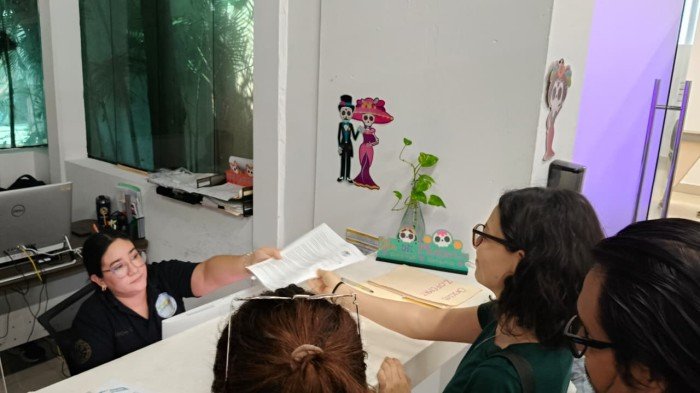
Playa del Carmen, Quintana Roo — Residents have formally submitted a petition to the municipal government asking it to preserve two poplar trees and a cenote in their current state on a private lot at the corner of Quinta Avenida bis and Calle 38, in the city’s tourist zone.
Liliana Valdez, a neighborhood representative, said the petition urges city officials — specifically the municipal Environment Department — to speed up the enactment of rules protecting trees, noting that the relevant regulation has not been updated in 17 years.
She said the trees need protection urgently given the pace of growth in Playa del Carmen. She stressed that residents do not want to halt the city’s development, but argued it must find a way to coexist with local ecosystems and safeguard cenotes, wildlife and trees.
Council agreed to pause relocation work
At the most recent session of the Municipal Environment Council, where residents presented the issue, members agreed to stop work toward a possible relocation of the poplar.
Valdez said, however, that they cannot claim victory. The only result so far, she said, is a second review of permits that had already been issued.
She said the tree is not the only specimen at risk. Through the campaign they launched and meetings with other environmentalists, residents learned of additional cases.
Valdez said the group intends to join forces with other organizations to protect not only trees but also areas such as Punta Venado, where two hotel and residential developments are planned.
She acknowledged the difficulty of the effort, since the land in question is privately owned, but insisted the aim is coexistence — integrating trees into the buildings that will come. “You can’t treat a tree like a piece of furniture that can be moved somewhere else,” she said. “They were here before us and are a fundamental part of the balance, so they have to be considered part of real estate projects.”
More Environment
- Sian Ka’an Ranked Among Most Flood-Exposed Coasts as NASA Maps Project Sea-Level Rise
- Biologist Calls for Regulation of Chivita Snail Harvesting in Bacalar Lagoon
- IUCN Declares Mesoamerican Reef Critically Endangered
- UIMQROO Researcher Proposes Genetic Study of Dengue, Zika and Chikunguña to Aid Vaccine Research
- Playa del Carmen Keeps Macondo Playacar Permits on Hold After Judge Dismisses Environmentalists’ Injunction
More Playa del Carmen
- Playa del Carmen Reviews Vehicle Rental Contract Signed Before Treasurer Took Office
- Monitoring Begins at 60 Cenotes Across Yucatan Peninsula to Measure Maya Aquifer Contamination
- Playa del Carmen Mayor Calls AI Videos a ‘Kindergarten Dirty War’ and Points to Friendly Fire
- Xcaret Founder Miguel Quintana Pali Inducted Into IAAPA Hall of Fame
- Mexico’s Supreme Court to Review Revocation of Aguakán Water Concession in Quintana Roo