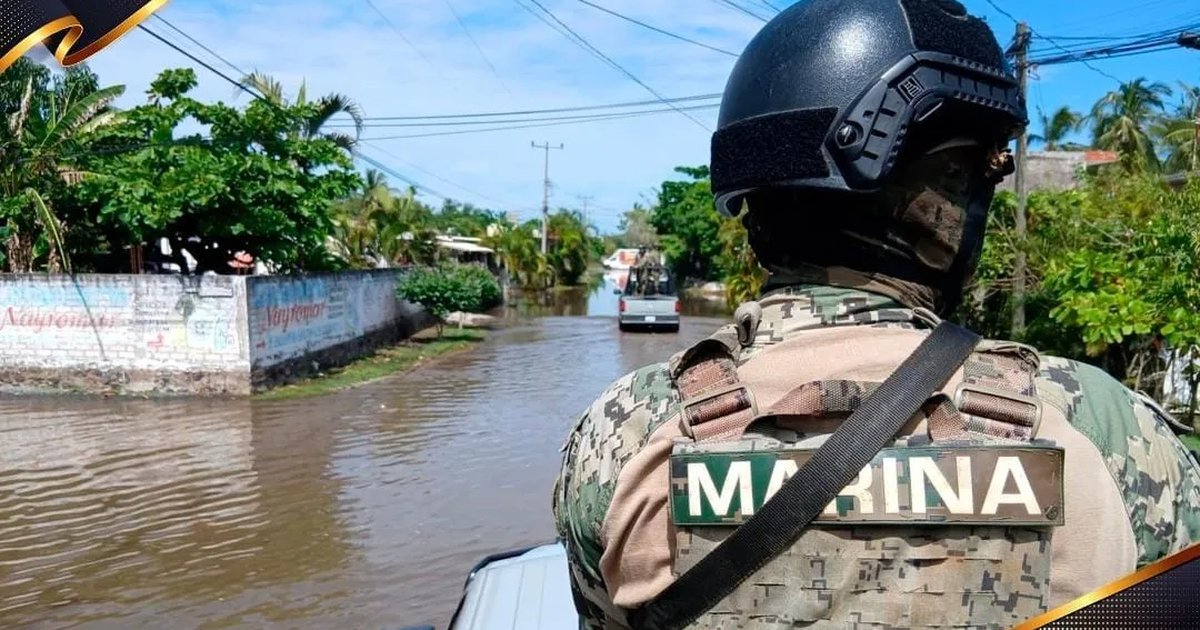
Mexico City — Six people have died as Hurricane Simón and the remnants of Storm Rachel pounded Mexico’s Pacific coast, bringing heavy rain, flooding and landslides, state and federal authorities said.
Simón was drifting slowly through the Mexican Pacific on Tuesday as a Category 1 hurricane, dumping rain on the states of Nayarit and Sinaloa, where officials remained on alert for swollen rivers and flooding. Over the weekend, the storm also triggered intense rainfall in Guerrero, where one person died.
But the worst damage occurred farther north, in the coastal city of Ensenada, Baja California, where the remnants of Storm Rachel caused rivers to overflow and triggered flooding.
At least five people were killed there. They include a 13-year-old girl whose body was found Sunday, along with two women aged 35 and 30 and a four-year-old boy whose bodies were recovered Monday, according to the Baja California State Prosecutor’s Office. Another body was found Tuesday near a stream, but the person has not yet been identified.
Five people remained missing in Baja California as of Tuesday: three in Ensenada and two in San Felipe, a community on the Gulf of California where a father and son set out to fish on Saturday and never returned.
State Civil Protection officials said about 300 military, police and rescue personnel launched a search operation along the El Pípila stream in Ensenada early Tuesday to find the people still missing after the Pacific storms.
The Mexican Navy (SEMAR) is continuing its own search for the two people missing in San Felipe.
The flooding swept away vehicles, damaged homes and left some areas cut off. Johana Nuriulu, a resident of the Buena Vista community in Ensenada, said the flooding began at night, shortly after the downpour knocked out electricity.
She said she went outside and discovered that a nearby stream had overflowed.
“The water was taking everything — it took a cabin, animals, everything,” she said.
In another area near Ensenada, the Mexican Army used helicopters to rescue 32 people, including 13 minors, from a place known as Rancho Génesis. According to its website, the site is an orphan camp run by missionaries.
According to the Army’s statement, 22 of those rescued were foreign nationals. Baja California Public Security Secretary Gen. Laureano Carrillo said they included Germans and Americans.
Hurricane Simón was moving Tuesday parallel to Mexico’s Pacific coast off the states of Jalisco, Nayarit and Sinaloa.
By Tuesday, the storm’s center was located 180 kilometers (about 110 miles) west of Cabo Corrientes in Jalisco, with sustained winds of 150 kilometers per hour (roughly 93 mph), moving west at 4 kilometers per hour (about 2.5 mph), according to the U.S. National Hurricane Center in Miami.
The hurricane knocked down trees and power poles, blocked roads and flooded homes in coastal communities in Guerrero, including the major port of Acapulco.
More Environment
- Cancún Fumigates Cemeteries to Curb Dengue Ahead of Day of the Dead
- Selvame MX Calls HAZUL Project With Artificial Beach a ‘Fantasy’ in Playa del Carmen
- Farmer Warns of Difficult Corn Season Ahead in José María Morelos
- Video Shows Rescue of Large Sea Turtle Trapped Between Rocks on Isla Mujeres
- Insurers Pull Back Coastal Coverage as Category 5 Hurricanes Multiply