
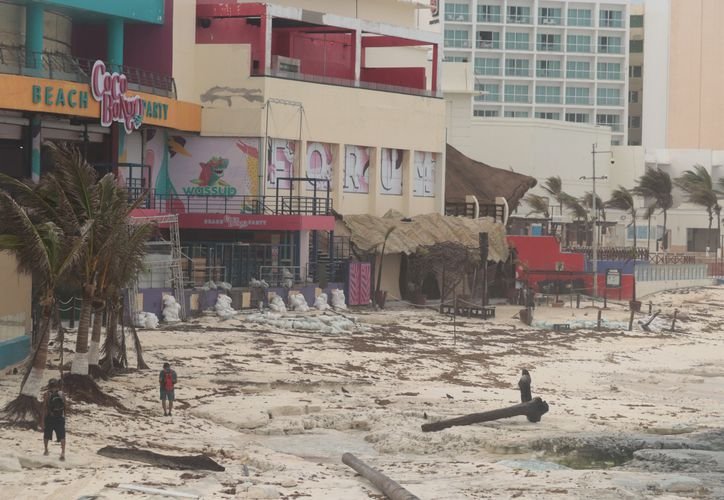
Cancún, Quintana Roo — Insurers are scaling back coverage in beach destinations as hurricanes hit more often and with greater force, and in some coastal cities obtaining a policy for a beachfront property is becoming nearly impossible.
In recent years, insurers have halved the number of policies offered in places such as Acapulco, where beachfront coverage is increasingly hard to secure. Losses have soared, and climate change has been identified as the biggest risk facing reinsurers, fueling concern that some areas and types of business could become uninsurable.
Bernardo de la Vega, head of corporate governance for Mexico, Colombia and Latin America at EY, one of the world’s four largest consulting firms, warned hoteliers and business leaders in Quintana Roo about the growing difficulty of obtaining hurricane coverage along the entire coastline. He spoke during the Green Economy and Sustainable Development forum.
“There are more and more hurricanes that are no longer category 1 or 2; there are more and more category 5 events,” he said, adding that Acapulco shows insuring hotels is no longer profitable.
Policies are rising in price, offering narrower coverage and, in some cases, exiting markets altogether in a push for better returns.
The trend is global. Several international reinsurers have already cut the capacity available for coastal areas with high climate risk, driving premium increases of 30% to 60%. More frequent natural disasters are pushing companies to reduce their exposure to those risks.
De la Vega warned that more policies will be cancelled and that owners will have to choose between continuing to invest and reinvest in growth or abandoning their projects.
He predicted the shift will become an “interesting” challenge for coastal destinations, because without insurance there is no access to credit; without financing there is no reconstruction, and without reconstruction there is no continuity.
That problem, he said, cannot be solved through environmental sustainability measures alone. It requires day-to-day corporate governance decisions: processes, policies, delegated authority, accountability and holding structures that institutionalize a company rather than leaving it dependent on its founder, while managing strategic risks and being prepared to absorb climate and financial shocks without jeopardizing operations, investment or the family legacy.
More Business
- Banxico Cuts Rate to 6.25% in Surprise 3-2 Vote
- Ramada Residences by Wyndham Opens in Tulum With 190 Rooms
- Aeroméxico Reminds Passengers of New US Sworn Declaration Requirement Over Ebola Concerns
- Plant Growers in Lázaro Cárdenas Face Two-Month Stretches Without Sales
- Condusef Warns of Financial Identity Theft in Quintana Roo
More Quintana Roo
- Quintana Roo Tightens Tourism Oversight to Curb Fraud Ahead of Winter Season
- Profepa Orders 25 Closures Over Illegal Land Clearing in Quintana Roo
- Dengue Cases in Quintana Roo Climb to 570 With Four Deaths Confirmed
- Quintana Roo Governor Celebrates ACLUVAQ’s 40 Years as a Vacation Tourism Leader
- Quintana Roo Keeps Free Winter Vaccination Drive Running in All 11 Municipalities