
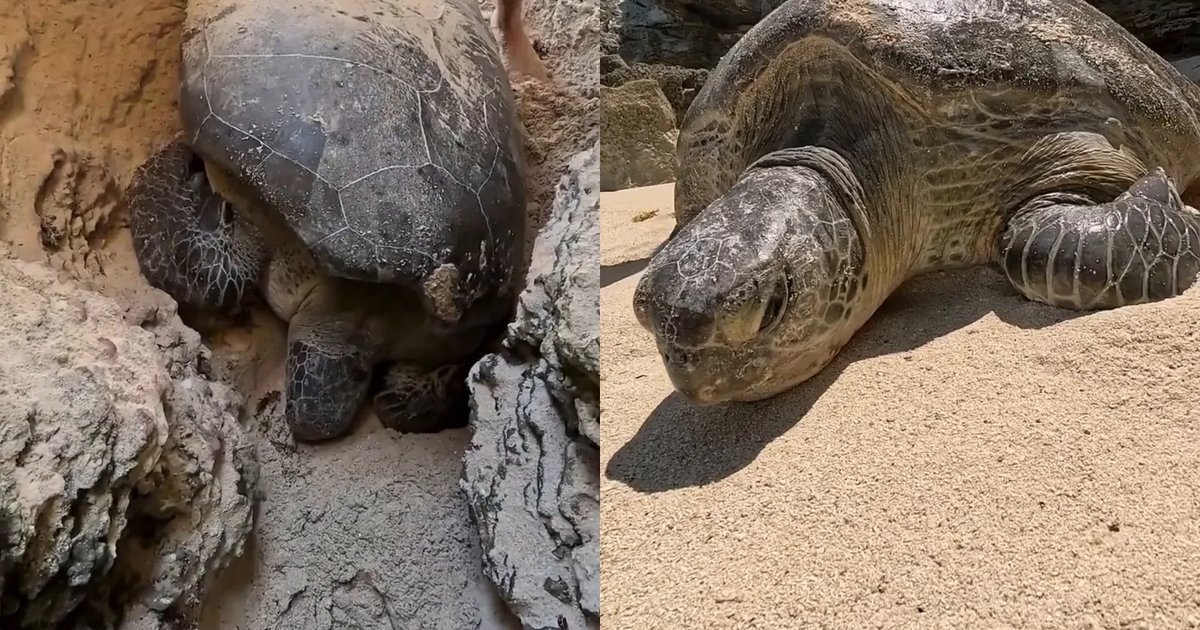
Isla Mujeres, Quintana Roo — A large sea turtle was rescued by a couple and several other people after it became trapped between rock formations on Isla Mujeres, according to video circulating on social media.
The footage shows the animal immobilized in a narrow space, with no apparent way to return to the sea on its own.
Content creator Isabella Santos and her partner, Claudio de Alba, shared the rescue, which drew in several bystanders who worked together to free the animal.
In the images, the turtle is wedged between walls of rock, its shell filling nearly all of the available space. Those present can be heard voicing concern about its condition and organizing to help it out.
After several attempts, the group managed to carry it back to the water, where, according to the account shared online, the turtle was able to swim.
Turtle May Have Become Trapped After Nesting
Santos said one of the hypotheses among those who took part in the rescue is that the turtle left the sea overnight to lay its eggs and became trapped when the tide went out.
No official assessment has confirmed how the animal reached that spot, how long it remained trapped, or whether it had in fact come ashore to nest.
The video shows a large adult, possibly a green sea turtle (Chelonia mydas), though the species cannot be identified with certainty from the available images alone.
It is also unknown whether the animal received a veterinary examination after being released.
Isla Mujeres a Haven for Turtles During Nesting Season
The rescue comes during the marine turtle breeding season in Quintana Roo, which generally runs from April to November, depending on the species and the area.
Green turtles, loggerheads and hawksbills are the main species that nest along Mexico’s Caribbean coast. All are protected and use the region’s beaches to lay their eggs.
Females come ashore, dig nests in the sand and return to the sea. After roughly 45 to 60 days of incubation, the hatchlings emerge and head for the ocean.
Isla Mujeres operates nest protection and hatchling release programs. During the 2024 season, the municipal turtle camp reported 701 protected nests, more than 80,000 eggs recorded and 35,501 hatchlings released.
The efforts are aimed at improving the survival odds of species whose reproduction depends on beaches in suitable condition.
Why Sea Turtles Are Endangered
Marine turtles face threats both in the ocean and on the beaches where they nest.
Among the main risks are accidental capture in nets and other fishing gear, plastic pollution, collisions with boats, the poaching of eggs, and the loss of nesting beaches to coastal development.
Artificial lighting can also disorient hatchlings as they leave their nests, while obstacles on the sand can hinder adult females from moving across the beach.
In Mexico, marine turtles are protected under environmental law, and the species that reach the coasts of Quintana Roo are listed as endangered.
More Environment
- Dolphin Mincho Dies at 37 in Cancún as AMHMAR Calls for Necropsy
- Quintana Roo Bat Expert Warns of Research Gaps and Cave Damage From Urban Growth
- Yucatán DJ Parties in Secret Cenotes Trigger Environmental Scrutiny
- Firefighters Rescue Man, 57, Who Fell Into Urban Cenote in Cancún’s Supermanzana 100
- Mexico’s CONANP Deems Royal Caribbean’s Royal Beach Club Cozumel Unviable