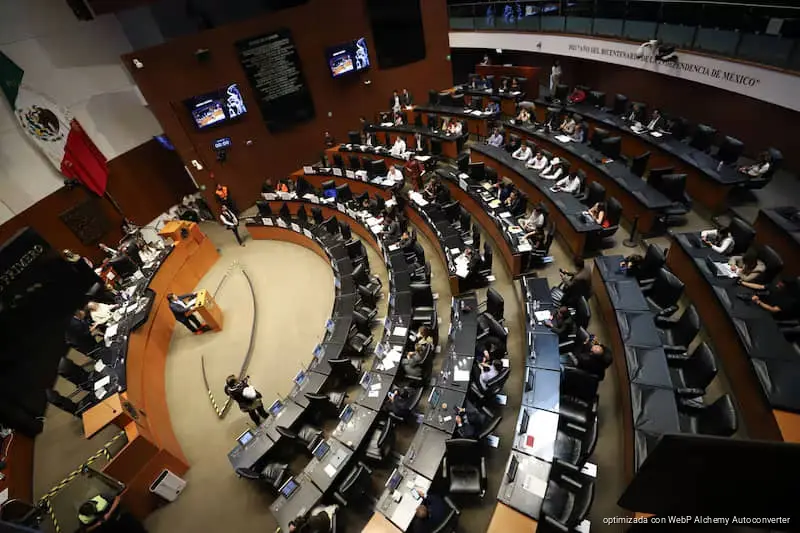
Mexico City — Mexico’s Senate has approved a reform to the Foreign Investment Law that gives the Defense Ministry (SEDENA) and the Navy Ministry (SEMAR) a direct vote on screening foreign capital deals that could pose risks to national security.
The measure, backed by President Claudia Sheinbaum, passed in general terms with 65 votes in favor from Morena and its allies and 30 against from the PAN, PRI and Movimiento Ciudadano during the Sept. 30 session.
Military Joins Investment Screening Commission
The most contested element of the reform is the addition of the armed forces to the National Foreign Investment Commission (CNIE). Defense and Navy officials will not serve merely as advisers — they will have both a voice and a vote on the body’s decisions.
The change also brings in the Secretariat of Security and Citizen Protection (SSPC) and the Digital Transformation and Telecommunications Agency (ATDT), whose heads will likewise hold voting seats.
Speaking from the floor, Movimiento Ciudadano Senator Luis Donaldo Colosio Riojas criticized the modification, arguing it represents another expansion of the duties assigned to soldiers and sailors. According to Colosio, the reform enables a “militarization” of the economy, because the armed forces will take part directly in decisions about who may carry out certain investments in Mexico.
His position contrasts with the argument of the reform’s promoters, who say the new mechanism is designed to protect strategic sectors from foreign operations that could eventually threaten national security.
New Screening Procedure
The presidential initiative establishes a specific procedure for reviewing acquisitions made with foreign capital when matters deemed sensitive for state security are involved.
The framework applies in particular to operations in which foreign investors seek to acquire more than 49% of the capital stock of a Mexican company, provided the deal exceeds a threshold set by the commission itself and involves elements tied to national security.
Under the reform, Mexico would weigh not only economic factors but also explicitly assess potential risks to national security. Specialists have noted that the model resembles foreign investment review mechanisms already in place in other economies.
Focus on Critical Technologies
The new mechanism is especially relevant to investments tied to strategic infrastructure, energy, telecommunications, critical technologies, semiconductors, artificial intelligence, cybersecurity and sensitive information.
It was precisely the technological nature of some of the operations under review that led lawmakers to add the Digital Transformation and Telecommunications Agency to the commission, with the ability to take part in decisions.
When national security matters are discussed, other institutions linked to intelligence, auditing and the fight against illicit operations may also participate. These include the Federal Prosecutor’s Office (FGR), the National Intelligence Center (CNI), the Tax Administration Service (SAT) and the Financial Intelligence Unit (UIF).
Those agencies would act as permanent guests at the relevant sessions, though their role would differ from that of Defense, Navy, Security and the ATDT, which join the commission with voting rights.
The reform sets a 45-business-day deadline for resolving requests related to national security. During committee discussions, lawmakers who backed the change argued the period allows for a sufficient assessment of risks without needlessly prolonging uncertainty for companies.
The debate comes as foreign investment remains a significant force in Mexico’s economy. Data from the Economy Ministry cited during the legislative process shows foreign investment in Mexico totaled $34.968 billion during the second quarter of 2026.
More Government
- Quintana Roo High School System Aims to Install Cameras at All 44 Campuses
- Biometric CURP in Quintana Roo: Where to Apply, What to Bring and Whether It’s Mandatory
- Cancún Shelter Offers Medical Care and Detox for Homeless Residents
- Cancún Receives Up to 60 Animal Abuse Complaints a Day
- OXXO Round-Up Drive to Fund School Breakfasts for 680 Children in Cozumel