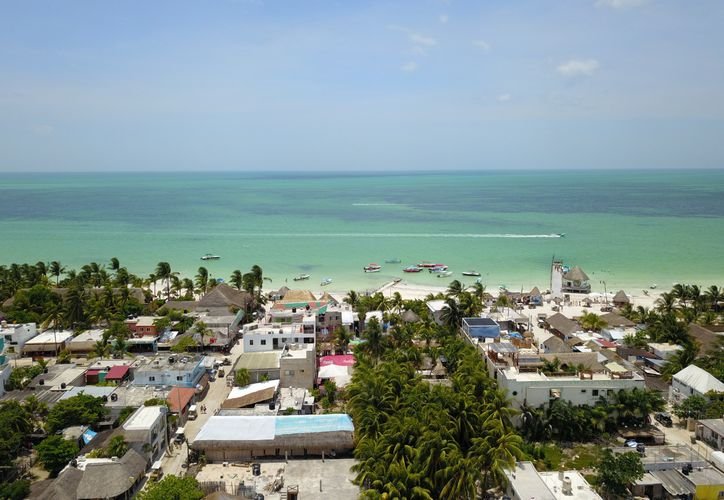
Holbox, Quintana Roo — Mexico’s Environment and Natural Resources Ministry (Semarnat) has conditionally authorized a three-story hotel with 42 rooms and one suite on Holbox, a project that follows years of rejections for similar developments on the island.
The project, filed as “MIA Holbox,” would be built on lot 1, block 139, zone 1, in the Isla Chica area of Holbox. The island forms part of Yum Balam, a federally protected flora and fauna reserve decreed in 1994. The reserve covers more than 154,000 hectares of land and sea in northern Quintana Roo, including jungle, dunes, wetlands, mangroves and a marine strip, and has been governed since 2018 by a management plan that restricts hotel construction.
The development site measures 1,944.73 square meters. Officials authorized use of 1,065.39 square meters for the building, walkways and services, including a wastewater treatment system. The remainder must be preserved as green space. No pool is permitted, and any below-ground structures must be redesigned to sit 1.5 meters above the natural terrain before construction begins.
The permit is valid for 65 months to prepare the site and build, and for 50 years of operation. The ruling specifies that it is not a construction start permit and does not replace municipal or state licenses.
Hotel projects of this kind have repeatedly been rejected on Holbox. Between 2018 and 2022, Semarnat denied at least 10 similar applications. In 2024, reports noted the agency had gone four years without authorizing a new hotel. In 2025 it rejected the Hotel Aruna and the Condo Hotel Kában, and in June 2026 it turned down the Biocentro Isla Grande, a 49-room project. The same lot proposed for MIA Holbox held a permit in 2012 that has since expired, and a separate application was denied in 2022.
The approval carries several conditions:
- Present a bond before construction begins.
- Submit a hurricane preparedness plan.
- Restore mangrove on an area equal to or larger than the hotel’s footprint, in coordination with the National Commission of Natural Protected Areas (CONANP).
Burning vegetation, introducing non-native species, feeding wild animals and obstructing water flow are prohibited.
The file went through public consultation and no requests for an informational meeting were filed. The Federal Environmental Protection Agency (Profepa) will monitor compliance with all conditions.
More Development
- Quintana Roo Nautical Association Pursues Maritime Alliance With Belize
- Playa del Carmen’s Water Pollution Rules Exist but Go Unenforced, Activist Says
- Environmentalists Denounce Road and Gate Built in Cozumel Mangrove Tied to Royal Caribbean Project
- Cancún Hotel Zone Abandoned Lots Face 2027 Crackdown
- Quintana Roo Bat Expert Warns of Research Gaps and Cave Damage From Urban Growth